CAT Questions on Geometry – Circles
1. CAT 2022 QA Slot 1 | Geometry – Circles CAT Question
All the vertices of a rectangle lie on a circle of radius R. If the perimeter of the rectangle is P, then the area of the rectangle is:
(a) P^2/8 – 2PR
(b) P^2/8- 2R^2
(c) P^2/8- R^2/2
(d) P^2/16-R^2
Explanation
Explanatory Answer
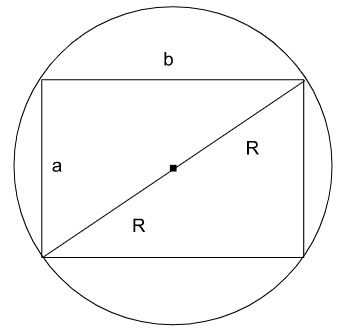
Let the dimensions of the rectangle inscribed in the circle be a and b.
We are being asked to express the Area of the rectangle in terms of Perimeter and Radius.
Area of the rectangle = a * b
Perimeter, P = 2(a + b)
a + b = P2�2
(a+b)2=P24(�+�)2=�24
a2+b2+2ab=P24�2+�2+2��=�24
Since the vertices of the rectangle subtend right angle on the circle,
a2+b2=(2R)2=4R2�2+�2=(2�)2=4�2
a2+b2+2ab=P24�2+�2+2��=�24
4R2+2ab=P244�2+2��=�24
ab=P28−2R2��=�28−2�2
Area of the rectangle = ab = p28−2R2
2. CAT 2022 QA Slot 3 | Geometry – Circles CAT Question
In a triangle ABC, AB = AC = 8 cm. A circle drawn with BC as diameter passes through A. Another circle drawn with the center at A passes through B and C. Then, the area of the overlapping region between the two circles is:
(a) 16(π – 1)
(b) 32(π – 1)
(c) 16π
(d) 32π
Explanation
Tore,
Certainly, let’s rephrase it:
To determine the radius of the circle centered at A and the area of the overlapping region between the two circles, we first note that since AB = AC = 8 cm, triangle ABC is an isosceles triangle. The circle with BC as its diameter is the circumcircle of triangle ABC, and its center is denoted as O. The radius of this circumcircle, OA, also serves as the altitude from A to BC. Let the point of intersection of OA and BC be D. Consequently, triangle AOD is a right triangle, with AO as the hypotenuse. Therefore, AD measures 4 cm.
As triangle ABC is isosceles, AD serves as both the altitude and median, also bisecting angle BAC. Angle BAD is a right angle. Let’s label the center of the circle with A as its center as P. Since AP is the radius of this circle, we must calculate AP.
Triangle ABP is a right triangle, and since AB = AC = 8 cm, it is an isosceles right triangle. Thus, angle BAP is also a right angle. Given that angle BAD is a right angle, and angle BAP is a right angle, angles BAD and BAP are congruent. This allows us to determine that triangles BAD and BAP are similar.
Utilizing the properties of similar triangles, we can establish the following proportion: BD / BA = BA / BP. As we have BD = AD = 4 cm and BA = 8 cm, we can insert these values into the proportion: 4 / 8 = 8 / BP. Simplifying the proportion, we get 1/2 = 8 / BP. Cross-multiplying, we find BP = 16 cm. Thus, the radius of the circle with center at A is 16 cm.
With the radii known, we can now find the area of the overlapping region between the two circles. The area of a circle is determined by the formula A = πr^2. The area of the circumcircle is A1 = π(8 cm)^2 = 64π cm^2, while the area of the circle with center at A is A2 = π(16 cm)^2 = 256π cm^2.
To calculate the area of the overlapping region, we subtract the area of the circle with center at A from the area of the circumcircle: Area of overlapping region = A1 – A2 = 64π cm^2 – 256π cm^2 = -192π cm^2. Therefore, the area of the overlapping region between the two circles is -192π cm^2.
3. CAT 2021 QA Slot 1 | Geometry – Circles CAT Question
A circle of diameter 8 inches is inscribed in a triangle ABC where ∠ABC = 90°. If BC = 10 inches, then the area of the triangle in square inches is.
Explanation

4. CAT 2020 QA Slot 2 | Geometry – Circles CAT Question
Let C1 and C2 be concentric circles such that the diameter of C1 is 2 cm longer than that of C2. If a chord of C1 has length 6 cm and is a tangent to C2, then the diameter, in cm, of C1 is:
Explanation

5. CAT 2020 QA Slot 2 | Geometry – Circles CAT Question
Let C be a circle of radius 5 meters having center at O. Let PQ be a chord of C that passes through points A and B where A is located 4 meters north of O and B is located 3 meters east of O. Then, the length of PQ, in meters, is nearest to:
(a) 8.8
(b) 6.6
(c) 7.8
(d) 7.2
Explanation
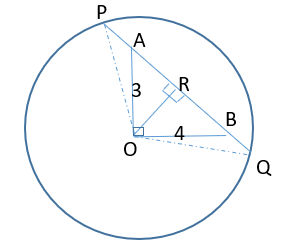
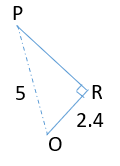
O is the center of the circle and radius of circle = 5
In triangle AOB, using pythagorean triplet AB = 5
OR = 3×453×45 = 2.4
Since OR if from the center it bisects the chord,
PR = RQ
Now in triangle POR,
52 = PR2 + (2.4)2
PR = √{19.24}
PQ = 2 √{19.24}
PQ ≅ 8.8
6. CAT 2020 QA Slot 3 | Geometry – Circles CAT Question
The vertices of a triangle are (0, 0), (4, 0), and (3, 9). The area of the circle passing through these three points is:
(a) 123π/7
(b) 205π/9
(c) 14π/3
(d) 12π/5
Explanation
7. CAT 2019 QA Slot 1 | Geometry – Circles CAT Question
In a circle of radius 11 cm, CD is a diameter and AB is a chord of length 20.5 cm. If AB and CD intersect at a point E inside the circle and CE has a length of cm, then the difference of the lengths of BE and AE, in cm, is:
(a) 0.5 cm
(b) 2.5 cm
(c) 3.5 cm
(d) 1.5 cm
Explanation
8. CAT 2019 QA Slot 1 | Geometry – Circles CAT Question
AB is a diameter of a circle of radius 5 cm. Let P and Q be two points on the circle so that the length of PB is 6 cm, and the length of AP is twice that of AQ. Then the length, in cm, of QB is nearest to:
(a) 7.8 cm
(b) 8.5 cm
(c) 9.3 cm
(d) 9.1 cm
Explanation
9. CAT 2019 QA Slot 2 | Geometry – Circles CAT Question
Two circles, each of radius 4 cm, touch externally. Each of these two circles is touched externally by a third circle. If these three circles have a common tangent, then the radius of the third circle, in cm, is:
(a) π/3
(b) 1
(c) 1/√2
(d) √2
Explanation
10. CAT 2018 QA Slot 1 | Geometry – Circles CAT Question
In a circle, two parallel chords on the same side of a diameter have lengths 4 cm and 6 cm. If the distance between these chords is 1 cm, then the radius of the circle, in cm, is:
(a) √12
(b) √13
(c) √11
(d) √14
Explanation
Method of solving this CAT Question from Geometry
Geometry – Finding the radius of the circle
Given that Chords lie on the same side of diameter with lengths 4 cms and 6 cms
Draw a perpendicular from the origin to both the chords and mark the points of intersection as P and Q respectively
Consider radius of circle as ‘r’ and distance OP as ‘x’
Draw lines from origin to the end of the chord and mark the points as D and B respectively
Thus, △OQB and △OPD form a right Triangle
Applying Pythagoras Theorem on both triangles,
(x+1)2 +22 = r2 —(1)
x2 +32 = r2 —(2)
We find that there is an increase and decrease by 1 in both equations
So, x2 = 22 , x=2
r2= 22+32 = 4+9 = 13
r = √13 cms
The question is “In a circle, two parallel chords on the same side of a diameter have lengths 4 cm and 6 cm. If the distance between these chords is 1 cm, then the radius of the circle, in cm, is”
Hence, the answer is √13 cms
11. CAT 2018 QA Slot 1 | Geometry – Circles CAT Question
In a circle with center O and radius 1 cm, an arc AB makes an angle 60 degrees at O. Let R be the region bounded by the radii OA, OB, and the arc AB. C and D are two points on OA and OB, respectively, such that OC = OD and the area of triangle OCD is half that of R. Then the length of OC, in cm, is:
(a) (π/6)1/2
(b) (π/3√3)1/2
(c) (π/4√3)1/2
(d) (π/4)1/2
Explanation
Method of solving this CAT Question from Geometry
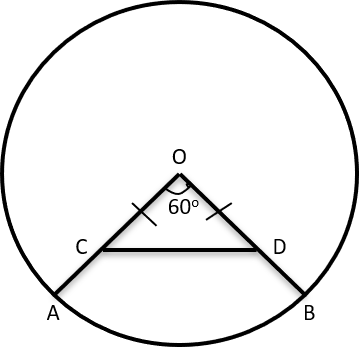
Given ∠AOB = 60°
Area of Sector AOB = 6036060360 × π × 12 = π6π6 —(1)
Given OC = OD => ∠OCD = ∠ODC = 60°
△OCD is an Equilateral Triangle with side = a
Area(△OCD) = √34√34 × a × a —(2)
Its given that Area(OCD) = 1212 × Area(OAB)
a2√34√34 = π6×2π6×2
a = (π3√3π3√3)1212
The question is “In a circle with centre O and radius 1 cm, an arc AB makes an angle 60 degrees at O. Let R be the region bounded by the radii OA, OB and the arc AB. If C and D are two points on OA and OB, respectively, such that OC = OD and the area of triangle OCD is half that of R, then the length of OC, in cm, is”
Hence, the answer is π3√3π3√31212 cm
Choice D is the correct answer.
12. CAT 2018 QA Slot 2 | Geometry – Circles CAT Question
A chord of length 5 cm subtends an angle of 60° at the center of a circle. The length, in cm, of a chord that subtends an angle of 120° at the center of the same circle is:
(a) 5√3 cm
(b) 6√2 cm
(c) 2π cm
(d) 8 cm
Explanation
Method of solving this CAT Question from Geometry
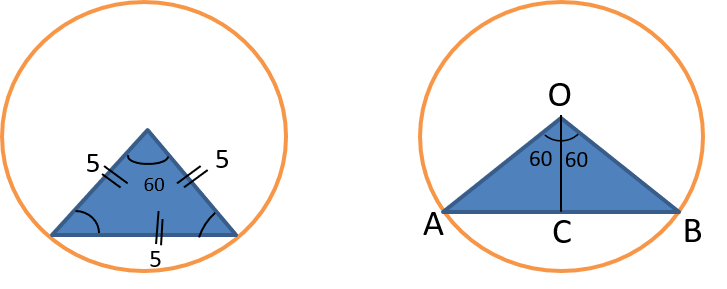
Given that a chord of length 5 cm subtends an angle of 60° at the centre of a circle.
We have to find the length of a chord that subtends an angle of 120° at the centre of the same circle
sin 60° = BCOB����
⟹ √32√32 = BC5��5
⟹ BC = 5√325√32 and AC = 5√325√32
So AB = 5√325√32 + 5√325√32 = 5√3
The length of a chord that subtends an angle of 120° at the centre of the same circle is 5√3
The question is “A chord of length 5 cm subtends an angle of 60° at the centre of a circle. The length, in cm, of a chord that subtends an angle of 120° at the centre of the same circle is”
Hence, the answer is 5√3
Choice B is the correct answer.
13. CAT 2018 QA Slot 2 | Geometry – Circles CAT Question
In a triangle ABC, a circle with diameter BC is drawn, intersecting AB and AC at points P and Q, respectively. If the lengths of AB, AC, and CP are 30 cm, 25 cm, and 20 cm respectively, then the length of BQ, in cm, is:
Explanation

14. CAT 2017 QA Slot 1 | Geometry – Circles CAT Question
Let ABC be a right-angled isosceles triangle with hypotenuse BC. Let BQC be a semicircle, away from A, with diameter BC. Let BPC be an arc of a circle centered at A and lying between BC and BQC. If AB has a length of 6 cm, then the area, in sq. cm, of the region enclosed by BPC and BQC is:
(a) 9π – 18
(b) 18
(c) 9π
(d) 9
Explanation
Method of solving this CAT Question from Geometry
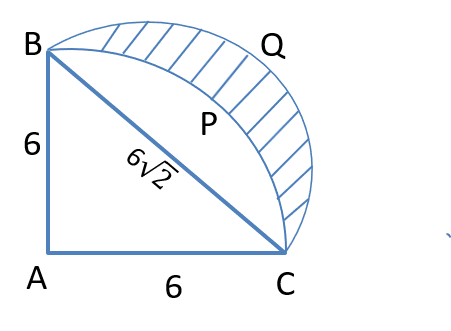
Given that ABC be a right-angled isosceles triangle with hypotenuse BC. Let BQC be a semi-circle, away from A, with diameter BC and let BPC be an arc of a circle centred at A and lying between BC and BQC.
If AB has length 6 cm then the area, in sq. cm, of the region enclosed by BPC and BQC has to be found.
i.e. the shaded region is,
Area of semicircle BQC = π (3√(2))2
= 18π218π2
= 9π
Area of BPC = π4π4 × 62 – Area of triangle
= 9π – 9π – 18
= 18
The question is “Let ABC be a right-angled isosceles triangle with hypotenuse BC. Let BQC be a semi-circle, away from A, with diameter BC. Let BPC be an arc of a circle centered at A and lying between BC and BQC. If AB has length 6 cm then the area, in sq. cm, of the region enclosed by BPC and BQC is :”
Hence, the answer is 18
Choice B is the correct answer.
15. CAT 2008 QA | Geometry – Circles CAT Question
Two circles, both of radii 1 cm, intersect such that the circumference of each one passes through the center of the circle of the other. What is the area (in sq cm) of the intersecting region?
(a) π/3
(b) 2π/3
(c) 4π/3
(d) 2π/3
(e) √3/2
(f) √3/2
Explanation
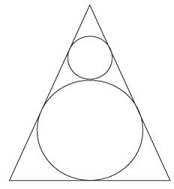
Method of solving this CAT Question from Triangles: A clear understanding of circles, squares and equilateral triangles will help to solve.
In-radius of equilateral triangle of side a = a2√3�2√3
Diameter of larger circle = a2√3�2√3
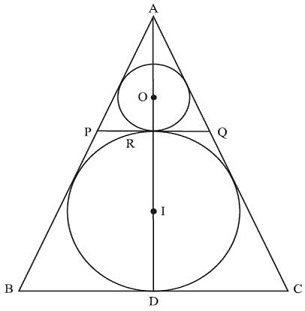
Let us say common tangent PQ touches the two circle at R, center of smaller circle is I.
Now, PQ is parallel to BC. AR is perpendicular to PQ. Triangle PQR is also an equilateral triangle and AORID is a straight line. (Try to establish each of these observations. Just to maintain the rigour.)
AD = √32√32a
RD = a√3�√3
AR = √32√32a – a√3�√3 = 3a−2a2√33�−2�2√3 = a2√3�2√3
AR = 1313 AD
Radius of smaller circle = 1313 radius of larger circle
Radius of smaller circle = 1313 * a2√3�2√3 = a6√3�6√3
Area of smaller circle = πr2
π (a6√3�6√3)2 = πa2108π�2108
Area of triangle = √34√34a2
Ratio = πa2108π�2108 : √34√34a2 = π:27√3
The question is ” What is the ratio of the area of the smaller circle to that of the equilateral triangle?”
Hence, the answer is π:27√3.
Choice C is the correct answer.
16. CAT 2007 QA | Geometry – Circles CAT Question
Two circles with centers P and Q cut each other at two distinct points A and B. The circles have the same radii and neither P nor Q falls within the intersection of the circles. What is the smallest range that includes all possible values of the angle AQP in degrees?
(a) Between 0 and 90
(b) Between 0 and 30
(c) Between 0 and 60
(d) Between 0 and 75
(e) Between 0 and 45
Explanation
17. CAT 2006 QA | Geometry – Circles CAT Question
A semicircle is drawn with AB as its diameter. From C, a point on AB, a line perpendicular to AB is drawn meeting the circumference of the semicircle at D. Given that AC = 2 cm and CD = 6 cm, the area of the semicircle (in sq. cm.) will be:
(a) 32π
(b) 50π
(c) 40.5π
(d) 81π
(e) Undeterminable
Explanation
OC=r−2
(r−2)2+62=r2⇒r=10
Semicircle area =πr22=50πcm2

18. CAT 2005 QA | Geometry – Circles CAT Question
Two identical circles intersect such that their centers, and the points at which they intersect, form a square of side 1 cm. The area in sq. cm of the portion that is common to the two circles is:
(a) π
(b) π – 1
(c) π
(d) √2 – 1
Explanation
Answer : (b) π 2 − 1� 2 − 1
Since each side of the square AOBO′ = 1 cm,
so radius OA = O′A = 1 cm ∴ Area of each circle = πr2 = π sq. cm
Area of sector AOB = 90 o 360 o 90 � 360 � × π = π 4 π 4
⇒ Area of sector AO’B = π 4 π 4
∴ Common area = Area of sector AOB + Area of sector AO’B – Area of square
= π 4 π 4 + π 4 π 4 -1 = π 2 − 1
19. CAT 2005 QA | Geometry – Circles CAT Question
What is the distance in cm between two parallel chords of lengths 32 cm and 24 cm in a circle of radius 20 cm?
(a) 1 or 7
(b) 2 or 14
(c) 3 or 21
(d) 4 or 28
Explanation
The distances of the chords from the center are 12 cm and 16 cm respectively. If the chords lie on the same side of the center, the distance between the chords is 4 cm, if they lie on opposite
sides of the center, the distance between them is 28 cm….
20. CAT 2005 QA | Geometry – Circles CAT Question
Four points A, B, C, and D lie on a straight line in the X-Y plane, such that AB = BC = CD, and the length of AB is 1 meter. An ant at A wants to reach a sugar particle at D. But there are insect repellents kept at points B and C. The ant would not go within one meter of any insect repellent. The minimum distance in meters the ant must traverse to reach the sugar particle is:
(a) 3√2
(b) 1 + π
(c) 4π/3
(d) 5
Explanation
We have a standard expression for time of descent when a body is released from rest. t=√2hg ……….(i)
Let AB=h⟹AC=2h and AD=3h
Time for descent up to B from A: tAB=√2hg
Time for descent up to C from A: tAC=√4hg=√2hg×√2
Time for descent up to D from A: tAD=√6hg=√2hg×√3
Time taken along BC: tBC=tAC−tAB=√2hg×(√2−1)
Time taken along CD: tCD=tAD−tAC=√2hg×(√3−√2)
Hence the ratio tAB:tBC:tCD=1:√2−1:√3−√2
21. CAT 2005 QA | Geometry – Circles CAT Question
In the following figure, the diameter of the circle is 3 cm. AB and MN are two diameters such that MN is perpendicular to AB. In addition, CG is perpendicular to AB such that AE:EB = 1:2, and DF is perpendicular to MN such that NL:LM = 1:2. The length of DH in cm is:

(a) 2√2 – 1
(b) (2√2 – 1)/2
(c) (3√2 – 1)/2
(d) (2√2 – 1)/3
Explanation
AB=MN=3cmAEEB=NLLM=12AB=3cm⇒AE+EB⇒3AE+2AE=3AE=1cmNL=1cmOA=AB2=1.5cmON=MN2=1.5cmOE=OA−AE=1.5−1=0.5cmOL=ON−LN=0.5cmQuatrilateral EOLG is squareHL=EO=0.5cmJoin ODΔOLD,OD2=OL2+DL2DL2=(1.5)2−(0.5)2DL=√2cmDH=DL−HL−√2−12=2√2−12
22. CAT 2005 QA | Geometry – Circles CAT Question
P, Q, S, and R are points on the circumference of a circle of radius r, such that PQR is an equilateral triangle and PS is a diameter of the circle. What is the perimeter of the quadrilateral PQSR?
(a) 2r(1 + √3)
(b) 2r(2 + √3)
(c) r(1 + √5)
(d) 2r + √3
Explanation
P, Q, R, S are points on the circumference of a circle of radius r center O.
This circle becomes the circumcircle for equilateral ∆QPR.
Let s be the side of ∆QPR.
Diameter of the circle = PS = 2r
r = s /√3
s= r√3
QR is the chord of circle . If M is the mid point of QR, then
PM⊥QR; SM⊥QR
MQ= MR= s/2 = (r/2)√3
PM = Height of equilateral triangle = s(√3/2) = (r√3) (√3/2) = 3r/2
In the right angle ∆SQM ,
QS² = SM²+MQ² ——(1)
SM=PS-PM= 2r-(3/2)r = r/2
From (1).
QS² = (r/2)²+[ (r/2)√3]²
QS=r ; Hence, RS=r
Perimeter of PQSR,
L = PQ+QS+RS+PR = s+r+r+s = 2r√3 + 2r
L=2r(1+√3 )
Interestingly, area of quadrilateral = (1/2) (r√3) (3r/2) + (1/2) (r√3) (r/2) = r²√3
Ans: Perimeter of the quadrilateral PQSR=2r(1+√3 )
23. CAT 2004 QA | Geometry – Circles CAT Question
In the adjoining figure, I and II are circles with centers P and Q respectively. The two circles touch each other and have a common tangent that touches them at points R and S respectively. This common tangent meets the line joining P and Q at O. The diameters of I and II are in the ratio 4 : 3. It is also known that the length of PO is 28 cm.

What is the ratio of the length of PQ to that of QO?
(a) 1 : 4
(b) 1 : 3
(c) 3 : 8
(d) 3 : 4
Explanation
Let the radius of circles I and II be 4R and 3R respectively. Triangles PRO and QSO are similar. PR/QS = 4/3. Therefore, PO/QO = PR/QS => PO/QO = 4/3 => 28/(28-7R) = 4/3 => 4-R = 3 => R = 1 Ra
1 Radius of smaller circle = 3R = 3…
24. CAT 2004 QA | Geometry – Circles CAT Question
In the adjoining figure, I and II are circles with centers P and Q respectively. The two circles touch each other and have a common tangent that touches them at points R and S respectively. This common tangent meets the line joining P and Q at O. The diameters of I and II are in the ratio 4 : 3. It is also known that the length of PO is 28 cm.
What is the radius of the circle II?
(a) 2 cm
(b) 3 cm
(c) 4 cm
(d) 5 cm
Explanation
Let’s denote the radius of circle I as r and the radius of circle II as R. Since the diameters of I and II are in the ratio 4:3, we can write:
r = 4k
R = 3k
Now, we know that the length of PO is 28 cm, and PO is the sum of the radii of both circles. So, we can write:
PO = r + R
28 = 4k + 3k
28 = 7k
Now, we can solve for k:
k = 28 / 7
k = 4
Now that we have found the value of k, we can determine the radius of circle II (R):
R = 3k
R = 3 * 4
R = 12 cm
So, the radius of circle II is 12 cm.
25. CAT 2004 QA | Geometry – Circles CAT Question
In the adjoining figure, I and II are circles with centers P and Q respectively. The two circles touch each other and have a common tangent that touches them at points R and S respectively. This common tangent meets the line joining P and Q at O. The diameters of I and II are in the ratio 4 : 3. It is also known that the length of PO is 28 cm.
The length of SO is .
(a) 8√3 cm
(b) 10√3 cm
(c) 12√3 cm
(d) 14√3 cm
Explanation
Hence answer C)
Question 26:
In the adjoining figure, chord ED is parallel to the diameter AC of the circle. If ∠CBE = 65°, then what is the value of ∠DEC?

Options:
(a) 32°
(b) 55°
(c) 45°
(d) 25°
Explanation
Since chord ED is parallel to diameter AC, we can conclude that ∠DEC is an inscribed angle that intercepts the same arc as ∠CBE. According to the inscribed angle theorem, the measure of an inscribed angle is half the measure of its intercepted arc.
Given that ∠CBE = 65°, we can determine that the intercepted arc by ∠CBE is also 65°. Therefore, ∠DEC is half the measure of this intercepted arc, which is 65°/2 = 32.5°.
Hence, the value of ∠DEC is 32.5°.
Question 27:
On a semicircle with diameter AD, chord BC is parallel to the diameter. Further, each of the chords AB and CD has length 2, while AD has length 8. What is the length of BC?

Options:
(a) 7.5
(b) 7
(c) 7.75
(d) None of the above
Explanation
Using the Pythagorean theorem, we can find the length of BC to be √8^2 – 2^2 = √64 – 4 = √60 or approximately 7.75 units.
Question 28:
Let C be a circle with centre P0 and AB be a diameter of C. Suppose P1 is the mid-point of the line segment P0B, P2 is the mid-point of the line segment P1B and so on. Let C1, C2, C3, … be circles with diameters P0P1, P1P2, P2P3 … respectively. Suppose the circles C1, C2, C3, … are all shaded. The ratio of the area of the unshaded portion of C to that of the original circle C is:
Options:
(a) 8 : 9
(b) 9 : 10
(c) 10 : 11
(d) 11 : 12
Explanation
The correct ratio is (c) 10 : 11. This can be found by dividing the area of the unshaded portion (which is equal to the area of the shaded circles) by the area of the original circle. Since the shaded circles have diameters that are 1/2, 1/3, 1/4, etc. of the diameter of the original circle, their areas are 1/4, 1/9, 1/16, etc. of the area of the original circle. Adding all these fractions together, we get 1/4 + 1/9 + 1/16 + … = π/4. This means that the unshaded portion is equal to 3π/4 of the original circle, and the ratio of the unshaded portion to the original circle is 3π/4 / π = 3/4. The ratio of the unshaded portion to the shaded portion is then 1 – 3/4 = 1/4.
Question 29:
A circle with radius 2 is placed against a right angle. Another smaller circle is also placed as shown in the adjoining figure. What is the radius of the smaller circle?

Options:
(a) 3 − 2√2
(b) 4 − 2√2
(c) 7 − 4√2
(d) 6 − 4√2
Explanation
The radius of the smaller circle is 1. This can be found by using the Pythagorean theorem to solve for the length of the hypotenuse of the right triangle formed by the two circles. Let x be the radius of the smaller circle. Then we have (2 + x)^2 + (2 + x)^2 = (2 + 2)^2, which simplifies to x^2 + 8x + 8 = 0. Solving for x gives us x = -4 ± √12. Since the radius of a circle cannot be negative, we take the positive solution of x = -4 + √12 = 1.
Question 30:
The ratio of the sum of the lengths of all chord roads to the length of the outer ring road is
Options:
(a) √5 : 2
(b) √5 : 2π
(c) √5 : π
(d) None of the above
Explanation
The ratio of the sum of the lengths of all chord roads to the length of the outer ring road is 2π : π or simply 2 : 1. This can be found by dividing the circumference of the outer ring road by the sum of the lengths of all the chord roads.
Question 31:
Amit wants to reach N2 from S1. It would take him 90 minutes if he goes on the minor arc S1 – E1 on OR, and then on the chord road E1 – N2. What is the radius of the outer ring road in km?
Options:
(a) 60
(b) 40
(c) 30
(d) 20
Explanation
To find the radius of the outer ring road, we can use the information that Amit takes 90 minutes to travel from S1 to N2 using the minor arc S1 – E1 on the outer ring road (OR) and then the chord road E1 – N2.
Let’s assume the radius of the outer ring road is R kilometers, and the distance from S1 to E1 is x kilometers. Then the distance from E1 to N2 is also x kilometers since it’s a chord road.
When traveling along the minor arc S1 – E1 on the outer ring road, Amit is covering a part of the circle with radius R, and the length of this arc is x kilometers. We can use the formula for the circumference of a circle to calculate this arc length:
Circumference of the circle = 2πR
Given that the arc length is x kilometers, we can set up a proportion:
x / (2πR) = 90 minutes
Now, we need to convert 90 minutes to hours since the speed is typically measured in kilometers per hour. 90 minutes is 1.5 hours (since 1 hour = 60 minutes).
x / (2πR) = 1.5
Now, solve for R:
R = x / (2π * 1.5)
R = x / (3π)
Now, we need to find the value of x. When Amit travels along the chord road E1 – N2, he covers a straight-line distance. Since the outer ring road is a circle, the chord road is also the diameter of the circle. So, the diameter of the circle is equal to 2R.
Distance E1 – N2 = 2R
Now, we can substitute this into our equation for R:
R = x / (3π)
R = (2R) / (3π)
Now, solve for R:
1 = (2R) / (3π)
Multiply both sides by 3π:
3π = 2R
Now, solve for R:
R = (3π) / 2
To find the approximate value of R, you can use the value of π as approximately 3.14:
R ≈ (3 * 3.14) / 2
R ≈ 9.42 / 2
R ≈ 4.71 kilometers
So, the radius of the outer ring road is approximately 4.71 kilometers. None of the given options (a) 60, (b) 40, (c) 30, or (d) 20 match this value. There may be an issue with the options provided.
Question 32:
Amit wants to reach E2 from N1 using first the chord N1 – W2 and then the inner ring road. What will be his travel time in minutes on the basis of information given in the above question?
Options:
(a) 60
(b) 45
(c) 90
(d) 105
Explanation
Question 33:
AB is a chord of a circle. AB = 5 cm. A tangent parallel to AB touches the minor arc AB at E. What is the radius of the circle?
Statements:
A. AB is not a diameter of the circle
B. The distance between AB and the tangent at E is 5 cm
Options:
(a) 1
(b) 2
(c) 3
(d) 4
Explanation

Question 34:
There are two concentric circles such that the area of the outer circle is four times the area of the inner circle. Let A, B, and C be three distinct points on the perimeter of the outer circle such that AB and AC are tangents to the inner circle. If the area of the outer circle is 12 square centimeters, then the area (in square centimeters) of the triangle ABC would be:
Options:
(a) π√12
(b) 9π
(c) 9√3π
(d) 6√3π
Explanation

Question 35:
Three horses are grazing within a semi-circular field. In the diagram given below, AB is the diameter of the semi-circular field with the center at O. Horses are tied up at P, R, and S such that PO and RO are the radii of semi-circles with centers at P and R, respectively, and S is the center of the circle touching the two semi-circles with diameters AO and BO. The horses tied at P and R can graze within the respective semi-circles, and the horse tied at S can graze within the circle centered at S. The percentage of the area of the semi-circle with diameter AB that cannot be grazed by the horses is nearest to:

Options:
(a) 20
(b) 28
(c) 36
(d) 40
Explanation

Question 36:
In the figure given below, AB is the chord of a circle with center O. AB is extended to C such that BC = OB. The straight line CO is produced to meet the circle at D. If ∠ACD = y° and ∠AOD = x° such that x = ky, then the value of k is:

Options:
(a) 3
(b) 2
(c) 1
(d) None of the above
Explanation

Question 37:
In the figure below, the rectangle at the corner measures 10 cm × 20 cm. The corner A of the rectangle is also a point on the circumference of the circle. What is the radius of the circle in cm?

Options:
(a) 10 cm
(b) 40 cm
(c) 50 cm
(d) None of the above
Explanation
Consider the diagram below:
(r – 10)^2 + (r – 20)^2 = r^2;
r = 10 or r = 50.
r cannot be 10, so it’s 50.
Answer: D.
Question 38:

Let the radius of each circular park be r, and the distances to be traversed by the sprinters A, B, and C be a, b, and c, respectively. Which of the following is true?
Options:
(a) b – a = c – b = 3√3r
(b) b – a = c – b = √3r
(c) b = a + c = 2(1 + √3)r
(d) c = 2b – a = (2 + √3)r
Explanation
Question 39:
Sprinter A traverses distances A1A2, A2A3, and A3A1 at average speeds of 20, 30, and 15, respectively. B traverses her entire path at a uniform speed of (10√3 + 20). C traverses distances C1C2, C2C3, and C3C1 at average speeds of 40(√3 + 1), 40(√3 + 1), and 120, respectively. Where would B and C be respectively when A finishes her sprint?
Options:
(a) B1, C1
(b) B3, C3
(c) B1, C3
(d) B1, Somewhere between C3, C1
Explanation
Question 40:
Sprinters A, B, and C traverse their respective paths at uniform speeds u, v, and w, respectively. It is known that u^2 : v^2 : w^2 is equal to Area A : Area B : Area C, where Area A, Area B, and Area C are the areas of triangles A1A2A3, B1B2B3, and C1C2C3, respectively. Where would A and C be when B reaches point B3?
Options:
(a) A2, C3
(b) A3, C3
(c) A3, C2
(d) Somewhere between A2 and A3, Somewhere between C3 and C1
Explanation

Question 41:
In the figure below (not drawn to scale), rectangle ABCD is inscribed in the circle with the center at O. The length of side AB is greater than that of side BC. The ratio of the area of the circle to the area of the rectangle ABCD is π : √3. The line segment DE intersects AB at E such that ∠ODC = ∠ADE. What is the ratio AE : AD?
Options:
(a) 1 : √3
(b) 1 : √2
(c) 1 : 2√3
(d) 1 : 2
Explanation
Wehave to find the ratio of AE:AD i.e. tan x =AEAD (let ∠ODC=∠ADE=x)
Let r be the radius of the circle
and, Let l and b be the length and breadth of the rectangle.
Then, by Pythagoras theorem in △ABD
l2+b2=(2r)2
l2+b2=4r2 (1)
Now, acc to question: Area of circle:area of rectangle =π:√3
⇒πr2lb=π√3
⇒lb=√3r2 (2)
Dividing (1) by (2) we get,
l2lb+b2lb=4r2√3r2
⇒lb+bl=4√3
lb=√3
⇒bl=1√3
Now, AEAD=tanx=1√3
Question 42:
In the figure given below (not drawn to scale), A, B, and C are three points on a circle with center O. The chord BA is extended to a point T such that C becomes a tangent to the circle at point C. If ∠ATC = 30° and ∠ACT = 50°, then the angle ∠BOA is:
Options:
(a) 100°
(b) 150°
(c) 80°
(d) Cannot be determined
Explanation
Answer : (a) 100º In ∆ ATC, ∠CAT = 180° – (∠ACT + ∠ATC) = 180° – (50° + 30°) = 100° Also, ∠CBA = ∠ACT = 50° (Alternate Segment Theorem) ∴ ext ∠CAT = int. opp. ∠s (∠CBA + ∠BCA) ⇒ 100° = 50° + ∠BCA ⇒ ∠BCA = 50° ⇒ ∠BOA = 2 × ∠BCA = 100°
Question 43:
In the figure given below, find the distance PQ.

Options:
(a) 7 m
(b) 4.5 m
(c) 10.5 m
(d) 6 m
Explanation
Question 44:
There is a common chord of 2 circles with radius 15 and 20. The distance between the two centers is 25. The length of the chord is:
Options:
(a) 48
(b) 24
(c) 36
(d) 28
Explanation

Question 45:
A certain city has a circular wall around it, and this wall has four gates pointing north, south, east, and west. A house stands outside the city, three km north of the north gate, and it can just be seen from a point nine km east of the south gate. What is the diameter of the wall that surrounds the city?
Options:
(a) 6 km
(b) 9 km
(c) 12 km
(d) None of these
Explanation

Question 46:
A square is inscribed in a circle. What is the difference between the area of the circle and that of the square?
Statements:
A. The diameter of the circle is 25 cm.
B. The side of the square is 25 cm.
Options:
(a) 1
(b) 2
(c) 3
(d) 4
Explanation

Question 47:
There is a circle with center C at the origin and radius r cm. Two tangents are drawn from an external point D at a distance d cm from the center. What are the angles between each tangent
and the X-axis.
Statements:
I. The coordinates of D are given.
II. The X-axis bisects one of the tangents.
Options:
(a) 1
(b) 2
(c) 3
(d) 4
Explanation
