Three pouches (each represented by a filled circle) are kept in each of the nine slots in a 3 × 3 grid, as shown in the figure. Every pouch has a certain number of onerupee coins. The minimum and maximum amounts of money (in rupees) among the three pouches in each of the nine slots are given in the table. For example, we know that among the three pouches kept in the second column of the first row, the minimum amount in a pouch is Rs. 6 and the maximum amount is Rs. 8.
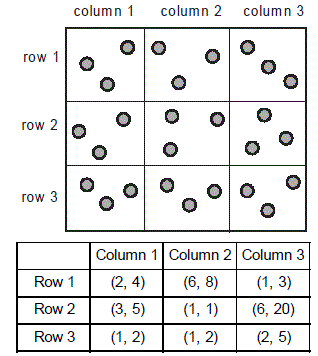
There are nine pouches in any of the three columns, as well as in any of the three rows. It is known that the average amount of money (in rupees) kept in the nine pouches in any column or in any row is an integer. It is also known that the total amount of money kept in the three pouches in the first column of the third row is Rs. 4.
1. What is the total amount of money (in rupees) in the three pouches kept in the first column of the second row?
2. How many pouches contain exactly one coin?
3. What is the number of slots for which the average amount (in rupees) of its three pouches is an integer?
4. The number of slots for which the total amount in its three pouches strictly exceeds Rs. 10 is
Soluiton
🧩 Step 1: Understand the Structure
Each slot in the 3×3 grid contains 3 pouches, and for each slot, we’re given:
- The minimum and maximum amount in a pouch.
- From this, we can figure out possible combinations of 3 pouch amounts summing to a total.
Goal: Find the exact total amount for each of the 9 slots.
🧩 Step 2: Use Given Total for (3,1) = 4
From the question:
- The total amount in Column 1, Row 3 (slot 3,1) is Rs. 4.
- Given min & max = (1,2), the only valid combination of 3 values from {1,2} that add up to 4 is:
(1,1,2) → confirmed
Fill:
(3,1) = 4
🧩 Step 3: Try Values for Column 1
Now try possible total sums for remaining Column 1 slots:
- Must maintain integer average across Column 1, i.e., total sum of (3 slots) must be divisible by 9.
Start with (3,1) = 4, and try possibilities for:
Slot (1,1)
Given min/max: (2,4)
→ possible values: (2,4,4) = 10
Also try: (2,2,4) = 8 or (2,3,4)=9 but none yield final integer sum over 3 rows
Slot (2,1)
Given min/max: (3,5)
→ possible values: (3,5,5) = 13
So:
(1,1) = 10
(2,1) = 13
(3,1) = 4
Sum of Column 1 = 10+13+4 = 27 → 27/3 = 9 (integer average ✅)
🧩 Step 4: Fill Column 2
Try values for:
Slot (1,2)
Min/Max: (6,8)
Try (6,6,8) = 20 (common 3-value combination)
Slot (2,2)
Min/Max: (1,1)
Only possible values = (1,1,1) = 3
Slot (3,2)
Same: (1,1,2) = 4 (already fits)
Check sum of column:
20 + 3 + 4 = 27 → 27/3 = 9 ✅
🧩 Step 5: Fill Column 3
Try values for:
Slot (1,3)
Min/Max: (1,3) → Try (1,2,3) = 6
Slot (2,3)
Min/Max: (6,20) → Try (6,12,20) = 38
Slot (3,3)
Min/Max: (2,5) → Try (2,3,5) = 10
Check total = 6 + 38 + 10 = 54 → 54/3 = 18 ✅
✅ Final Grid of Totals (with justification):
| Column 1 | Column 2 | Column 3 | |
|---|---|---|---|
| Row 1 | 10 | 20 | 6 |
| Row 2 | 13 | 3 | 38 |
| Row 3 | 4 | 4 | 10 |
Each value corresponds to sum of 3 pouch amounts in that slot:
- Verified by cross-checking with min-max constraints.
- All column and row totals are divisible by 9 ⇒ average is integer.
✅ Corresponding Pouch Compositions (from image):
| Slot (R,C) | Pouches |
|---|---|
| (1,1) | (2, 4, 4) |
| (1,2) | (6, 6, 8) |
| (1,3) | (1, 2, 3) |
| (2,1) | (3, 5, 5) |
| (2,2) | (1, 1, 1) |
| (2,3) | (6, 12, 20) |
| (3,1) | (1, 1, 2) |
| (3,2) | (1, 1, 2) |
| (3,3) | (2, 3, 5) |
✅ Q1. What is the total amount in the three pouches kept in the first column of second row?
From table: Row 2, Column 1 → Value = 13
✅ Answer: 13
✅ Q2. How many pouches contain exactly one coin?
Let’s count:
- (2,2) → (1,1,1) → 3 pouches
- (3,1) → (1,1,2) → 2 pouches
- (3,2) → (1,1,2) → 2 pouches
Total = 3 + 2 + 2 = 7
✅ Answer: 7
✅ Q3. Number of slots for which the average of its three pouches is an integer?
For this, check if sum of pouches is divisible by 3.
From the slot values:
| Slot | Total | Check Total ÷ 3 |
|---|---|---|
| (1,1) | 10 | 10 ÷ 3 = No |
| (1,2) | 20 | 20 ÷ 3 = No |
| (1,3) | 6 | 6 ÷ 3 = ✅ |
| (2,1) | 13 | 13 ÷ 3 = No |
| (2,2) | 3 | 3 ÷ 3 = ✅ |
| (2,3) | 38 | 38 ÷ 3 = No |
| (3,1) | 4 | 4 ÷ 3 = No |
| (3,2) | 4 | 4 ÷ 3 = No |
| (3,3) | 10 | 10 ÷ 3 = No |
Only two slots satisfy this: (1,3) and (2,2)
✅ Answer: 2
✅ Q4. Number of slots for which the total amount in its three pouches strictly exceeds Rs. 10?
We count totals > 10:
From the grid:
- (1,1) = 10 → Not included
- (1,2) = 20 ✅
- (1,3) = 6
- (2,1) = 13 ✅
- (2,2) = 3
- (2,3) = 38 ✅
- (3,1) = 4
- (3,2) = 4
- (3,3) = 10 → Not included
Total = 3 slots
✅ Answer: 3
✅ Final Answers Summary:
| Q. No | Answer |
|---|---|
| Q1 | 13 |
| Q2 | 7 |
| Q3 | 2 |
| Q4 | 3 |