CAT Scheduling questions (2017–2025) — actual DILR sets with solutions

75 real CAT Scheduling questions from CAT 2017 to CAT 2025, each with options, the verified answer and a step-by-step solution. Practice one topic at a time, th

Let’s Crack CAT 2026

Your CAT check-up · tap a ring to see yours

75 real CAT questions · CAT 2017–2025 · 4 Medium

Q1CAT 2025 · Slot 3 · CAT Medium✓ Answer verified

Puzzles Competition | CAT 2025 Slot 3 DILR | Scheduling based Puzzle | Medium

Anirbid, Chandranath, Koushik, and Suranjan participated in a puzzle solving competition. The competition comprised 10 puzzles that had to be solved in the same sequence, i.e., a competitor got access to a puzzle as soon as they solved the previous puzzle. Some of the puzzles were visual puzzles and the others were number-based puzzles. The winner of the competition was the one who solved all puzzles in the least time. The following charts describe their progress in the competition. The chart on the left shows the number of puzzles solved by each competitor at a given time (in minutes) after the start of the competition. The chart on the right shows the number of visual puzzles solved by each competitor at a given time (in minutes) after the start of the competition.
Figure for this question

Who had solved the largest number of puzzles by the 20-th minute from the start of the competition?

Q2CAT 2025 · Slot 3 · CAT Medium · TITA✓ Answer verified

Puzzles Competition | CAT 2025 Slot 3 DILR | Scheduling based Puzzle | Medium

Anirbid, Chandranath, Koushik, and Suranjan participated in a puzzle solving competition. The competition comprised 10 puzzles that had to be solved in the same sequence, i.e., a competitor got access to a puzzle as soon as they solved the previous puzzle. Some of the puzzles were visual puzzles and the others were number-based puzzles. The winner of the competition was the one who solved all puzzles in the least time. The following charts describe their progress in the competition. The chart on the left shows the number of puzzles solved by each competitor at a given time (in minutes) after the start of the competition. The chart on the right shows the number of visual puzzles solved by each competitor at a given time (in minutes) after the start of the competition.
Figure for this question

How many minutes did Suranjan take to solve the third visual puzzle in the competition?

Q3CAT 2025 · Slot 3 · CAT Medium · TITA✓ Answer verified

Puzzles Competition | CAT 2025 Slot 3 DILR | Scheduling based Puzzle | Medium

Anirbid, Chandranath, Koushik, and Suranjan participated in a puzzle solving competition. The competition comprised 10 puzzles that had to be solved in the same sequence, i.e., a competitor got access to a puzzle as soon as they solved the previous puzzle. Some of the puzzles were visual puzzles and the others were number-based puzzles. The winner of the competition was the one who solved all puzzles in the least time. The following charts describe their progress in the competition. The chart on the left shows the number of puzzles solved by each competitor at a given time (in minutes) after the start of the competition. The chart on the right shows the number of visual puzzles solved by each competitor at a given time (in minutes) after the start of the competition.
Figure for this question

At what number in the sequence was the fourth number-based puzzle?

Q4CAT 2025 · Slot 3 · CAT Medium✓ Answer verified

Puzzles Competition | CAT 2025 Slot 3 DILR | Scheduling based Puzzle | Medium

Anirbid, Chandranath, Koushik, and Suranjan participated in a puzzle solving competition. The competition comprised 10 puzzles that had to be solved in the same sequence, i.e., a competitor got access to a puzzle as soon as they solved the previous puzzle. Some of the puzzles were visual puzzles and the others were number-based puzzles. The winner of the competition was the one who solved all puzzles in the least time. The following charts describe their progress in the competition. The chart on the left shows the number of puzzles solved by each competitor at a given time (in minutes) after the start of the competition. The chart on the right shows the number of visual puzzles solved by each competitor at a given time (in minutes) after the start of the competition.
Figure for this question

Which of the following is the closest to the average time taken by Anirbid to solve the number-based puzzles in the competition?

Q5CAT 2023 · Slot 2✓ Answer verified
Q1-5. Anjali, Bipasha, and Chitra visited an entertainment park that has four rides. Each ride lasts one hour and can accommodate one visitor at one point. All rides begin at 9 am and must be completed by 5 pm except for Ride-3, for which the last ride has to be completed by 1 pm. Ride gates open every 30 minutes, e.g. 10 am, 10:30 am, and so on. Whenever a ride gate opens, and there is no visitor inside, the first visitor waiting in the queue buys the ticket just before taking the ride. The ticket prices are Rs. 20, Rs. 50, Rs. 30 and Rs. 40 for Rides 1 to 4, respectively. Each of the three visitors took at least one ride and did not necessarily take all rides. None of them took the same ride more than once. The movement time from one ride to another is negligible, and a visitor leaves the ride immediately after the completion of the ride. No one takes a break inside the park unless mentioned explicitly. The following information is also known. Chitra never waited in the queue and completed her visit by 11 am after spending Rs. 50 to pay for the ticket(s). Anjali took Ride-1 at 11 am after waiting for 30 mins for Chitra to complete it. It was the only ride where Anjali waited. Bipasha began her first of three rides at 11:30 am. All three visitors incurred the same amount of ticket expense by 12:15 pm. The last ride taken by Anjali and Bipasha was the same, where Bipasha waited 30 mins for Anjali to complete her ride. Before standing in the queue for that ride, Bipasha took a 1-hour coffee break after completing her previous ride

Q1. What was the total amount spent on tickets (in Rs.) by Bipasha?

Q6CAT 2023 · Slot 2✓ Answer verified
Q1-5. Anjali, Bipasha, and Chitra visited an entertainment park that has four rides. Each ride lasts one hour and can accommodate one visitor at one point. All rides begin at 9 am and must be completed by 5 pm except for Ride-3, for which the last ride has to be completed by 1 pm. Ride gates open every 30 minutes, e.g. 10 am, 10:30 am, and so on. Whenever a ride gate opens, and there is no visitor inside, the first visitor waiting in the queue buys the ticket just before taking the ride. The ticket prices are Rs. 20, Rs. 50, Rs. 30 and Rs. 40 for Rides 1 to 4, respectively. Each of the three visitors took at least one ride and did not necessarily take all rides. None of them took the same ride more than once. The movement time from one ride to another is negligible, and a visitor leaves the ride immediately after the completion of the ride. No one takes a break inside the park unless mentioned explicitly. The following information is also known. Chitra never waited in the queue and completed her visit by 11 am after spending Rs. 50 to pay for the ticket(s). Anjali took Ride-1 at 11 am after waiting for 30 mins for Chitra to complete it. It was the only ride where Anjali waited. Bipasha began her first of three rides at 11:30 am. All three visitors incurred the same amount of ticket expense by 12:15 pm. The last ride taken by Anjali and Bipasha was the same, where Bipasha waited 30 mins for Anjali to complete her ride. Before standing in the queue for that ride, Bipasha took a 1-hour coffee break after completing her previous ride

Q2. Which were all the rides that Anjali completed by 2:00 pm?

Q7CAT 2023 · Slot 2✓ Answer verified
Q1-5. Anjali, Bipasha, and Chitra visited an entertainment park that has four rides. Each ride lasts one hour and can accommodate one visitor at one point. All rides begin at 9 am and must be completed by 5 pm except for Ride-3, for which the last ride has to be completed by 1 pm. Ride gates open every 30 minutes, e.g. 10 am, 10:30 am, and so on. Whenever a ride gate opens, and there is no visitor inside, the first visitor waiting in the queue buys the ticket just before taking the ride. The ticket prices are Rs. 20, Rs. 50, Rs. 30 and Rs. 40 for Rides 1 to 4, respectively. Each of the three visitors took at least one ride and did not necessarily take all rides. None of them took the same ride more than once. The movement time from one ride to another is negligible, and a visitor leaves the ride immediately after the completion of the ride. No one takes a break inside the park unless mentioned explicitly. The following information is also known. Chitra never waited in the queue and completed her visit by 11 am after spending Rs. 50 to pay for the ticket(s). Anjali took Ride-1 at 11 am after waiting for 30 mins for Chitra to complete it. It was the only ride where Anjali waited. Bipasha began her first of three rides at 11:30 am. All three visitors incurred the same amount of ticket expense by 12:15 pm. The last ride taken by Anjali and Bipasha was the same, where Bipasha waited 30 mins for Anjali to complete her ride. Before standing in the queue for that ride, Bipasha took a 1-hour coffee break after completing her previous ride

Q3. Which ride was taken by all three visitors?

Q8CAT 2023 · Slot 2 · TITA✓ Answer verified
Q1-5. Anjali, Bipasha, and Chitra visited an entertainment park that has four rides. Each ride lasts one hour and can accommodate one visitor at one point. All rides begin at 9 am and must be completed by 5 pm except for Ride-3, for which the last ride has to be completed by 1 pm. Ride gates open every 30 minutes, e.g. 10 am, 10:30 am, and so on. Whenever a ride gate opens, and there is no visitor inside, the first visitor waiting in the queue buys the ticket just before taking the ride. The ticket prices are Rs. 20, Rs. 50, Rs. 30 and Rs. 40 for Rides 1 to 4, respectively. Each of the three visitors took at least one ride and did not necessarily take all rides. None of them took the same ride more than once. The movement time from one ride to another is negligible, and a visitor leaves the ride immediately after the completion of the ride. No one takes a break inside the park unless mentioned explicitly. The following information is also known. Chitra never waited in the queue and completed her visit by 11 am after spending Rs. 50 to pay for the ticket(s). Anjali took Ride-1 at 11 am after waiting for 30 mins for Chitra to complete it. It was the only ride where Anjali waited. Bipasha began her first of three rides at 11:30 am. All three visitors incurred the same amount of ticket expense by 12:15 pm. The last ride taken by Anjali and Bipasha was the same, where Bipasha waited 30 mins for Anjali to complete her ride. Before standing in the queue for that ride, Bipasha took a 1-hour coffee break after completing her previous ride

Q4. How many rides did Anjali and Chitra take in total?

Q9CAT 2023 · Slot 2 · TITA✓ Answer verified
Q1-5. Anjali, Bipasha, and Chitra visited an entertainment park that has four rides. Each ride lasts one hour and can accommodate one visitor at one point. All rides begin at 9 am and must be completed by 5 pm except for Ride-3, for which the last ride has to be completed by 1 pm. Ride gates open every 30 minutes, e.g. 10 am, 10:30 am, and so on. Whenever a ride gate opens, and there is no visitor inside, the first visitor waiting in the queue buys the ticket just before taking the ride. The ticket prices are Rs. 20, Rs. 50, Rs. 30 and Rs. 40 for Rides 1 to 4, respectively. Each of the three visitors took at least one ride and did not necessarily take all rides. None of them took the same ride more than once. The movement time from one ride to another is negligible, and a visitor leaves the ride immediately after the completion of the ride. No one takes a break inside the park unless mentioned explicitly. The following information is also known. Chitra never waited in the queue and completed her visit by 11 am after spending Rs. 50 to pay for the ticket(s). Anjali took Ride-1 at 11 am after waiting for 30 mins for Chitra to complete it. It was the only ride where Anjali waited. Bipasha began her first of three rides at 11:30 am. All three visitors incurred the same amount of ticket expense by 12:15 pm. The last ride taken by Anjali and Bipasha was the same, where Bipasha waited 30 mins for Anjali to complete her ride. Before standing in the queue for that ride, Bipasha took a 1-hour coffee break after completing her previous ride

Q5. What was the total amount spent on tickets (in Rs.) by Anjali?

Q10CAT 2023 · Slot 1 · TITA✓ Answer verified

Visa processing

A visa processing office (VPO) accepts visa applications in four categories – US, UK, Schengen, and Others. The applications are scheduled for processing in twenty 15-minute slots starting at 9:00 am and ending at 2:00 pm. Ten applications are scheduled in each slot. There are ten counters in the office, four dedicated to US applications, and two each for UK applications, Schengen applications and Others applications. Applicants are called in for processing sequentially on a first-come-first-served basis whenever a counter gets freed for their category. The processing time for an application is the same within each category. But it may vary across the categories. Each US and UK application requires 10 minutes of processing time. Depending on the number of applications in a category and time required to process an application for that category, it is possible that an applicant for a slot may be processed later. On a particular day, Ira, Vijay and Nandini were scheduled for Schengen visa processing in that order. They had a 9:15 am slot but entered the VPO at 9:20 am. When they entered the office, exactly six out of the ten counters were either processing applications, or had finished processing one and ready to start processing the next. Mahira and Osman were scheduled in the 9:30 am slot on that day for visa processing in the Others category. The following additional information is known about that day. 1. All slots were full. 2. The number of US applications was the same in all the slots. The same was true for the other three categories. 3. 50% of the applications were US applications. 4. All applicants except Ira, Vijay and Nandini arrived on time. 5. Vijay was called to a counter at 9:25 am.

How many UK applications were scheduled on that day?

Q11CAT 2023 · Slot 1 · TITA✓ Answer verified

Visa processing

A visa processing office (VPO) accepts visa applications in four categories – US, UK, Schengen, and Others. The applications are scheduled for processing in twenty 15-minute slots starting at 9:00 am and ending at 2:00 pm. Ten applications are scheduled in each slot. There are ten counters in the office, four dedicated to US applications, and two each for UK applications, Schengen applications and Others applications. Applicants are called in for processing sequentially on a first-come-first-served basis whenever a counter gets freed for their category. The processing time for an application is the same within each category. But it may vary across the categories. Each US and UK application requires 10 minutes of processing time. Depending on the number of applications in a category and time required to process an application for that category, it is possible that an applicant for a slot may be processed later. On a particular day, Ira, Vijay and Nandini were scheduled for Schengen visa processing in that order. They had a 9:15 am slot but entered the VPO at 9:20 am. When they entered the office, exactly six out of the ten counters were either processing applications, or had finished processing one and ready to start processing the next. Mahira and Osman were scheduled in the 9:30 am slot on that day for visa processing in the Others category. The following additional information is known about that day. 1. All slots were full. 2. The number of US applications was the same in all the slots. The same was true for the other three categories. 3. 50% of the applications were US applications. 4. All applicants except Ira, Vijay and Nandini arrived on time. 5. Vijay was called to a counter at 9:25 am.

What is the maximum possible value of the total time (in minutes, nearest to its integer value) required to process all applications in the Others category on that day?

Q12CAT 2023 · Slot 1✓ Answer verified

Visa processing

A visa processing office (VPO) accepts visa applications in four categories – US, UK, Schengen, and Others. The applications are scheduled for processing in twenty 15-minute slots starting at 9:00 am and ending at 2:00 pm. Ten applications are scheduled in each slot. There are ten counters in the office, four dedicated to US applications, and two each for UK applications, Schengen applications and Others applications. Applicants are called in for processing sequentially on a first-come-first-served basis whenever a counter gets freed for their category. The processing time for an application is the same within each category. But it may vary across the categories. Each US and UK application requires 10 minutes of processing time. Depending on the number of applications in a category and time required to process an application for that category, it is possible that an applicant for a slot may be processed later. On a particular day, Ira, Vijay and Nandini were scheduled for Schengen visa processing in that order. They had a 9:15 am slot but entered the VPO at 9:20 am. When they entered the office, exactly six out of the ten counters were either processing applications, or had finished processing one and ready to start processing the next. Mahira and Osman were scheduled in the 9:30 am slot on that day for visa processing in the Others category. The following additional information is known about that day. 1. All slots were full. 2. The number of US applications was the same in all the slots. The same was true for the other three categories. 3. 50% of the applications were US applications. 4. All applicants except Ira, Vijay and Nandini arrived on time. 5. Vijay was called to a counter at 9:25 am.

Which of the following is the closest to the time when Nandini’s application process got over?

Q13CAT 2023 · Slot 1✓ Answer verified

Visa processing

A visa processing office (VPO) accepts visa applications in four categories – US, UK, Schengen, and Others. The applications are scheduled for processing in twenty 15-minute slots starting at 9:00 am and ending at 2:00 pm. Ten applications are scheduled in each slot. There are ten counters in the office, four dedicated to US applications, and two each for UK applications, Schengen applications and Others applications. Applicants are called in for processing sequentially on a first-come-first-served basis whenever a counter gets freed for their category. The processing time for an application is the same within each category. But it may vary across the categories. Each US and UK application requires 10 minutes of processing time. Depending on the number of applications in a category and time required to process an application for that category, it is possible that an applicant for a slot may be processed later. On a particular day, Ira, Vijay and Nandini were scheduled for Schengen visa processing in that order. They had a 9:15 am slot but entered the VPO at 9:20 am. When they entered the office, exactly six out of the ten counters were either processing applications, or had finished processing one and ready to start processing the next. Mahira and Osman were scheduled in the 9:30 am slot on that day for visa processing in the Others category. The following additional information is known about that day. 1. All slots were full. 2. The number of US applications was the same in all the slots. The same was true for the other three categories. 3. 50% of the applications were US applications. 4. All applicants except Ira, Vijay and Nandini arrived on time. 5. Vijay was called to a counter at 9:25 am.

Which of the following statements is false?

Q14CAT 2023 · Slot 1✓ Answer verified

Visa processing

A visa processing office (VPO) accepts visa applications in four categories – US, UK, Schengen, and Others. The applications are scheduled for processing in twenty 15-minute slots starting at 9:00 am and ending at 2:00 pm. Ten applications are scheduled in each slot. There are ten counters in the office, four dedicated to US applications, and two each for UK applications, Schengen applications and Others applications. Applicants are called in for processing sequentially on a first-come-first-served basis whenever a counter gets freed for their category. The processing time for an application is the same within each category. But it may vary across the categories. Each US and UK application requires 10 minutes of processing time. Depending on the number of applications in a category and time required to process an application for that category, it is possible that an applicant for a slot may be processed later. On a particular day, Ira, Vijay and Nandini were scheduled for Schengen visa processing in that order. They had a 9:15 am slot but entered the VPO at 9:20 am. When they entered the office, exactly six out of the ten counters were either processing applications, or had finished processing one and ready to start processing the next. Mahira and Osman were scheduled in the 9:30 am slot on that day for visa processing in the Others category. The following additional information is known about that day. 1. All slots were full. 2. The number of US applications was the same in all the slots. The same was true for the other three categories. 3. 50% of the applications were US applications. 4. All applicants except Ira, Vijay and Nandini arrived on time. 5. Vijay was called to a counter at 9:25 am.

When did the application processing for all US applicants get over on that day?

Q15CAT 2022 · Slot 1 · TITA✓ Answer verified
There are 15 girls and some boys among the graduating students in a class. They are planning a get-together, which can be either a 1-day event, or a 2-day event, or a 3-day event. There are 6 singers in the class, 4 of them are boys. There are 10 dancers in the class, 4 of them are girls. No dancer in the class is a singer. Some students are not interested in attending the get-together. Those students who are interested in attending a 3-day event are also interested in attending a 2-day event; those who are interested in attending a 2-day event are also interested in attending a 1-day event. The following facts are also known: 1. All the girls and 80% of the boys are interested in attending a 1-day event. 60% of the boys are interested in attending a 2-day event. 2. Some of the girls are interested in attending a 1-day event, but not a 2-day event; some of the other girls are interested in attending both. 3. 70% of the boys who are interested in attending a 2-day event are neither singers nor dancers. 60% of the girls who are interested in attending a 2-day event are neither singers nor dancers. 4. No girl is interested in attending a 3-day event. All male singers and 2 of the dancers are interested in attending a 3-day event. 5. The number of singers interested in attending a 2-day event is one more than the number of dancers interested in attending a 2-day event.
Figure for this question

How many boys are there in the class?

Q16CAT 2022 · Slot 1✓ Answer verified
There are 15 girls and some boys among the graduating students in a class. They are planning a get-together, which can be either a 1-day event, or a 2-day event, or a 3-day event. There are 6 singers in the class, 4 of them are boys. There are 10 dancers in the class, 4 of them are girls. No dancer in the class is a singer. Some students are not interested in attending the get-together. Those students who are interested in attending a 3-day event are also interested in attending a 2-day event; those who are interested in attending a 2-day event are also interested in attending a 1-day event. The following facts are also known: 1. All the girls and 80% of the boys are interested in attending a 1-day event. 60% of the boys are interested in attending a 2-day event. 2. Some of the girls are interested in attending a 1-day event, but not a 2-day event; some of the other girls are interested in attending both. 3. 70% of the boys who are interested in attending a 2-day event are neither singers nor dancers. 60% of the girls who are interested in attending a 2-day event are neither singers nor dancers. 4. No girl is interested in attending a 3-day event. All male singers and 2 of the dancers are interested in attending a 3-day event. 5. The number of singers interested in attending a 2-day event is one more than the number of dancers interested in attending a 2-day event.
Figure for this question

Which of the following can be determined from the given information? I. The number of boys who are interested in attending a 1-day event and are neither dancers nor singers. II. The number of female dancers who are interested in attending a 1-day event.

Q17CAT 2022 · Slot 1✓ Answer verified
There are 15 girls and some boys among the graduating students in a class. They are planning a get-together, which can be either a 1-day event, or a 2-day event, or a 3-day event. There are 6 singers in the class, 4 of them are boys. There are 10 dancers in the class, 4 of them are girls. No dancer in the class is a singer. Some students are not interested in attending the get-together. Those students who are interested in attending a 3-day event are also interested in attending a 2-day event; those who are interested in attending a 2-day event are also interested in attending a 1-day event. The following facts are also known: 1. All the girls and 80% of the boys are interested in attending a 1-day event. 60% of the boys are interested in attending a 2-day event. 2. Some of the girls are interested in attending a 1-day event, but not a 2-day event; some of the other girls are interested in attending both. 3. 70% of the boys who are interested in attending a 2-day event are neither singers nor dancers. 60% of the girls who are interested in attending a 2-day event are neither singers nor dancers. 4. No girl is interested in attending a 3-day event. All male singers and 2 of the dancers are interested in attending a 3-day event. 5. The number of singers interested in attending a 2-day event is one more than the number of dancers interested in attending a 2-day event.
Figure for this question

What fraction of the class are interested in attending a 2-day event?

Q18CAT 2022 · Slot 1✓ Answer verified
There are 15 girls and some boys among the graduating students in a class. They are planning a get-together, which can be either a 1-day event, or a 2-day event, or a 3-day event. There are 6 singers in the class, 4 of them are boys. There are 10 dancers in the class, 4 of them are girls. No dancer in the class is a singer. Some students are not interested in attending the get-together. Those students who are interested in attending a 3-day event are also interested in attending a 2-day event; those who are interested in attending a 2-day event are also interested in attending a 1-day event. The following facts are also known: 1. All the girls and 80% of the boys are interested in attending a 1-day event. 60% of the boys are interested in attending a 2-day event. 2. Some of the girls are interested in attending a 1-day event, but not a 2-day event; some of the other girls are interested in attending both. 3. 70% of the boys who are interested in attending a 2-day event are neither singers nor dancers. 60% of the girls who are interested in attending a 2-day event are neither singers nor dancers. 4. No girl is interested in attending a 3-day event. All male singers and 2 of the dancers are interested in attending a 3-day event. 5. The number of singers interested in attending a 2-day event is one more than the number of dancers interested in attending a 2-day event.
Figure for this question

What BEST can be concluded about the number of male dancers who are interested in attending a 1-day event?

Q19CAT 2022 · Slot 1✓ Answer verified
There are 15 girls and some boys among the graduating students in a class. They are planning a get-together, which can be either a 1-day event, or a 2-day event, or a 3-day event. There are 6 singers in the class, 4 of them are boys. There are 10 dancers in the class, 4 of them are girls. No dancer in the class is a singer. Some students are not interested in attending the get-together. Those students who are interested in attending a 3-day event are also interested in attending a 2-day event; those who are interested in attending a 2-day event are also interested in attending a 1-day event. The following facts are also known: 1. All the girls and 80% of the boys are interested in attending a 1-day event. 60% of the boys are interested in attending a 2-day event. 2. Some of the girls are interested in attending a 1-day event, but not a 2-day event; some of the other girls are interested in attending both. 3. 70% of the boys who are interested in attending a 2-day event are neither singers nor dancers. 60% of the girls who are interested in attending a 2-day event are neither singers nor dancers. 4. No girl is interested in attending a 3-day event. All male singers and 2 of the dancers are interested in attending a 3-day event. 5. The number of singers interested in attending a 2-day event is one more than the number of dancers interested in attending a 2-day event.
Figure for this question

How many female dancers are interested in attending a 2-day event?
Q20CAT 2022 · Slot 1✓ Answer verified
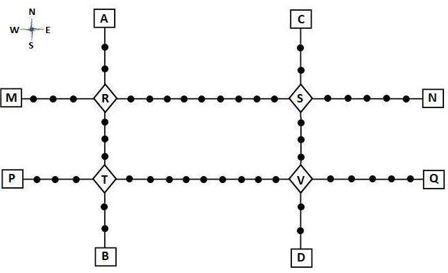
Given above is the schematic map of the metro lines in a city with rectangles denoting terminal stations (e.g. A), diamonds denoting junction stations (e.g. R) and small filled-up circles denoting other stations. Each train runs either in east-west or north-south direction, but not both. All trains stop for 2 minutes at each of the junction stations on the way and for 1 minute at each of the other stations. It takes 2 minutes to reach the next station for trains going in east-west direction and 3 minutes to reach the next station for trains going in north-south direction. From each terminal station, the first train starts at 6 am; the last trains leave the terminal stations at midnight. Otherwise, during the service hours, there are metro service every 15 minutes in the north-south lines and every 10 minutes in the east-west lines. A train must rest for at least 15 minutes after completing a trip at the terminal station, before it can undertake the next trip in the reverse direction. (All questions are related to this metro service only. Assume that if someone reaches a station exactly at the time a train is supposed to leave, (s)he can catch that train.)
Figure for this questionFigure for this question

If Hari is ready to board a train at 8:05 am from station M, then when is the earliest that he can reach station N?

Q21CAT 2022 · Slot 1✓ Answer verified
Given above is the schematic map of the metro lines in a city with rectangles denoting terminal stations (e.g. A), diamonds denoting junction stations (e.g. R) and small filled-up circles denoting other stations. Each train runs either in east-west or north-south direction, but not both. All trains stop for 2 minutes at each of the junction stations on the way and for 1 minute at each of the other stations. It takes 2 minutes to reach the next station for trains going in east-west direction and 3 minutes to reach the next station for trains going in north-south direction. From each terminal station, the first train starts at 6 am; the last trains leave the terminal stations at midnight. Otherwise, during the service hours, there are metro service every 15 minutes in the north-south lines and every 10 minutes in the east-west lines. A train must rest for at least 15 minutes after completing a trip at the terminal station, before it can undertake the next trip in the reverse direction. (All questions are related to this metro service only. Assume that if someone reaches a station exactly at the time a train is supposed to leave, (s)he can catch that train.)
Figure for this questionFigure for this question

If Priya is ready to board a train at 10:25 am from station T, then when is the earliest that she can reach station S?

Q22CAT 2022 · Slot 1✓ Answer verified
Given above is the schematic map of the metro lines in a city with rectangles denoting terminal stations (e.g. A), diamonds denoting junction stations (e.g. R) and small filled-up circles denoting other stations. Each train runs either in east-west or north-south direction, but not both. All trains stop for 2 minutes at each of the junction stations on the way and for 1 minute at each of the other stations. It takes 2 minutes to reach the next station for trains going in east-west direction and 3 minutes to reach the next station for trains going in north-south direction. From each terminal station, the first train starts at 6 am; the last trains leave the terminal stations at midnight. Otherwise, during the service hours, there are metro service every 15 minutes in the north-south lines and every 10 minutes in the east-west lines. A train must rest for at least 15 minutes after completing a trip at the terminal station, before it can undertake the next trip in the reverse direction. (All questions are related to this metro service only. Assume that if someone reaches a station exactly at the time a train is supposed to leave, (s)he can catch that train.)
Figure for this questionFigure for this question

Haripriya is expected to reach station S late. What is the latest time by which she must be ready to board at station S if she must reach station B before 1 am via station R?

Q23CAT 2022 · Slot 1 · TITA✓ Answer verified
Given above is the schematic map of the metro lines in a city with rectangles denoting terminal stations (e.g. A), diamonds denoting junction stations (e.g. R) and small filled-up circles denoting other stations. Each train runs either in east-west or north-south direction, but not both. All trains stop for 2 minutes at each of the junction stations on the way and for 1 minute at each of the other stations. It takes 2 minutes to reach the next station for trains going in east-west direction and 3 minutes to reach the next station for trains going in north-south direction. From each terminal station, the first train starts at 6 am; the last trains leave the terminal stations at midnight. Otherwise, during the service hours, there are metro service every 15 minutes in the north-south lines and every 10 minutes in the east-west lines. A train must rest for at least 15 minutes after completing a trip at the terminal station, before it can undertake the next trip in the reverse direction. (All questions are related to this metro service only. Assume that if someone reaches a station exactly at the time a train is supposed to leave, (s)he can catch that train.)
Figure for this questionFigure for this question

What is the minimum number of trains that are required to provide the service on the AB line (considering both north and south directions)?

Q24CAT 2022 · Slot 1✓ Answer verified
The management of a university hockey team was evaluating performance of four women players − Amla, Bimla, Harita and Sarita for their possible selection in the university team for next year. For this purpose, the management was looking at the number of goals scored by them in the past 8 matches, numbered 1 through 8. The four players together had scored a total of 12 goals in these matches. In the 8 matches, each of them had scored at least one goal. No two players had scored the same total number of goals. The following facts are known about the goals scored by these four players only. All the questions refer only to the goals scored by these four players. 1. Only one goal was scored in every even numbered match. 2. Harita scored more goals than Bimla. 3. The highest goal scorer scored goals in exactly 3 matches including Match 4 and Match 8. 4. Bimla scored a goal in Match 1 and one each in three other consecutive matches. 5. An equal number of goals were scored in Match 3 and Match 7, which was different from the number of goals scored in either Match 1 or Match 5. 6. The match in which the highest number of goals was scored was unique and it was not Match 5.
Figure for this question

How many goals were scored in Match 7?

Q25CAT 2022 · Slot 1✓ Answer verified
The management of a university hockey team was evaluating performance of four women players − Amla, Bimla, Harita and Sarita for their possible selection in the university team for next year. For this purpose, the management was looking at the number of goals scored by them in the past 8 matches, numbered 1 through 8. The four players together had scored a total of 12 goals in these matches. In the 8 matches, each of them had scored at least one goal. No two players had scored the same total number of goals. The following facts are known about the goals scored by these four players only. All the questions refer only to the goals scored by these four players. 1. Only one goal was scored in every even numbered match. 2. Harita scored more goals than Bimla. 3. The highest goal scorer scored goals in exactly 3 matches including Match 4 and Match 8. 4. Bimla scored a goal in Match 1 and one each in three other consecutive matches. 5. An equal number of goals were scored in Match 3 and Match 7, which was different from the number of goals scored in either Match 1 or Match 5. 6. The match in which the highest number of goals was scored was unique and it was not Match 5.
Figure for this question

Which of the following is the correct sequence of goals scored in matches 1, 3, 5 and 7?

Q26CAT 2022 · Slot 1✓ Answer verified
The management of a university hockey team was evaluating performance of four women players − Amla, Bimla, Harita and Sarita for their possible selection in the university team for next year. For this purpose, the management was looking at the number of goals scored by them in the past 8 matches, numbered 1 through 8. The four players together had scored a total of 12 goals in these matches. In the 8 matches, each of them had scored at least one goal. No two players had scored the same total number of goals. The following facts are known about the goals scored by these four players only. All the questions refer only to the goals scored by these four players. 1. Only one goal was scored in every even numbered match. 2. Harita scored more goals than Bimla. 3. The highest goal scorer scored goals in exactly 3 matches including Match 4 and Match 8. 4. Bimla scored a goal in Match 1 and one each in three other consecutive matches. 5. An equal number of goals were scored in Match 3 and Match 7, which was different from the number of goals scored in either Match 1 or Match 5. 6. The match in which the highest number of goals was scored was unique and it was not Match 5.
Figure for this question

Which of the following statement(s) is/are true? Statement-1: Amla and Sarita never scored goals in the same match. Statement-2: Harita and Sarita never scored goals in the same match.

Q27CAT 2022 · Slot 1✓ Answer verified
The management of a university hockey team was evaluating performance of four women players − Amla, Bimla, Harita and Sarita for their possible selection in the university team for next year. For this purpose, the management was looking at the number of goals scored by them in the past 8 matches, numbered 1 through 8. The four players together had scored a total of 12 goals in these matches. In the 8 matches, each of them had scored at least one goal. No two players had scored the same total number of goals. The following facts are known about the goals scored by these four players only. All the questions refer only to the goals scored by these four players. 1. Only one goal was scored in every even numbered match. 2. Harita scored more goals than Bimla. 3. The highest goal scorer scored goals in exactly 3 matches including Match 4 and Match 8. 4. Bimla scored a goal in Match 1 and one each in three other consecutive matches. 5. An equal number of goals were scored in Match 3 and Match 7, which was different from the number of goals scored in either Match 1 or Match 5. 6. The match in which the highest number of goals was scored was unique and it was not Match 5.
Figure for this question

Which of the following statement(s) is/are false? Statement-1: In every match at least one player scored a goal. Statement-2: No two players scored goals in the same number of matches.

Q28CAT 2022 · Slot 1✓ Answer verified
The management of a university hockey team was evaluating performance of four women players − Amla, Bimla, Harita and Sarita for their possible selection in the university team for next year. For this purpose, the management was looking at the number of goals scored by them in the past 8 matches, numbered 1 through 8. The four players together had scored a total of 12 goals in these matches. In the 8 matches, each of them had scored at least one goal. No two players had scored the same total number of goals. The following facts are known about the goals scored by these four players only. All the questions refer only to the goals scored by these four players. 1. Only one goal was scored in every even numbered match. 2. Harita scored more goals than Bimla. 3. The highest goal scorer scored goals in exactly 3 matches including Match 4 and Match 8. 4. Bimla scored a goal in Match 1 and one each in three other consecutive matches. 5. An equal number of goals were scored in Match 3 and Match 7, which was different from the number of goals scored in either Match 1 or Match 5. 6. The match in which the highest number of goals was scored was unique and it was not Match 5.
Figure for this question

If Harita scored goals in one more match as compared to Sarita, which of the following statement(s) is/are necessarily true? Statement-1: Amla scored goals in consecutive matches. Statement-2: Sarita scored goals in consecutive matches.

Q29CAT 2022 · Slot 1 · TITA✓ Answer verified
Adhara, Bithi, Chhaya, Dhanavi, Esther, and Fathima are the interviewers in a process that awards funding for new initiatives. Every interviewer individually interviews each of the candidates individually and awards a token only if she recommends funding. A token has a face value of 2, 3, 5, 7, 11, or 13. Each interviewer awards tokens of a single face value only. Once all six interviews are over for a candidate, the candidate receives a funding that is Rs.1000 times the product of the face values of all the tokens. For example, if a candidate has tokens with face values 2, 5, and 7, then they get a funding of Rs.1000 × (2 × 5 × 7) = Rs.70,000. Pragnyaa, Qahira, Rasheeda, Smera, and Tantra were five candidates who received funding. The funds they received, in descending order, were Rs.390,000, Rs.210,000, Rs.165,000, Rs.77,000, and Rs.66,000. The following additional facts are known: 1. Fathima awarded tokens to everyone except Qahira, while Adhara awarded tokens to no one except Pragnyaa. 2. Rashida received the highest number of tokens that anyone received, but she did not receive one from Esther. 3. Bithi awarded a token to Smera but not to Qahira, while Dhanavi awarded a token to Qahira but not to Smera.
Figure for this question

How many tokens did Qahira receive?

Q30CAT 2022 · Slot 1✓ Answer verified
Adhara, Bithi, Chhaya, Dhanavi, Esther, and Fathima are the interviewers in a process that awards funding for new initiatives. Every interviewer individually interviews each of the candidates individually and awards a token only if she recommends funding. A token has a face value of 2, 3, 5, 7, 11, or 13. Each interviewer awards tokens of a single face value only. Once all six interviews are over for a candidate, the candidate receives a funding that is Rs.1000 times the product of the face values of all the tokens. For example, if a candidate has tokens with face values 2, 5, and 7, then they get a funding of Rs.1000 × (2 × 5 × 7) = Rs.70,000. Pragnyaa, Qahira, Rasheeda, Smera, and Tantra were five candidates who received funding. The funds they received, in descending order, were Rs.390,000, Rs.210,000, Rs.165,000, Rs.77,000, and Rs.66,000. The following additional facts are known: 1. Fathima awarded tokens to everyone except Qahira, while Adhara awarded tokens to no one except Pragnyaa. 2. Rashida received the highest number of tokens that anyone received, but she did not receive one from Esther. 3. Bithi awarded a token to Smera but not to Qahira, while Dhanavi awarded a token to Qahira but not to Smera.
Figure for this question

Who among the following definitely received a token from Bithi but not from Dhanavi?

Q31CAT 2022 · Slot 1 · TITA✓ Answer verified
Adhara, Bithi, Chhaya, Dhanavi, Esther, and Fathima are the interviewers in a process that awards funding for new initiatives. Every interviewer individually interviews each of the candidates individually and awards a token only if she recommends funding. A token has a face value of 2, 3, 5, 7, 11, or 13. Each interviewer awards tokens of a single face value only. Once all six interviews are over for a candidate, the candidate receives a funding that is Rs.1000 times the product of the face values of all the tokens. For example, if a candidate has tokens with face values 2, 5, and 7, then they get a funding of Rs.1000 × (2 × 5 × 7) = Rs.70,000. Pragnyaa, Qahira, Rasheeda, Smera, and Tantra were five candidates who received funding. The funds they received, in descending order, were Rs.390,000, Rs.210,000, Rs.165,000, Rs.77,000, and Rs.66,000. The following additional facts are known: 1. Fathima awarded tokens to everyone except Qahira, while Adhara awarded tokens to no one except Pragnyaa. 2. Rashida received the highest number of tokens that anyone received, but she did not receive one from Esther. 3. Bithi awarded a token to Smera but not to Qahira, while Dhanavi awarded a token to Qahira but not to Smera.
Figure for this question

How many tokens did Chhaya award?

Q32CAT 2022 · Slot 1 · TITA✓ Answer verified
Adhara, Bithi, Chhaya, Dhanavi, Esther, and Fathima are the interviewers in a process that awards funding for new initiatives. Every interviewer individually interviews each of the candidates individually and awards a token only if she recommends funding. A token has a face value of 2, 3, 5, 7, 11, or 13. Each interviewer awards tokens of a single face value only. Once all six interviews are over for a candidate, the candidate receives a funding that is Rs.1000 times the product of the face values of all the tokens. For example, if a candidate has tokens with face values 2, 5, and 7, then they get a funding of Rs.1000 × (2 × 5 × 7) = Rs.70,000. Pragnyaa, Qahira, Rasheeda, Smera, and Tantra were five candidates who received funding. The funds they received, in descending order, were Rs.390,000, Rs.210,000, Rs.165,000, Rs.77,000, and Rs.66,000. The following additional facts are known: 1. Fathima awarded tokens to everyone except Qahira, while Adhara awarded tokens to no one except Pragnyaa. 2. Rashida received the highest number of tokens that anyone received, but she did not receive one from Esther. 3. Bithi awarded a token to Smera but not to Qahira, while Dhanavi awarded a token to Qahira but not to Smera.
Figure for this question

How many tokens did Smera receive?

Q33CAT 2022 · Slot 1
Adhara, Bithi, Chhaya, Dhanavi, Esther, and Fathima are the interviewers in a process that awards funding for new initiatives. Every interviewer individually interviews each of the candidates individually and awards a token only if she recommends funding. A token has a face value of 2, 3, 5, 7, 11, or 13. Each interviewer awards tokens of a single face value only. Once all six interviews are over for a candidate, the candidate receives a funding that is Rs.1000 times the product of the face values of all the tokens. For example, if a candidate has tokens with face values 2, 5, and 7, then they get a funding of Rs.1000 × (2 × 5 × 7) = Rs.70,000. Pragnyaa, Qahira, Rasheeda, Smera, and Tantra were five candidates who received funding. The funds they received, in descending order, were Rs.390,000, Rs.210,000, Rs.165,000, Rs.77,000, and Rs.66,000. The following additional facts are known: 1. Fathima awarded tokens to everyone except Qahira, while Adhara awarded tokens to no one except Pragnyaa. 2. Rashida received the highest number of tokens that anyone received, but she did not receive one from Esther. 3. Bithi awarded a token to Smera but not to Qahira, while Dhanavi awarded a token to Qahira but not to Smera.
Figure for this question

Which of the following could be the amount of funding that Tantra received? (a) Rs. 66,000 (b) Rs. 165,000

Q34CAT 2021 · Slot 1 · TITA✓ Answer verified

Smoothie Scheduling

Ganga, Kaveri, and Narmada are three women who buy four raw materials (Mango, Apple, Banana and Milk) and sell five finished products (Mango smoothie, Apple smoothie, Banana smoothie, Mixed fruit smoothie and Fruit salad). Table-1 gives information about the raw materials required to produce the five finished products. One unit of a finished product requires one unit of each of the raw materials mentioned in the second column of the table. One unit of milk, mango, apple, and banana cost Rs.5, Rs.3, Rs.2, and Rs.1 respectively. Each unit of a finished product is sold for a profit equal to two times the number of raw materials used to make that product. For example, apple smoothie is made with two raw materials (apple and milk) and will be sold for a profit of Rs.4 per unit. Leftover raw materials are sold during the last business hour of the day for a loss of Rs.1 per unit. The amount, in rupees, received from sales (revenue) for each woman in each of the four business hours of the day is given in Table-2. The following additional facts are known. 1. No one except possibly Ganga sold any Mango smoothie. 2. Each woman sold either zero or one unit of any single finished product in any hour. 3. Each woman had exactly one unit each of two different raw materials as leftovers. 4. No one had any banana leftover.
Figure for this questionFigure for this question

What BEST can be concluded about the number of units of fruit salad sold in the first hour?

Q35CAT 2021 · Slot 1✓ Answer verified

Smoothie Scheduling

Ganga, Kaveri, and Narmada are three women who buy four raw materials (Mango, Apple, Banana and Milk) and sell five finished products (Mango smoothie, Apple smoothie, Banana smoothie, Mixed fruit smoothie and Fruit salad). Table-1 gives information about the raw materials required to produce the five finished products. One unit of a finished product requires one unit of each of the raw materials mentioned in the second column of the table. One unit of milk, mango, apple, and banana cost Rs.5, Rs.3, Rs.2, and Rs.1 respectively. Each unit of a finished product is sold for a profit equal to two times the number of raw materials used to make that product. For example, apple smoothie is made with two raw materials (apple and milk) and will be sold for a profit of Rs.4 per unit. Leftover raw materials are sold during the last business hour of the day for a loss of Rs.1 per unit. The amount, in rupees, received from sales (revenue) for each woman in each of the four business hours of the day is given in Table-2. The following additional facts are known. 1. No one except possibly Ganga sold any Mango smoothie. 2. Each woman sold either zero or one unit of any single finished product in any hour. 3. Each woman had exactly one unit each of two different raw materials as leftovers. 4. No one had any banana leftover.
Figure for this questionFigure for this question

Which of the following is NECESSARILY true?

Q36CAT 2021 · Slot 1 · TITA✓ Answer verified

Smoothie Scheduling

Ganga, Kaveri, and Narmada are three women who buy four raw materials (Mango, Apple, Banana and Milk) and sell five finished products (Mango smoothie, Apple smoothie, Banana smoothie, Mixed fruit smoothie and Fruit salad). Table-1 gives information about the raw materials required to produce the five finished products. One unit of a finished product requires one unit of each of the raw materials mentioned in the second column of the table. One unit of milk, mango, apple, and banana cost Rs.5, Rs.3, Rs.2, and Rs.1 respectively. Each unit of a finished product is sold for a profit equal to two times the number of raw materials used to make that product. For example, apple smoothie is made with two raw materials (apple and milk) and will be sold for a profit of Rs.4 per unit. Leftover raw materials are sold during the last business hour of the day for a loss of Rs.1 per unit. The amount, in rupees, received from sales (revenue) for each woman in each of the four business hours of the day is given in Table-2. The following additional facts are known. 1. No one except possibly Ganga sold any Mango smoothie. 2. Each woman sold either zero or one unit of any single finished product in any hour. 3. Each woman had exactly one unit each of two different raw materials as leftovers. 4. No one had any banana leftover.
Figure for this questionFigure for this question

What BEST can be concluded about the total number of units of milk the three women had in the beginning?

Q37CAT 2021 · Slot 1 · TITA✓ Answer verified

Smoothie Scheduling

Ganga, Kaveri, and Narmada are three women who buy four raw materials (Mango, Apple, Banana and Milk) and sell five finished products (Mango smoothie, Apple smoothie, Banana smoothie, Mixed fruit smoothie and Fruit salad). Table-1 gives information about the raw materials required to produce the five finished products. One unit of a finished product requires one unit of each of the raw materials mentioned in the second column of the table. One unit of milk, mango, apple, and banana cost Rs.5, Rs.3, Rs.2, and Rs.1 respectively. Each unit of a finished product is sold for a profit equal to two times the number of raw materials used to make that product. For example, apple smoothie is made with two raw materials (apple and milk) and will be sold for a profit of Rs.4 per unit. Leftover raw materials are sold during the last business hour of the day for a loss of Rs.1 per unit. The amount, in rupees, received from sales (revenue) for each woman in each of the four business hours of the day is given in Table-2. The following additional facts are known. 1. No one except possibly Ganga sold any Mango smoothie. 2. Each woman sold either zero or one unit of any single finished product in any hour. 3. Each woman had exactly one unit each of two different raw materials as leftovers. 4. No one had any banana leftover.
Figure for this questionFigure for this question

If it is known that three leftover units of mangoes were sold during the last business hour, how many apple smoothies were sold during the day?
Q38CAT 2021 · TITA✓ Answer verified
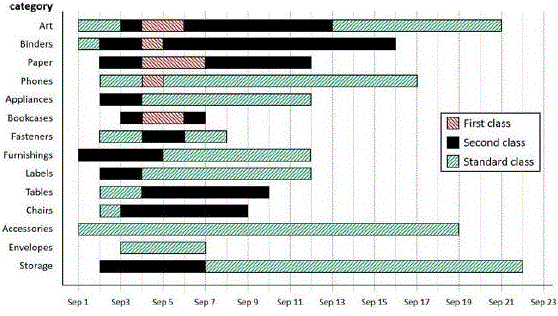
The different bars in the diagram above provide information about different orders invarious categories (Art, Binders, ….) that were booked in the first two weeks of Septemberof a store for one client. The colour and pattern of a bar denotes the ship mode (First Class/ Second Class / Standard Class). The left end point of a bar indicates the booking day ofthe order, while the right end point indicates the dispatch day of the order. The differencebetween the dispatch day and the booking day (measured in terms of the number of days)is called the processing time of the order. For the same category, an order is consideredfor booking only after the previous order of the same category is dispatched. No twoconsecutive orders of the same category had identical ship mode during this period. For example, there were only two orders in the furnishing category during this period. The first one was shipped in the Second Class. It was booked on Sep 1 and dispatched on Sep 5. The second order was shipped in the Standard class. It was booked on Sep 5 (although the order might have been placed before that) and dispatched on Sep 12. So the processing times were 4 and 7 days respectively for these orders
Figure for this questionFigure for this questionFigure for this questionFigure for this questionFigure for this question

Q. 1 How many days between Sep 1 and Sep 14 (both inclusive) had no booking from this client considering all the above categories?

Q39CAT 2021 · TITA✓ Answer verified
The different bars in the diagram above provide information about different orders invarious categories (Art, Binders, ….) that were booked in the first two weeks of Septemberof a store for one client. The colour and pattern of a bar denotes the ship mode (First Class/ Second Class / Standard Class). The left end point of a bar indicates the booking day ofthe order, while the right end point indicates the dispatch day of the order. The differencebetween the dispatch day and the booking day (measured in terms of the number of days)is called the processing time of the order. For the same category, an order is consideredfor booking only after the previous order of the same category is dispatched. No twoconsecutive orders of the same category had identical ship mode during this period. For example, there were only two orders in the furnishing category during this period. The first one was shipped in the Second Class. It was booked on Sep 1 and dispatched on Sep 5. The second order was shipped in the Standard class. It was booked on Sep 5 (although the order might have been placed before that) and dispatched on Sep 12. So the processing times were 4 and 7 days respectively for these orders
Figure for this questionFigure for this questionFigure for this questionFigure for this questionFigure for this question

Q. 2 What was the average processing time of all orders in the categories which had only one type of ship mode?

Q40CAT 2021✓ Answer verified
The different bars in the diagram above provide information about different orders invarious categories (Art, Binders, ….) that were booked in the first two weeks of Septemberof a store for one client. The colour and pattern of a bar denotes the ship mode (First Class/ Second Class / Standard Class). The left end point of a bar indicates the booking day ofthe order, while the right end point indicates the dispatch day of the order. The differencebetween the dispatch day and the booking day (measured in terms of the number of days)is called the processing time of the order. For the same category, an order is consideredfor booking only after the previous order of the same category is dispatched. No twoconsecutive orders of the same category had identical ship mode during this period. For example, there were only two orders in the furnishing category during this period. The first one was shipped in the Second Class. It was booked on Sep 1 and dispatched on Sep 5. The second order was shipped in the Standard class. It was booked on Sep 5 (although the order might have been placed before that) and dispatched on Sep 12. So the processing times were 4 and 7 days respectively for these orders
Figure for this questionFigure for this questionFigure for this questionFigure for this questionFigure for this question

Q. 3 The sequence of categories -- Art, Binders, Paper and Phones -- in decreasing order ofaverage processing time of their orders in this period is:

Q41CAT 2021✓ Answer verified
The different bars in the diagram above provide information about different orders invarious categories (Art, Binders, ….) that were booked in the first two weeks of Septemberof a store for one client. The colour and pattern of a bar denotes the ship mode (First Class/ Second Class / Standard Class). The left end point of a bar indicates the booking day ofthe order, while the right end point indicates the dispatch day of the order. The differencebetween the dispatch day and the booking day (measured in terms of the number of days)is called the processing time of the order. For the same category, an order is consideredfor booking only after the previous order of the same category is dispatched. No twoconsecutive orders of the same category had identical ship mode during this period. For example, there were only two orders in the furnishing category during this period. The first one was shipped in the Second Class. It was booked on Sep 1 and dispatched on Sep 5. The second order was shipped in the Standard class. It was booked on Sep 5 (although the order might have been placed before that) and dispatched on Sep 12. So the processing times were 4 and 7 days respectively for these orders
Figure for this questionFigure for this questionFigure for this questionFigure for this questionFigure for this question

Q. 4 Approximately what percentage of orders had a processing time of one day during theperiod Sep 1 to Sep 22 (both dates inclusive)?

Q42CAT 2021✓ Answer verified
The figure above shows the schedule of four employees – Abani, Bahni, Danni and Tinni – whom Dhoni supervised in 2020. Altogether there were five projects which started and concluded in 2020 in which they were involved. For each of these projects and for each employee, the starting day was at the beginning of a month and the concluding day was the end of a month, and these are indicated by the left and right end points of the corresponding horizontal bars. The number within each bar indicates the percentage of assigned work completed by the employee for that project, as assessed by Dhoni. For each employee, his/her total project-month (in 2020) is the sum of the number of months (s)he worked across the five project, while his/her annual completion index is the weightage average of the completion percentage assigned from the different projects, with the weights being the corresponding number of months (s)he worked in these projects. For each project, the total employee-month is the sum of the number of months four employees worked in this project, while its completion index is the weightage average of the completion percentage assigned for the employees who worked in this project, with the weights being the corresponding number of months they worked in this project.
Figure for this questionFigure for this questionFigure for this questionFigure for this question

Q. 1 Which of the following statements is/are true? I: The total project-month was the same for the four employees. II: The total employee-month was the same for the five projects.

Q43CAT 2021✓ Answer verified
The figure above shows the schedule of four employees – Abani, Bahni, Danni and Tinni – whom Dhoni supervised in 2020. Altogether there were five projects which started and concluded in 2020 in which they were involved. For each of these projects and for each employee, the starting day was at the beginning of a month and the concluding day was the end of a month, and these are indicated by the left and right end points of the corresponding horizontal bars. The number within each bar indicates the percentage of assigned work completed by the employee for that project, as assessed by Dhoni. For each employee, his/her total project-month (in 2020) is the sum of the number of months (s)he worked across the five project, while his/her annual completion index is the weightage average of the completion percentage assigned from the different projects, with the weights being the corresponding number of months (s)he worked in these projects. For each project, the total employee-month is the sum of the number of months four employees worked in this project, while its completion index is the weightage average of the completion percentage assigned for the employees who worked in this project, with the weights being the corresponding number of months they worked in this project.
Figure for this questionFigure for this questionFigure for this questionFigure for this question

Q. 2 Which employees did not work in multiple projects for any of the months in 2020

Q44CAT 2021✓ Answer verified
The figure above shows the schedule of four employees – Abani, Bahni, Danni and Tinni – whom Dhoni supervised in 2020. Altogether there were five projects which started and concluded in 2020 in which they were involved. For each of these projects and for each employee, the starting day was at the beginning of a month and the concluding day was the end of a month, and these are indicated by the left and right end points of the corresponding horizontal bars. The number within each bar indicates the percentage of assigned work completed by the employee for that project, as assessed by Dhoni. For each employee, his/her total project-month (in 2020) is the sum of the number of months (s)he worked across the five project, while his/her annual completion index is the weightage average of the completion percentage assigned from the different projects, with the weights being the corresponding number of months (s)he worked in these projects. For each project, the total employee-month is the sum of the number of months four employees worked in this project, while its completion index is the weightage average of the completion percentage assigned for the employees who worked in this project, with the weights being the corresponding number of months they worked in this project.
Figure for this questionFigure for this questionFigure for this questionFigure for this question

Q. 3 The list of employees in decreasing order of annual completion index is:

Q45CAT 2021✓ Answer verified
The figure above shows the schedule of four employees – Abani, Bahni, Danni and Tinni – whom Dhoni supervised in 2020. Altogether there were five projects which started and concluded in 2020 in which they were involved. For each of these projects and for each employee, the starting day was at the beginning of a month and the concluding day was the end of a month, and these are indicated by the left and right end points of the corresponding horizontal bars. The number within each bar indicates the percentage of assigned work completed by the employee for that project, as assessed by Dhoni. For each employee, his/her total project-month (in 2020) is the sum of the number of months (s)he worked across the five project, while his/her annual completion index is the weightage average of the completion percentage assigned from the different projects, with the weights being the corresponding number of months (s)he worked in these projects. For each project, the total employee-month is the sum of the number of months four employees worked in this project, while its completion index is the weightage average of the completion percentage assigned for the employees who worked in this project, with the weights being the corresponding number of months they worked in this project.
Figure for this questionFigure for this questionFigure for this questionFigure for this question

Q. 4 Which employees did not work in multiple projects for any of the months in 2020

Q46CAT 2020 · Slot 2

Seminars

The Humanities department of a college is planning to organize eight seminars, one for each of the eight doctoral students − A, B, C, D, E, F, G and H. Four of them are from Economics, three from Sociology and one from Anthropology department. Each student is guided by one among P, Q, R, S and T. Two students are guided by each of P, R and T, while one student is guided by each of Q and S. Each student is guided by a guide belonging to their department. Each seminar is to be scheduled in one of four consecutive 30-minute slots starting at 9:00 am, 9:30 am, 10:00 am and 10:30 am on the same day. More than one seminars can be scheduled in a slot, provided the guide is free. Only three rooms are available and hence at the most three seminars can be scheduled in a slot. Students who are guided by the same guide must be scheduled in consecutive slots. The following additional facts are also known. Seminars by students from Economics are scheduled in each of the four slots. A’s is the only seminar that is scheduled at 10:00 am. A is guided by R. F is an Anthropology student whose seminar is scheduled at 10:30 am. The seminar of a Sociology student is scheduled at 9:00 am. B and G are both Sociology students, whose seminars are scheduled in the same slot. The seminar of an Economics student, who is guided by T, is also scheduled in the same slot. P, who is guiding both B and C, has students scheduled in the first two slots. A and G are scheduled in two consecutive slots.

Which one of the following statements is true?

Q47CAT 2020 · Slot 2

Seminars

The Humanities department of a college is planning to organize eight seminars, one for each of the eight doctoral students − A, B, C, D, E, F, G and H. Four of them are from Economics, three from Sociology and one from Anthropology department. Each student is guided by one among P, Q, R, S and T. Two students are guided by each of P, R and T, while one student is guided by each of Q and S. Each student is guided by a guide belonging to their department. Each seminar is to be scheduled in one of four consecutive 30-minute slots starting at 9:00 am, 9:30 am, 10:00 am and 10:30 am on the same day. More than one seminars can be scheduled in a slot, provided the guide is free. Only three rooms are available and hence at the most three seminars can be scheduled in a slot. Students who are guided by the same guide must be scheduled in consecutive slots. The following additional facts are also known. Seminars by students from Economics are scheduled in each of the four slots. A’s is the only seminar that is scheduled at 10:00 am. A is guided by R. F is an Anthropology student whose seminar is scheduled at 10:30 am. The seminar of a Sociology student is scheduled at 9:00 am. B and G are both Sociology students, whose seminars are scheduled in the same slot. The seminar of an Economics student, who is guided by T, is also scheduled in the same slot. P, who is guiding both B and C, has students scheduled in the first two slots. A and G are scheduled in two consecutive slots.

Who all are NOT guiding any Economics students?

Q48CAT 2020 · Slot 2

Seminars

The Humanities department of a college is planning to organize eight seminars, one for each of the eight doctoral students − A, B, C, D, E, F, G and H. Four of them are from Economics, three from Sociology and one from Anthropology department. Each student is guided by one among P, Q, R, S and T. Two students are guided by each of P, R and T, while one student is guided by each of Q and S. Each student is guided by a guide belonging to their department. Each seminar is to be scheduled in one of four consecutive 30-minute slots starting at 9:00 am, 9:30 am, 10:00 am and 10:30 am on the same day. More than one seminars can be scheduled in a slot, provided the guide is free. Only three rooms are available and hence at the most three seminars can be scheduled in a slot. Students who are guided by the same guide must be scheduled in consecutive slots. The following additional facts are also known. Seminars by students from Economics are scheduled in each of the four slots. A’s is the only seminar that is scheduled at 10:00 am. A is guided by R. F is an Anthropology student whose seminar is scheduled at 10:30 am. The seminar of a Sociology student is scheduled at 9:00 am. B and G are both Sociology students, whose seminars are scheduled in the same slot. The seminar of an Economics student, who is guided by T, is also scheduled in the same slot. P, who is guiding both B and C, has students scheduled in the first two slots. A and G are scheduled in two consecutive slots.

Which of the following statements is necessarily true?

Q49CAT 2020 · Slot 2

Seminars

The Humanities department of a college is planning to organize eight seminars, one for each of the eight doctoral students − A, B, C, D, E, F, G and H. Four of them are from Economics, three from Sociology and one from Anthropology department. Each student is guided by one among P, Q, R, S and T. Two students are guided by each of P, R and T, while one student is guided by each of Q and S. Each student is guided by a guide belonging to their department. Each seminar is to be scheduled in one of four consecutive 30-minute slots starting at 9:00 am, 9:30 am, 10:00 am and 10:30 am on the same day. More than one seminars can be scheduled in a slot, provided the guide is free. Only three rooms are available and hence at the most three seminars can be scheduled in a slot. Students who are guided by the same guide must be scheduled in consecutive slots. The following additional facts are also known. Seminars by students from Economics are scheduled in each of the four slots. A’s is the only seminar that is scheduled at 10:00 am. A is guided by R. F is an Anthropology student whose seminar is scheduled at 10:30 am. The seminar of a Sociology student is scheduled at 9:00 am. B and G are both Sociology students, whose seminars are scheduled in the same slot. The seminar of an Economics student, who is guided by T, is also scheduled in the same slot. P, who is guiding both B and C, has students scheduled in the first two slots. A and G are scheduled in two consecutive slots.

If D is scheduled in a slot later than Q's, then which of the following two statement(s) is(are) true? (i) E and H are guided by T. (ii) G is guided by Q.

Q50CAT 2020 · Slot 2

Seminars

The Humanities department of a college is planning to organize eight seminars, one for each of the eight doctoral students − A, B, C, D, E, F, G and H. Four of them are from Economics, three from Sociology and one from Anthropology department. Each student is guided by one among P, Q, R, S and T. Two students are guided by each of P, R and T, while one student is guided by each of Q and S. Each student is guided by a guide belonging to their department. Each seminar is to be scheduled in one of four consecutive 30-minute slots starting at 9:00 am, 9:30 am, 10:00 am and 10:30 am on the same day. More than one seminars can be scheduled in a slot, provided the guide is free. Only three rooms are available and hence at the most three seminars can be scheduled in a slot. Students who are guided by the same guide must be scheduled in consecutive slots. The following additional facts are also known. Seminars by students from Economics are scheduled in each of the four slots. A’s is the only seminar that is scheduled at 10:00 am. A is guided by R. F is an Anthropology student whose seminar is scheduled at 10:30 am. The seminar of a Sociology student is scheduled at 9:00 am. B and G are both Sociology students, whose seminars are scheduled in the same slot. The seminar of an Economics student, who is guided by T, is also scheduled in the same slot. P, who is guiding both B and C, has students scheduled in the first two slots. A and G are scheduled in two consecutive slots.

If E and Q are both scheduled in the same slot, then which of the following statements BEST describes the relationship between D, H, and T?

Q51CAT 2020 · Slot 2 · TITA

Seminars

The Humanities department of a college is planning to organize eight seminars, one for each of the eight doctoral students − A, B, C, D, E, F, G and H. Four of them are from Economics, three from Sociology and one from Anthropology department. Each student is guided by one among P, Q, R, S and T. Two students are guided by each of P, R and T, while one student is guided by each of Q and S. Each student is guided by a guide belonging to their department. Each seminar is to be scheduled in one of four consecutive 30-minute slots starting at 9:00 am, 9:30 am, 10:00 am and 10:30 am on the same day. More than one seminars can be scheduled in a slot, provided the guide is free. Only three rooms are available and hence at the most three seminars can be scheduled in a slot. Students who are guided by the same guide must be scheduled in consecutive slots. The following additional facts are also known. Seminars by students from Economics are scheduled in each of the four slots. A’s is the only seminar that is scheduled at 10:00 am. A is guided by R. F is an Anthropology student whose seminar is scheduled at 10:30 am. The seminar of a Sociology student is scheduled at 9:00 am. B and G are both Sociology students, whose seminars are scheduled in the same slot. The seminar of an Economics student, who is guided by T, is also scheduled in the same slot. P, who is guiding both B and C, has students scheduled in the first two slots. A and G are scheduled in two consecutive slots.

If D is scheduled in the slot immediately before Q’s, then which of the following is NOT necessarily true?

Q52CAT 2020✓ Answer verified
A shopping mall has a large basement parking lot with parking slots painted in it along a single row. These slots are quite narrow; a compact car can fit in a single slot but an SUV requires two slots. When a car arrives, the parking attendant guides the car to the first available slot from the beginning of the row into which the car can fit. For our purpose, cars are numbered according to the order in which they arrive at the lot. For example, the first car to arrive is given a number 1, the second a number 2, and so on. This numbering does not indicate whether a car is a compact or an SUV. The configuration of a parking lot is a sequence of the car numbers in each slot. Each single vacant slot is represented by letter V. For instance, suppose cars numbered 1 through 5 arrive and park, where cars 1, 3 and 5 are compact cars and 2 and 4 are SUVs. At this point, the parking lot would be described by the sequence 1, 2, 3, 4, 5. If cars 2 and 5 now vacate their slots, the parking lot would now be described as 1, V, V, 3, 4. If a compact car (numbered 6) arrives subsequently followed by an SUV (numbered 7), the parking lot would be described by the sequence 1, 6, V, 3, 4, 7. Answer the following questions INDEPENDENTLY of each other.
Figure for this question

Q. 1 Initially cars numbered 1, 2, 3, and 4 arrive among which 1 and 4 are SUVs while 2 and 3 are compact cars. Car 1 then leaves, followed by the arrivals of car 5 (a compact car) and car 6 (an SUV). Car 4 then leaves. Then car 7 (an SUV) and car 8 (a compact car) arrive. At this moment, which among the following numbered car is parked next to car 3?

Q53CAT 2020✓ Answer verified
A shopping mall has a large basement parking lot with parking slots painted in it along a single row. These slots are quite narrow; a compact car can fit in a single slot but an SUV requires two slots. When a car arrives, the parking attendant guides the car to the first available slot from the beginning of the row into which the car can fit. For our purpose, cars are numbered according to the order in which they arrive at the lot. For example, the first car to arrive is given a number 1, the second a number 2, and so on. This numbering does not indicate whether a car is a compact or an SUV. The configuration of a parking lot is a sequence of the car numbers in each slot. Each single vacant slot is represented by letter V. For instance, suppose cars numbered 1 through 5 arrive and park, where cars 1, 3 and 5 are compact cars and 2 and 4 are SUVs. At this point, the parking lot would be described by the sequence 1, 2, 3, 4, 5. If cars 2 and 5 now vacate their slots, the parking lot would now be described as 1, V, V, 3, 4. If a compact car (numbered 6) arrives subsequently followed by an SUV (numbered 7), the parking lot would be described by the sequence 1, 6, V, 3, 4, 7. Answer the following questions INDEPENDENTLY of each other.
Figure for this question

Q. 2 Suppose eight cars have arrived, of which two have left. Also suppose that car 4 is a compact and car 7 is an SUV. Which of the following is a POSSIBLE current configuration of the parking lot?

Q54CAT 2020✓ Answer verified
A shopping mall has a large basement parking lot with parking slots painted in it along a single row. These slots are quite narrow; a compact car can fit in a single slot but an SUV requires two slots. When a car arrives, the parking attendant guides the car to the first available slot from the beginning of the row into which the car can fit. For our purpose, cars are numbered according to the order in which they arrive at the lot. For example, the first car to arrive is given a number 1, the second a number 2, and so on. This numbering does not indicate whether a car is a compact or an SUV. The configuration of a parking lot is a sequence of the car numbers in each slot. Each single vacant slot is represented by letter V. For instance, suppose cars numbered 1 through 5 arrive and park, where cars 1, 3 and 5 are compact cars and 2 and 4 are SUVs. At this point, the parking lot would be described by the sequence 1, 2, 3, 4, 5. If cars 2 and 5 now vacate their slots, the parking lot would now be described as 1, V, V, 3, 4. If a compact car (numbered 6) arrives subsequently followed by an SUV (numbered 7), the parking lot would be described by the sequence 1, 6, V, 3, 4, 7. Answer the following questions INDEPENDENTLY of each other.
Figure for this question

Q. 3 Suppose the sequence at some point of time is 4, 5, 6, V, 3. Which of the following is NOT necessarily true?

Q55CAT 2020✓ Answer verified
A shopping mall has a large basement parking lot with parking slots painted in it along a single row. These slots are quite narrow; a compact car can fit in a single slot but an SUV requires two slots. When a car arrives, the parking attendant guides the car to the first available slot from the beginning of the row into which the car can fit. For our purpose, cars are numbered according to the order in which they arrive at the lot. For example, the first car to arrive is given a number 1, the second a number 2, and so on. This numbering does not indicate whether a car is a compact or an SUV. The configuration of a parking lot is a sequence of the car numbers in each slot. Each single vacant slot is represented by letter V. For instance, suppose cars numbered 1 through 5 arrive and park, where cars 1, 3 and 5 are compact cars and 2 and 4 are SUVs. At this point, the parking lot would be described by the sequence 1, 2, 3, 4, 5. If cars 2 and 5 now vacate their slots, the parking lot would now be described as 1, V, V, 3, 4. If a compact car (numbered 6) arrives subsequently followed by an SUV (numbered 7), the parking lot would be described by the sequence 1, 6, V, 3, 4, 7. Answer the following questions INDEPENDENTLY of each other.
Figure for this question

Q. 4 Suppose that car 4 is not the first car to leave and that the sequence at a time between the arrival of the car 7 and car 8 is V, 7, 3, 6, 5. Then which of the following statements MUST be false?

Q56CAT 2019 · Slot 2✓ Answer verified

Set 4 : Three doctors

Three doctors, Dr. Ben, Dr. Kane and Dr. Wayne visit a particular clinic Monday to Saturday to see patients. Dr. Ben sees each patient for 10 minutes and charges Rs. 100/−. Dr. Kane sees each patient for 15 minutes and charges Rs. 200/-, while Dr. Wayne sees each patient for 25 minutes and charges Rs. 300/−. The clinic has three rooms numbered 1, 2 and 3 which are assigned to the three doctors as per the following table. The clinic is open from 9 a.m. to 11.30 a.m. every Monday to Saturday. On arrival each patient is handed a numbered token indicating their position in the queue, starting with token number 1 every day. As soon as any doctor becomes free, the next patient in the queue enters that emptied room for consultation. If at any time, more than one room is free then the waiting patient enters the room with the smallest number. For example, if the next two patients in the queue have token numbers 7 and 8 and if rooms numbered 1 and 3 are free, then patient with token number 7 enters room number 1 and patient with token number 8 enters room number 3.
Figure for this question

What is the maximum number of patients that the clinic can cater to on any single day?

Q57CAT 2019 · Slot 2✓ Answer verified

Set 4 : Three doctors

Three doctors, Dr. Ben, Dr. Kane and Dr. Wayne visit a particular clinic Monday to Saturday to see patients. Dr. Ben sees each patient for 10 minutes and charges Rs. 100/−. Dr. Kane sees each patient for 15 minutes and charges Rs. 200/-, while Dr. Wayne sees each patient for 25 minutes and charges Rs. 300/−. The clinic has three rooms numbered 1, 2 and 3 which are assigned to the three doctors as per the following table. The clinic is open from 9 a.m. to 11.30 a.m. every Monday to Saturday. On arrival each patient is handed a numbered token indicating their position in the queue, starting with token number 1 every day. As soon as any doctor becomes free, the next patient in the queue enters that emptied room for consultation. If at any time, more than one room is free then the waiting patient enters the room with the smallest number. For example, if the next two patients in the queue have token numbers 7 and 8 and if rooms numbered 1 and 3 are free, then patient with token number 7 enters room number 1 and patient with token number 8 enters room number 3.
Figure for this question

The queue is never empty on one particular Saturday. Which of the three doctors would earn the maximum amount in consultation charges on that day?

Q58CAT 2019 · Slot 2

Set 4 : Three doctors

Three doctors, Dr. Ben, Dr. Kane and Dr. Wayne visit a particular clinic Monday to Saturday to see patients. Dr. Ben sees each patient for 10 minutes and charges Rs. 100/−. Dr. Kane sees each patient for 15 minutes and charges Rs. 200/-, while Dr. Wayne sees each patient for 25 minutes and charges Rs. 300/−. The clinic has three rooms numbered 1, 2 and 3 which are assigned to the three doctors as per the following table. The clinic is open from 9 a.m. to 11.30 a.m. every Monday to Saturday. On arrival each patient is handed a numbered token indicating their position in the queue, starting with token number 1 every day. As soon as any doctor becomes free, the next patient in the queue enters that emptied room for consultation. If at any time, more than one room is free then the waiting patient enters the room with the smallest number. For example, if the next two patients in the queue have token numbers 7 and 8 and if rooms numbered 1 and 3 are free, then patient with token number 7 enters room number 1 and patient with token number 8 enters room number 3.
Figure for this questionFigure for this question

Mr. Singh visited the clinic on Monday, Wednesday, and Friday of a particular week, arriving at 8:50 a.m. on each of the three days. His token number was 13 on all three days. On which day was he at the clinic for the maximum duration?

Q59CAT 2019 · Slot 2✓ Answer verified

Set 4 : Three doctors

Three doctors, Dr. Ben, Dr. Kane and Dr. Wayne visit a particular clinic Monday to Saturday to see patients. Dr. Ben sees each patient for 10 minutes and charges Rs. 100/−. Dr. Kane sees each patient for 15 minutes and charges Rs. 200/-, while Dr. Wayne sees each patient for 25 minutes and charges Rs. 300/−. The clinic has three rooms numbered 1, 2 and 3 which are assigned to the three doctors as per the following table. The clinic is open from 9 a.m. to 11.30 a.m. every Monday to Saturday. On arrival each patient is handed a numbered token indicating their position in the queue, starting with token number 1 every day. As soon as any doctor becomes free, the next patient in the queue enters that emptied room for consultation. If at any time, more than one room is free then the waiting patient enters the room with the smallest number. For example, if the next two patients in the queue have token numbers 7 and 8 and if rooms numbered 1 and 3 are free, then patient with token number 7 enters room number 1 and patient with token number 8 enters room number 3.
Figure for this questionFigure for this question

On a slow Thursday, only two patients are waiting at 9 a.m. After that two patients keep arriving at exact 15 minute intervals starting at 9:15 a.m. -- i.e. at 9:15 a.m., 9:30 a.m., 9:45 a.m. etc. Then the total duration in minutes when all three doctors are simultaneously free is

Q60CAT 2019✓ Answer verified

Clinic Scheduling

Three doctors, Dr. Ben, Dr. Kane and Dr. Wayne visit a particular clinic Monday to Saturday to see patients. Dr. Ben sees each patient for 10 minutes and charges Rs. 100/−. Dr. Kane sees each patient for 15 minutes and charges Rs. 200/-, while Dr. Wayne sees each patient for 25 minutes and charges Rs. 300/−. The clinic has three rooms numbered 1, 2 and 3 which are assigned to the three doctors as per the following table. The clinic is open from 9 a.m. to 11.30 a.m. every Monday to Saturday. On arrival each patient is handed a numbered token indicating their position in the queue, starting with token number 1 every day. As soon as any doctor becomes free, the next patient in the queue enters that emptied room for consultation. If at any time, more than one room is free then the waiting patient enters the room with the smallest number. For example, if the next two patients in the queue have token numbers 7 and 8 and if rooms numbered 1 and 3 are free, then patient with token number 7 enters room number 1 and patient with token number 8 enters room number 3.
Figure for this question

What is the maximum number of patients that the clinic can cater to on any single day?

Q61CAT 2019✓ Answer verified

Clinic Scheduling

Three doctors, Dr. Ben, Dr. Kane and Dr. Wayne visit a particular clinic Monday to Saturday to see patients. Dr. Ben sees each patient for 10 minutes and charges Rs. 100/−. Dr. Kane sees each patient for 15 minutes and charges Rs. 200/-, while Dr. Wayne sees each patient for 25 minutes and charges Rs. 300/−. The clinic has three rooms numbered 1, 2 and 3 which are assigned to the three doctors as per the following table. The clinic is open from 9 a.m. to 11.30 a.m. every Monday to Saturday. On arrival each patient is handed a numbered token indicating their position in the queue, starting with token number 1 every day. As soon as any doctor becomes free, the next patient in the queue enters that emptied room for consultation. If at any time, more than one room is free then the waiting patient enters the room with the smallest number. For example, if the next two patients in the queue have token numbers 7 and 8 and if rooms numbered 1 and 3 are free, then patient with token number 7 enters room number 1 and patient with token number 8 enters room number 3.
Figure for this question

The queue is never empty on one particular Saturday. Which of the three doctors would earn the maximum amount in consultation charges on that day?

Q62CAT 2019✓ Answer verified

Clinic Scheduling

Three doctors, Dr. Ben, Dr. Kane and Dr. Wayne visit a particular clinic Monday to Saturday to see patients. Dr. Ben sees each patient for 10 minutes and charges Rs. 100/−. Dr. Kane sees each patient for 15 minutes and charges Rs. 200/-, while Dr. Wayne sees each patient for 25 minutes and charges Rs. 300/−. The clinic has three rooms numbered 1, 2 and 3 which are assigned to the three doctors as per the following table. The clinic is open from 9 a.m. to 11.30 a.m. every Monday to Saturday. On arrival each patient is handed a numbered token indicating their position in the queue, starting with token number 1 every day. As soon as any doctor becomes free, the next patient in the queue enters that emptied room for consultation. If at any time, more than one room is free then the waiting patient enters the room with the smallest number. For example, if the next two patients in the queue have token numbers 7 and 8 and if rooms numbered 1 and 3 are free, then patient with token number 7 enters room number 1 and patient with token number 8 enters room number 3.
Figure for this question

Mr. Singh visited the clinic on Monday, Wednesday, and Friday of a particular week, arriving at 8:50 a.m. on each of the three days. His token number was 13 on all three days. On which day was he at the clinic for the maximum duration?

Q63CAT 2019✓ Answer verified

Clinic Scheduling

Three doctors, Dr. Ben, Dr. Kane and Dr. Wayne visit a particular clinic Monday to Saturday to see patients. Dr. Ben sees each patient for 10 minutes and charges Rs. 100/−. Dr. Kane sees each patient for 15 minutes and charges Rs. 200/-, while Dr. Wayne sees each patient for 25 minutes and charges Rs. 300/−. The clinic has three rooms numbered 1, 2 and 3 which are assigned to the three doctors as per the following table. The clinic is open from 9 a.m. to 11.30 a.m. every Monday to Saturday. On arrival each patient is handed a numbered token indicating their position in the queue, starting with token number 1 every day. As soon as any doctor becomes free, the next patient in the queue enters that emptied room for consultation. If at any time, more than one room is free then the waiting patient enters the room with the smallest number. For example, if the next two patients in the queue have token numbers 7 and 8 and if rooms numbered 1 and 3 are free, then patient with token number 7 enters room number 1 and patient with token number 8 enters room number 3.
Figure for this question

On a slow Thursday, only two patients are waiting at 9 a.m. After that two patients keep arriving at exact 15 minute intervals starting at 9:15 a.m. -- i.e. at 9:15 a.m., 9:30 a.m., 9:45 a.m. etc. Then the total duration in minutes when all three doctors are simultaneously free is

Q64CAT 2018 · Slot 2✓ Answer verified

Set 6 : Job Interview

Seven candidates, Akil, Balaram, Chitra, Divya, Erina, Fatima, and Ganeshan, were invited to interview for a position. Candidates were required to reach the venue before 8 am. Immediately upon arrival, they were sent to one of three interview rooms: 101, 102, and 103. The following venue log shows the arrival times for these candidates. Some of the names have not been recorded in the log and have been marked as ‘?’. Additionally here are some statements from the candidates: Balaram: I was the third person to enter Room 101. Chitra: I was the last person to enter the room I was allotted to. Erina: I was the only person in the room I was allotted to. Fatima: Three people including Akil were already in the room that I was allotted to when I entered it. Ganeshan: I was one among the two candidates allotted to Room 102.
Figure for this questionFigure for this questionFigure for this questionFigure for this questionFigure for this question

What best can be said about the room to which Divya was allotted?

Q65CAT 2018 · Slot 2✓ Answer verified

Set 6 : Job Interview

Seven candidates, Akil, Balaram, Chitra, Divya, Erina, Fatima, and Ganeshan, were invited to interview for a position. Candidates were required to reach the venue before 8 am. Immediately upon arrival, they were sent to one of three interview rooms: 101, 102, and 103. The following venue log shows the arrival times for these candidates. Some of the names have not been recorded in the log and have been marked as ‘?’. Additionally here are some statements from the candidates: Balaram: I was the third person to enter Room 101. Chitra: I was the last person to enter the room I was allotted to. Erina: I was the only person in the room I was allotted to. Fatima: Three people including Akil were already in the room that I was allotted to when I entered it. Ganeshan: I was one among the two candidates allotted to Room 102.
Figure for this questionFigure for this questionFigure for this questionFigure for this questionFigure for this question

Who else was in Room 102 when Ganeshan entered?

Q66CAT 2018 · Slot 2✓ Answer verified

Set 6 : Job Interview

Seven candidates, Akil, Balaram, Chitra, Divya, Erina, Fatima, and Ganeshan, were invited to interview for a position. Candidates were required to reach the venue before 8 am. Immediately upon arrival, they were sent to one of three interview rooms: 101, 102, and 103. The following venue log shows the arrival times for these candidates. Some of the names have not been recorded in the log and have been marked as ‘?’. Additionally here are some statements from the candidates: Balaram: I was the third person to enter Room 101. Chitra: I was the last person to enter the room I was allotted to. Erina: I was the only person in the room I was allotted to. Fatima: Three people including Akil were already in the room that I was allotted to when I entered it. Ganeshan: I was one among the two candidates allotted to Room 102.
Figure for this questionFigure for this questionFigure for this questionFigure for this questionFigure for this question

When did Erina reach the venue?

Q67CAT 2018 · Slot 2✓ Answer verified

Set 6 : Job Interview

Seven candidates, Akil, Balaram, Chitra, Divya, Erina, Fatima, and Ganeshan, were invited to interview for a position. Candidates were required to reach the venue before 8 am. Immediately upon arrival, they were sent to one of three interview rooms: 101, 102, and 103. The following venue log shows the arrival times for these candidates. Some of the names have not been recorded in the log and have been marked as ‘?’. Additionally here are some statements from the candidates: Balaram: I was the third person to enter Room 101. Chitra: I was the last person to enter the room I was allotted to. Erina: I was the only person in the room I was allotted to. Fatima: Three people including Akil were already in the room that I was allotted to when I entered it. Ganeshan: I was one among the two candidates allotted to Room 102.
Figure for this questionFigure for this questionFigure for this questionFigure for this questionFigure for this question

If Ganeshan entered the venue before Divya, when did Balaram enter the venue?

Q68CAT 2017 · Slot 1✓ Answer verified

Set 4 : Fast Food Joint

Q1-4. Healthy Bites is a fast food joint serving three items: burgers, fries and ice cream. It has two employees Anish and Bani who prepare the items ordered by the clients. Preparation time is 10 minutes for a burger and 2 minutes for an order of ice cream. An employee can prepare only one of these items at a time. The fries are prepared in an automatic fryer which can prepare up to 3 portions of fries at a time, and take 5 minutes irrespective of the number of portions. The fryer does not need an employee to constantly attend to it, and we can ignore time taken by an employee to start and stop the fryer; thus, an employee can be engaged in preparing other items while the frying is on. However, fries cannot be prepared in anticipation of future orders. Healthy Bites wishes to serve the orders as early as possible. The individual items in any orders are served as and when ready; however, the order is considered to be completely served only when all the items of that order are served. The table below gives the orders of three clients and the times at which they placed their orders:
Figure for this questionFigure for this questionFigure for this questionFigure for this questionFigure for this questionFigure for this question

1. Assume that only one client’s order can be processed at any given point of time. So, Anish or Bani cannot start preparing a new order while previous order is being prepared. At what time is the order placed by client 1 completely served?

Q69CAT 2017 · Slot 1✓ Answer verified

Set 4 : Fast Food Joint

Q1-4. Healthy Bites is a fast food joint serving three items: burgers, fries and ice cream. It has two employees Anish and Bani who prepare the items ordered by the clients. Preparation time is 10 minutes for a burger and 2 minutes for an order of ice cream. An employee can prepare only one of these items at a time. The fries are prepared in an automatic fryer which can prepare up to 3 portions of fries at a time, and take 5 minutes irrespective of the number of portions. The fryer does not need an employee to constantly attend to it, and we can ignore time taken by an employee to start and stop the fryer; thus, an employee can be engaged in preparing other items while the frying is on. However, fries cannot be prepared in anticipation of future orders. Healthy Bites wishes to serve the orders as early as possible. The individual items in any orders are served as and when ready; however, the order is considered to be completely served only when all the items of that order are served. The table below gives the orders of three clients and the times at which they placed their orders:
Figure for this questionFigure for this questionFigure for this questionFigure for this questionFigure for this questionFigure for this question

2. Assume that only one client’s order can be processed at any given point of time. So, Anish or Bani cannot start preparing a new order while previous order is being prepared. At what time is the order placed by client 3 completely served?

Q70CAT 2017 · Slot 1✓ Answer verified

Set 4 : Fast Food Joint

Q1-4. Healthy Bites is a fast food joint serving three items: burgers, fries and ice cream. It has two employees Anish and Bani who prepare the items ordered by the clients. Preparation time is 10 minutes for a burger and 2 minutes for an order of ice cream. An employee can prepare only one of these items at a time. The fries are prepared in an automatic fryer which can prepare up to 3 portions of fries at a time, and take 5 minutes irrespective of the number of portions. The fryer does not need an employee to constantly attend to it, and we can ignore time taken by an employee to start and stop the fryer; thus, an employee can be engaged in preparing other items while the frying is on. However, fries cannot be prepared in anticipation of future orders. Healthy Bites wishes to serve the orders as early as possible. The individual items in any orders are served as and when ready; however, the order is considered to be completely served only when all the items of that order are served. The table below gives the orders of three clients and the times at which they placed their orders:
Figure for this questionFigure for this questionFigure for this questionFigure for this questionFigure for this questionFigure for this question

3. Suppose the employees are allowed to process multiple orders at a time, but the preference would be to finish orders of clients who placed their orders earlier. At what time is the order placed by client 2 completely served?

Q71CAT 2017 · Slot 1✓ Answer verified

Set 4 : Fast Food Joint

Q1-4. Healthy Bites is a fast food joint serving three items: burgers, fries and ice cream. It has two employees Anish and Bani who prepare the items ordered by the clients. Preparation time is 10 minutes for a burger and 2 minutes for an order of ice cream. An employee can prepare only one of these items at a time. The fries are prepared in an automatic fryer which can prepare up to 3 portions of fries at a time, and take 5 minutes irrespective of the number of portions. The fryer does not need an employee to constantly attend to it, and we can ignore time taken by an employee to start and stop the fryer; thus, an employee can be engaged in preparing other items while the frying is on. However, fries cannot be prepared in anticipation of future orders. Healthy Bites wishes to serve the orders as early as possible. The individual items in any orders are served as and when ready; however, the order is considered to be completely served only when all the items of that order are served. The table below gives the orders of three clients and the times at which they placed their orders:
Figure for this questionFigure for this questionFigure for this questionFigure for this questionFigure for this questionFigure for this question

4. Suppose the employees are allowed to process multiple orders at a time, but the preference would be to finish orders of clients who placed their orders earlier. Also assume that the fourth client came in only at 10:35. Between 10:00 and 10:30, for how many minutes is exactly one of the employees idle?

Q72CAT 2017 · Slot 1✓ Answer verified

Team Project

There are 21 employees working in a division, out of whom 10 are special-skilled employees (SE) and the remaining are regular skilled employees (RE). During the next five months, the division has to complete five projects every month. Out of the 25 projects, 5 projects are "challenging", while the remaining ones are "standard". Each of the challenging projects has to be completed in different months. Every month, five teams − T1, T2, T3, T4 and T5, work on one project each. T1, T2, T3, T4 and T5 are allotted the challenging project in the first, second, third, fourth and fifth month, respectively. The team assigned the challenging project has one more employee than the rest. In the first month, T1 has one more SE than T2, T2 has one more SE than T3, T3 has one more SE than T4, and T4 has one more SE than T5. Between two successive months, the composition of the teams changes as follows: a. The team allotted the challenging project, gets two SE from the team which was allotted the challenging project in the previous month. In exchange, one RE is shifted from the former team to the latter team. b. After the above exchange, if T1 has any SE and T5 has any RE, then one SE is shifted from T1 to T5, and one RE is shifted from T 5 to T1. Also, if T2 has any SE and T4 has any RE, then one SE is shifted from T2 to T4, and one RE is shifted from T4 to T2. Each standard project has a total of 100 credit points, while each challenging project has 200 credit points. The credit points are equally shared between the employees included in that team.
Figure for this questionFigure for this questionFigure for this questionFigure for this questionFigure for this questionFigure for this question

The number of times in which the composition of team T2 and the number of times in which composition of team T4 remained unchanged in two successive months are:

Q73CAT 2017 · Slot 1✓ Answer verified

Team Project

There are 21 employees working in a division, out of whom 10 are special-skilled employees (SE) and the remaining are regular skilled employees (RE). During the next five months, the division has to complete five projects every month. Out of the 25 projects, 5 projects are "challenging", while the remaining ones are "standard". Each of the challenging projects has to be completed in different months. Every month, five teams − T1, T2, T3, T4 and T5, work on one project each. T1, T2, T3, T4 and T5 are allotted the challenging project in the first, second, third, fourth and fifth month, respectively. The team assigned the challenging project has one more employee than the rest. In the first month, T1 has one more SE than T2, T2 has one more SE than T3, T3 has one more SE than T4, and T4 has one more SE than T5. Between two successive months, the composition of the teams changes as follows: a. The team allotted the challenging project, gets two SE from the team which was allotted the challenging project in the previous month. In exchange, one RE is shifted from the former team to the latter team. b. After the above exchange, if T1 has any SE and T5 has any RE, then one SE is shifted from T1 to T5, and one RE is shifted from T 5 to T1. Also, if T2 has any SE and T4 has any RE, then one SE is shifted from T2 to T4, and one RE is shifted from T4 to T2. Each standard project has a total of 100 credit points, while each challenging project has 200 credit points. The credit points are equally shared between the employees included in that team.
Figure for this questionFigure for this questionFigure for this questionFigure for this questionFigure for this questionFigure for this question

The number of SE in T1 and T5 for the projects in the third month are, respectively:

Q74CAT 2017 · Slot 1✓ Answer verified

Team Project

There are 21 employees working in a division, out of whom 10 are special-skilled employees (SE) and the remaining are regular skilled employees (RE). During the next five months, the division has to complete five projects every month. Out of the 25 projects, 5 projects are "challenging", while the remaining ones are "standard". Each of the challenging projects has to be completed in different months. Every month, five teams − T1, T2, T3, T4 and T5, work on one project each. T1, T2, T3, T4 and T5 are allotted the challenging project in the first, second, third, fourth and fifth month, respectively. The team assigned the challenging project has one more employee than the rest. In the first month, T1 has one more SE than T2, T2 has one more SE than T3, T3 has one more SE than T4, and T4 has one more SE than T5. Between two successive months, the composition of the teams changes as follows: a. The team allotted the challenging project, gets two SE from the team which was allotted the challenging project in the previous month. In exchange, one RE is shifted from the former team to the latter team. b. After the above exchange, if T1 has any SE and T5 has any RE, then one SE is shifted from T1 to T5, and one RE is shifted from T 5 to T1. Also, if T2 has any SE and T4 has any RE, then one SE is shifted from T2 to T4, and one RE is shifted from T4 to T2. Each standard project has a total of 100 credit points, while each challenging project has 200 credit points. The credit points are equally shared between the employees included in that team.
Figure for this questionFigure for this questionFigure for this questionFigure for this questionFigure for this questionFigure for this question

Which of the following CANNOT be the total credit points earned by any employee from the projects?

Q75CAT 2017 · Slot 1✓ Answer verified

Team Project

There are 21 employees working in a division, out of whom 10 are special-skilled employees (SE) and the remaining are regular skilled employees (RE). During the next five months, the division has to complete five projects every month. Out of the 25 projects, 5 projects are "challenging", while the remaining ones are "standard". Each of the challenging projects has to be completed in different months. Every month, five teams − T1, T2, T3, T4 and T5, work on one project each. T1, T2, T3, T4 and T5 are allotted the challenging project in the first, second, third, fourth and fifth month, respectively. The team assigned the challenging project has one more employee than the rest. In the first month, T1 has one more SE than T2, T2 has one more SE than T3, T3 has one more SE than T4, and T4 has one more SE than T5. Between two successive months, the composition of the teams changes as follows: a. The team allotted the challenging project, gets two SE from the team which was allotted the challenging project in the previous month. In exchange, one RE is shifted from the former team to the latter team. b. After the above exchange, if T1 has any SE and T5 has any RE, then one SE is shifted from T1 to T5, and one RE is shifted from T 5 to T1. Also, if T2 has any SE and T4 has any RE, then one SE is shifted from T2 to T4, and one RE is shifted from T4 to T2. Each standard project has a total of 100 credit points, while each challenging project has 200 credit points. The credit points are equally shared between the employees included in that team.
Figure for this questionFigure for this questionFigure for this questionFigure for this questionFigure for this questionFigure for this question

One of the employees named Aneek scored 185 points. Which of the following CANNOT be true?

0/75 tried · 0 right

Every question here appeared in an actual CAT paper. For the full paper, open its page from the question's year and slot, or browse another topic from the list.