CAT 2021 Slot 3 Question 1- The number of distinct pairs of integers (m, n) satisfying |1+mn| < |m+n| < 5 is
Explanation
|1 + mn| < |m + n| < 5
For two numbers ‘a’ and ‘b’,
|a| < |b| is equivalent to a2 < b2
So, we can say that:
(1 + mn)2 < (m + n)2
1 + 2mn +m2n2 < m2 + n2 + 2mn
1 – n2 – m2 + m2n2 < 0
(1 – n2) – m2(1 – n2) < 0
(1 – m2)(1 – n2) < 0
For the product to be negative, either one of the two terms has to be negative.
But they cannot simultaneously be 0.
The only possibility for either of the two terms to be positive is when
n = 0 and |m| > 1, or |n| > 1 and m = 0
Now for the case when m = 0 and |n| > 1
|m + n| < 5
|0 + n| < 5
So n can be ±±2, ±±3, ±±4
Which are 6 cases
Similarly for the case when n = 1 and |m| > 1
|m + n| < 5
|0 + m| < 5
So m can be ±±2, ±±3, ±±4
Again we have 6 cases.
Hence the answer is 12.
CAT 2021 Slot 2 Question 2-
For all possible integers n satisfying 2.25 ≤ 2 + 2^n + 2 ≤ 202, the number of integer values of 3 + 3^n + 1 is
Explanation
2.25 ≤ 2 + 2n + 2 ≤ 202
So, 2 + 2 n+2 has to be either lesser than or equal to 202.
27 = 128 and so will satisfy the inequality, but 28 wont.
Hence, the value of n can be 5 at most.
Further, subtracting 2 from the first two parts of the inequality,
0.25 ≤ 2n+2
Or, 2-2 ≤ 2n+2
Hence, n ≥ -4
So from the inequality we can say that the integral value of n can be [-4, 5].
For 3 + 3n+1 to have integral values, n but be greater than or equal to -1 and go up till 5.
Hence the number of values of n can be -1, 0, 1, 2, 3, 4, 5.
7 values
CAT 2021 Slot 1 Question 3-
The number of integers n that satisfy the inequalities |n – 60| < |n – 100| < |n – 20| is
A.21
B.18
C.20
D.19
Explanation
|n – 60| < |n – 100| < |n – 20|
To solve this question, we need to know the basic concept that ‘if x and y are two points on the number line, then the distance between these two points can be represented by |x – y| or |y – x|.’
Let’s take the first part of the inequality
|n – 60| < |n – 100|

This inequality holds good for the values of n below 80. So this is the turning point.
Hence ‘n’ should be less than 80.
Now Let’s check for the later part of the inequality.
|n – 100| < |n – 20|

This inequality holds good for the values of n above 60. So, 60 is the turning point here.
Hence ‘n’ should be greater than 60.
Therefore, the values of ‘n’ range from 61 to 79.
So, the total possible integers that satisfy this inequality are 19.
CAT 2020 Slot 2 Question 4-
If x and y are non-negative integers such that x + 9 = z, y + 1 = z and x + y < z + 5, then the maximum possible value of 2x + y equals
Explanation
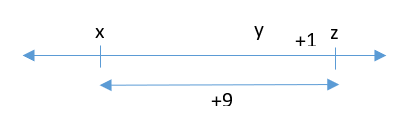
x + x + 8 < x + 9 + 5
2x + 8 < x + 14
x < 6
Maximum possible of x = 5, then y = 13
2x + y = 2(5) + 13 = 23
CAT 2018 Slot 2 Question 5- If a and b are integers such that 2x^2 – ax + 2 > 0 and x^2 – bx + 8 ≥ 0 for all real numbers x, then the largest possible value of 2a – 6b is
Explanation
Given that a and b are integers such that 2x2 − ax + 2 > 0 and x2 − bx + 8 ≥ 0 for all real numbers x
We have to find the largest possible value of 2a – 6b
Using the completion of squares method
2x2 − ax + 2 > 0 can be written as x2 – a/2x + 1 > 0
We know that (x – k )2 = x2 – 2kx + k2
Here we have a/2 = 2k or k = a/4
This a^2/16is added on both sides
⟹ x2 – a^2/16 + a^2/16 > a^2/16 – 1
⟹ (x – a/4)2 > a^2/16 – 1 [ this a^2/16 – 1 always holds good if it is negative or zero]
a^2/16 – 1 < 0
a2 < 16
a ∈(−4 , 4)
Since we have to find the largest value as possible and it cannot be 4 so a = 3
Similarly b can be found in the following way
x2 − bx + 8 ≥ 0
x2 − bx + b^2/4 ≥ b^2/4 – 8
x2 − bx + b^2/4 ≥ b^2/4 – 8 [b^2/4 = (b^2)2]
(x – b/2)2 ≥ b^2/4 – 32/4
b2 ≤ 32
b2 can go from -5 , -4 , -3 , -2 , -1 , 0 , 1 , 2 , 3 , 4 , 5
Since we have to find the largest possible value of 2a – 6b or b have to be very small so the smallest integer b can take -5
⟹ 2(3) – 6(-5)
⟹ 6 + 30 = 36
The largest possible value of 2a − 6b is 36
CAT 2017 Slot 1 Question 6-
For how many integers n, will the inequality (n – 5) (n – 10) – 3(n – 2) ≤ 0 be satisfied
Explanation
We have to find for how many integers n, will the inequality
(n – 5)(n – 10) – 3(n – 2) ≤ 0 be satisfied
(n – 5)(n – 10) – 3(n – 2) ≤ 0
n2 – 15n + 50 – 3n + 6 ≤ 0
n2 – 18n + 56 ≤ 0
(n – 4)(n – 14) ≤ 0
n = (4 , 5 , 6 , 7 , 8 , 9 , 10 , 11 , 12 , 13 , 14)
So n has to be between the two positive numbers 4 and 14 which is equal to 11.