Sixteen patients in a hospital must undergo a blood test for a disease. It is known that exactly one of them has the disease. The hospital has only eight testing kits and has decided to pool blood samples of patients into eight vials for the tests. The patients are numbered 1 through 16, and the vials are labelled A, B, C, D, E, F, G, and H. The following table shows the vials into which each patient’s blood sample is distributed
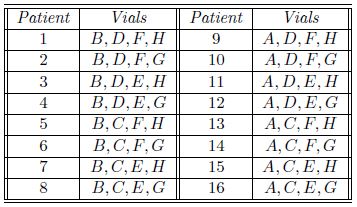
.
If a patient has the disease, then each vial containing his/her blood sample will test positive. If a vial tests positive, one of the patients whose blood samples were mixed in the vial has the disease. If a vial tests negative, then none of the patients whose blood samples were mixed in the vial has the disease.
Q.1Suppose vial C tests positive and vials A, E and H test negative. Which patient has the disease?
1) Patient 8
2) Patient 2
3) Patient 6
4) Patient 14
Q.2 Suppose vial A tests positive and vials D and G test negative. Which of the following vials should we test next to identify the patient with the disease?
1) Vial E
2) Vial H
3) Vial C
4) Vial B
Q.3 Which of the following combinations of test results is NOT possible?
1) Vials B and D positive, vials F and H negative2) Vials A and E positive, vials C and D negative3) Vials A and G positive, vials D and E negative4) Vial B positive, vials C, F and H negative
Q.4 Suppose one of the lab assistants accidentally mixed two patients’ blood samples before they were distributed to the vials. Which of the following correctly represents the set of all possible numbers of positive test results out of the eight vials?
1) {5, 6, 7, 8}
2) {4, 5, 6, 7}
3) {4, 5}
4) {4, 5, 6, 7, 8
Let’s solve questions 17 to 20 step by step using the vial-patient mapping from the images.
✅ Q.17
Given:
- Vial C tests positive
- Vials A, E, H test negative
Rule:
- A vial tests negative ⇒ all patients in that vial are disease-free
- The patient with the disease must be in vial C, but not in A, E, or H.
Step-by-step:
- Vial C patients = 5, 6, 7, 8, 13, 14, 15, 16
- Vial A patients = 9–16
→ Eliminate: 9 to 16 - Vial E patients = 3, 4, 7, 8, 11, 12, 15, 16
→ Eliminate: 3, 4, 7, 8, 11, 12, 15, 16 - Vial H patients = 1, 3, 5, 7, 9, 11, 13, 15
→ Eliminate: 1, 3, 5, 7, 9, 11, 13, 15
Now intersect:
- In C, but not in A, E, H
→ Left with Patient 6
✅ Answer: (3) Patient 6
✅ Q.18
Given:
- Vial A = positive
- Vials D, G = negative
→ Need to test 1 more vial to identify patient
Step-by-step:
- Vial A has: 9, 10, 11, 12, 13, 14, 15, 16
- D negative ⇒ eliminate: 1–6, 9–12
- G negative ⇒ eliminate: 2, 4, 6, 8, 10, 12, 14, 16
Now, patient must be:
- In A = 9–16
- Not in D (eliminate 9–12) → left with 13–16
- Not in G (eliminate 10,12,14,16) → left with 13, 15
→ Disease is in Patient 13 or 15
Now check: which vial distinguishes 13 and 15?
- Patient 13: vials A, C, F, H
- Patient 15: vials A, C, E, H
→ Difference = vial F vs E
So test either E or F
✅ Answer: (1) Vial E
✅ Q.19
Which combination is not possible?
Let’s check each:
Option 2:
A & E positive, C & D negative
C negative ⇒ eliminate 5–8,13–16
D negative ⇒ eliminate 1–6, 9–12
→ Eliminated: 1–8, 9–12, 13–16 ⇒ all 16 patients!
Contradiction. No one left.
❌ Option 2 is NOT possible
✅ Answer: (2) A & E positive, C & D negative
✅ Q.20
One lab assistant mixed 2 patients’ blood
⇒ A vial may show positive if either patient’s blood is present.
So, if both are mixed and one is positive, then all vials having either patient will test positive.
Each patient is in 4 vials
Maximum distinct vials when combined:
- Some overlap, so at most 8 vials
Now count how many positive vials possible if 2 patients are mixed:
Try a few pairs:
- Patient 1 (B,D,F,H), Patient 3 (B,D,E,H) → union = B,D,E,F,H → 5 vials
- Patient 4 (B,D,E,G), Patient 5 (C,F,G) → union = B,C,D,E,F,G → 6 vials
- Patient 6 (B,C,F,G), Patient 15 (A,C,E,H) → union = A,B,C,E,F,G,H → 7 vials
- Patient 9 (A,D,F,H), Patient 14 (A,C,F,G) → union = A,C,D,F,G,H → 6 vials
- Patient 13 (A,C,F,H), Patient 11 (A,D,E,H) → union = A,C,D,E,F,H → 6 vials
- Patient 7 (B,C,E,G), Patient 12 (A,D,E,H) → union = A,B,C,D,E,G,H → 7
- Patient 5 (C,F,G), Patient 15 (A,C,E,H) → A,C,E,F,G,H → 6
Now test max:
- Try Patient 6 (B,C,F,G) + 15 (A,C,E,H) → union = A,B,C,E,F,G,H → 7 vials
- Try Patient 6 + 13 (A,C,F,H) → union = A,B,C,F,G,H → 6
Max = 8 (if completely disjoint vials)
Try Patient 1 (B,D,F,H) and 15 (A,C,E,H) → union = A,B,C,D,E,F,H → 7
Try 1 + 6 → B,C,D,F,G,H → 6
Try 5 (C,F,G) and 15 → A,C,E,F,G,H → 6
But if we pick 2 patients with no overlapping vials, their union covers 8 vials
→ So possible positive counts = number of vials containing either patient = depends on overlap
Minimum overlap ⇒ 8
Max overlap (same person) = 4
So possible values: 4, 5, 6, 7, 8
✅ Answer: (4) {4, 5, 6, 7, 8}
✅ Final Answers Recap:
| Q | Answer | Explanation |
|---|---|---|
| 17 | (3) Patient 6 | Only patient in C, but not in A, E, or H |
| 18 | (1) Vial E | Distinguishes between Patient 13 and 15 |
| 19 | (2) A and E positive, C and D negative | Not possible (eliminates all patients) |
| 20 | (4) {4, 5, 6, 7, 8} | Range of possible vial positives due to mixing |