
Slots CAT 2024 DILR Teeny Wordy Arrangement G Strategy
The numbers 1, 2, 3, 4, 5, 6, 7, 8, 9, and 10 are placed in ten slots of the following grid based on the conditions below.
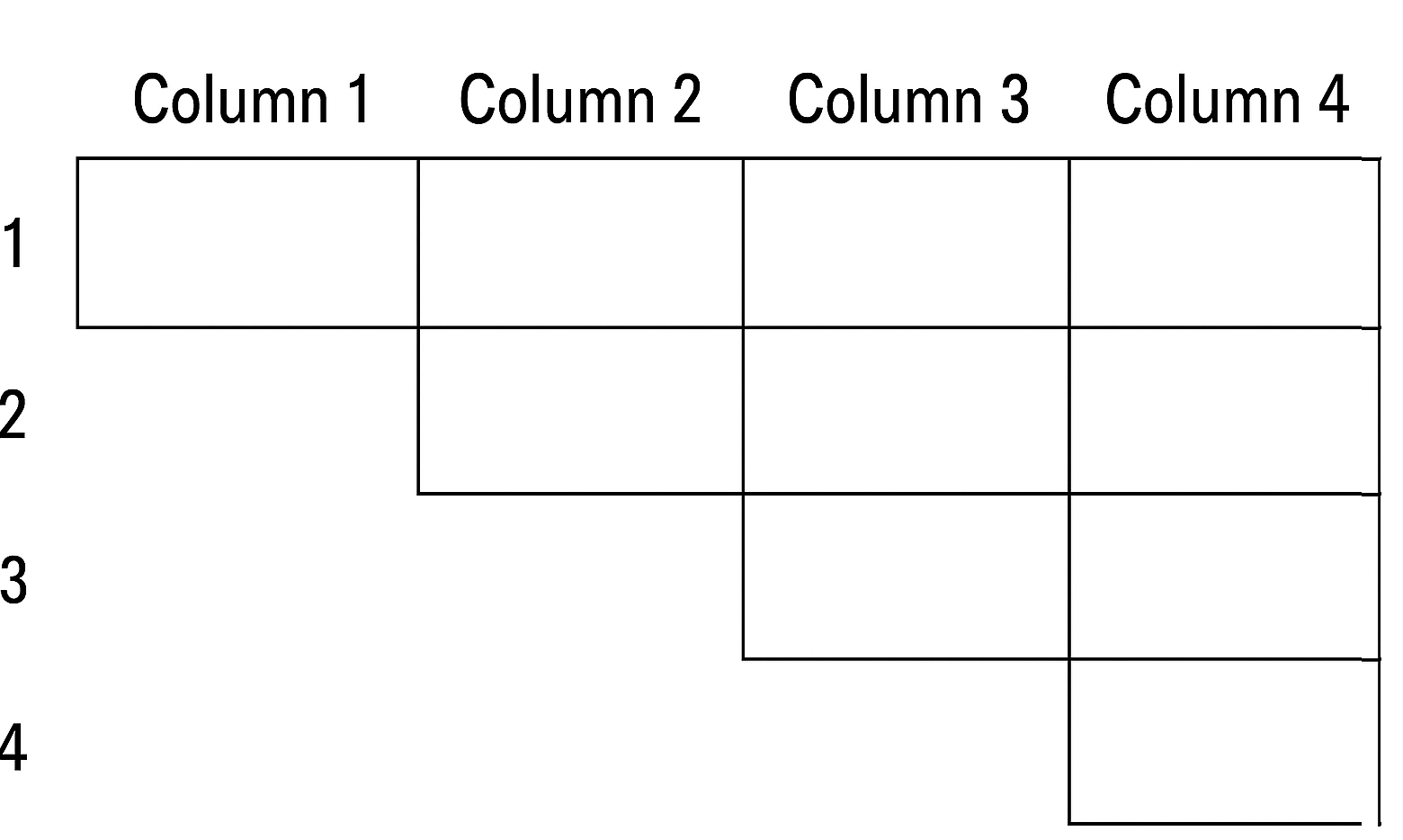
- Numbers in any row appear in an increasing order from left to right.
- Numbers in any column appear in a decreasing order from top to bottom.
- 1 is placed either in the same row or in the same column as 10.
- Neither 2 nor 3 is placed in the same row or in the same column as 10.
- Neither 7 nor 8 is placed in the same row or in the same column as 9.
- 4 and 6 are placed in the same row.
Q. 1 What is the row number which has the least sum of numbers placed in that row?
Q. 2 Which of the following statements MUST be true?
I. 10 is placed in a slot in Row 1.
II. 1 is placed in a slot in Row 4.
1) Only I 2) Both I and II 3) Only II 4) Neither I nor II
Q. 3 Which of the following statements MUST be true?
I. 2 is placed in a slot in Column 2.
II. 3 is placed in a slot in Column 3.
1) Both I and II 2) Neither I nor II 3) Only II 4) Only I
Q. 4 For how many slots in the grid, placement of numbers CANNOT be determined with certainty?
Q. 5 What is the sum of the numbers placed in Column 4?
Here is the final arrangement of the numbers from the last table in text format:
Using the final diagram provided, let's first extract the grid and then solve all 5 questions based on the constraints.
✅ Final Grid from Image
| Row \ Column | Column 1 | Column 2 | Column 3 | Column 4 |
|---|---|---|---|---|
| Row 1 | 4 | 6 | 9 | 10 |
| Row 2 | 2/3 | 5 | 8 | |
| Row 3 | 2/3 | 7 | ||
| Row 4 | 1 |
📌 Note: 2 and 3 are in Row 2 & Row 3, but which is where is uncertain. Either could be in Row 2 or Row 3.
All other numbers are fixed.
🔍 Let's now solve the 5 questions.
Q1. What is the row number which has the least sum of numbers placed in that row?
Let’s calculate row sums:
- Row 1: 4 + 6 + 9 + 10 = 29
- Row 2: (2 or 3) + 5 + 8 = 15 or 16
- Row 3: (2 or 3) + 7 = 9 or 10
- Row 4: 1
✅ Answer: Row 4 has the least sum (1)
Q2. Which of the following statements MUST be true?
I. 10 is placed in a slot in Row 1 → True (Row 1, Col 4)
II. 1 is placed in a slot in Row 4 → True (Row 4, Col 4)
✅ Answer: 2) Both I and II
Q3. Which of the following statements MUST be true?
I. 2 is placed in a slot in Column 2
II. 3 is placed in a slot in Column 3
Let’s consider both cases for 2 and 3:
- If 2 is in Row 2, it is in Column 2 → True
→ then 3 is in Row 3, Column 3 → True - If 2 is in Row 3, it is in Column 3 → False for I
→ then 3 is in Row 2, Column 2 → False for II
So neither statement is guaranteed to be true in all cases.
✅ Answer: 2) Neither I nor II
Q4. For how many slots in the grid, placement of numbers CANNOT be determined with certainty?
All values are fixed except:
- Two cells: Row 2, Col 2 and Row 3, Col 3 → either has 2 or 3.
So exactly 2 slots are uncertain.
✅ Answer: 2
Q5. What is the sum of the numbers placed in Column 4?
Column 4 has: 10, 8, 7, 1
→ Total = 10 + 8 + 7 + 1 = 26
✅ Answer: 26
✅ Final Answers Recap:
| Q# | Answer |
|---|---|
| Q1 | Row 4 |
| Q2 | 2) Both I and II |
| Q3 | 2) Neither I nor II |
| Q4 | 2 |
| Q5 | 26 |
Let me know if you want a visual version of the solution summary!