CAT CET SNAP NMAT CMAT XAT

Research Papers | CAT 2025 DILR Slot 1 | Teeny Numbers | Hard

Research Papers | Teeny Numbers | CAT 2025 DILR Slot 2 | Hard

The following charts depict details of research papers written by four authors, Arman, Brajen, Chintan, and Devon. The papers were of four types, single-author, two-author, three-author, and four-author, that is, written by one, two, three, or all four of these authors, respectively. No other authors were involved in writing these papers.
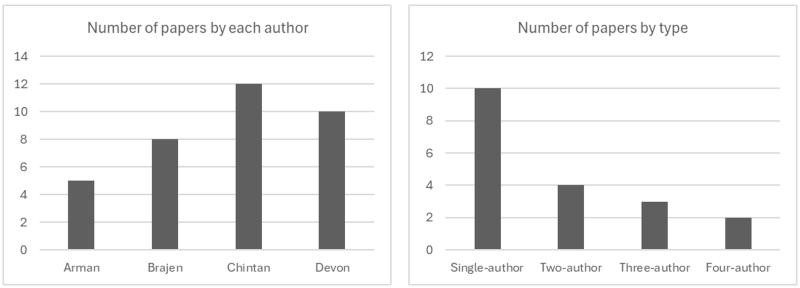
The following additional facts are known.

1. Each of the authors wrote at least one of each of the four types of papers.

2. The four authors wrote different numbers of single-author papers.

3. Both Chintan and Devon wrote more three-author papers than Brajen.

4. The number of single-author and two-author papers written by Brajen were the same.

What was the total number of two-author and three-author papers written by Brajen? Moderate_______

Answer & Explanation

Correct Answer: 4

From the given information and the graphs, Brajen wrote a total of 8 papers. Since there were two four-author papers and every author must have contributed to all four-author papers, Brajen wrote exactly 2 four-author papers. Hence, the remaining papers written by Brajen are 8 − 2 = 6.

It is given that Brajen wrote the same number of single-author and two-author papers. Trying possible splits of these 6 remaining papers, the only feasible distribution satisfying at least one paper of each type is:

2 single-author papers, 2 two-author papers, 2 three-author papers.

Thus, the total number of two-author and three-author papers written by Brajen is: 2 + 2 = 4.

Table Steps

Initial Working Table (Blank – from graphs only)

AuthorSingleTwo-authorThree-authorFour-authorTotal
Arman????5
Brajen????8
Chintan????12
Devon????10
Total1043235

(Source: Author bar graph + Paper-type bar graph)

Step 1

Total paper contributions =
1×10 (single-author) + 2×4 (two-author) + 3×3 (three-author) + 4×2 (four-author) = 35 → matches total author-wise papers 5 + 8 + 12 + 10 = 35
(Source: Paper-type bar graph + Author bar graph)

Step 2

There are exactly 2 four-author papers → all four authors must have written both → each author has exactly 2 four-author papers
(Source: Paper-type bar graph)

Table after Step 2

AuthorSingleTwo-authorThree-authorFour-authorTotal
Arman???25
Brajen???28
Chintan???212
Devon???210
Total1043235

Step 3

Subtract four-author papers from each author’s total:
Arman: 5 − 2 = 3
Brajen: 8 − 2 = 6
Chintan: 12 − 2 = 10
Devon: 10 − 2 = 8
(Source: Author bar graph + Step 2)

(These are working totals for single + two + three-author papers.)

Step 4

Brajen wrote the same number of single-author and two-author papers →
2 × (single-author of Brajen) + (three-author of Brajen) = 6 → only feasible split:
single = 2, two-author = 2, three-author = 2
(Source: Fact 4 + Step 3)

Table after Step 4

AuthorSingleTwo-authorThree-authorFour-authorTotal
Arman???25
Brajen22228
Chintan???212
Devon???210
Total1043235

Step 5

Arman must have written at least one of each type and has only 3 papers remaining → forced split:
1 single, 1 two-author, 1 three-author
(Source: Fact 1 + Step 3)

Table after Step 5

AuthorSingleTwo-authorThree-authorFour-authorTotal
Arman11125
Brajen22228
Chintan???212
Devon???210
Total1043235

Step 6

All authors wrote different numbers of single-author papers →
Arman = 1, Brajen = 2 → remaining single-author papers = 10 − (1 + 2) = 7 → only possible distinct split for Chintan and Devon is {3, 4}
(Source: Fact 2 + Single-author total from graph)

Step 7

Total three-author papers = 3 → total three-author contributions = 9 →
Arman contributes 1, Brajen contributes 2 → remaining contributions = 6 for Chintan and Devon
(Source: Paper-type bar graph + Steps 4 and 5)

Step 8

Chintan and Devon each wrote more three-author papers than Brajen (who wrote 2) → both must have written at least 3 → hence:
three-author of Chintan = 3, three-author of Devon = 3
(Source: Fact 3 + Step 7)

AuthorSingleTwo-authorThree-authorFour-authorTotal
Arman11125
Brajen22228
Chintan??3212
Devon??3210
Total1043235

Step 9

Since Chintan and Devon appear in all three three-author papers, every three-author paper must include both → only possible groups are
{Arman, Chintan, Devon} (1 paper) and {Brajen, Chintan, Devon} (2 papers)
(Source: Logical consequence of Step 8)

Step 10

Compute remaining two-author papers using row totals:

Case 1: Chintan single = 3, Devon single = 4 → Chintan two-author = 4, Devon two-author = 1

Case 2: Chintan single = 4, Devon single = 3 → Chintan two-author = 3, Devon two-author = 2

(Source: Step 3 + Step 6 + arithmetic consistency)

Step 11

Since both Case 1 and Case 2 satisfy all graphs and facts, statements assuming a fixed comparison between Chintan and Devon or a fixed two-author count for Chintan are not necessarily true
(Source: Deduction from Step 10)

Step 12

If Devon wrote more than one two-author paper → Case 1 is eliminated → only Case 2 remains → Chintan wrote exactly 3 two-author papers
(Source: Question 4 condition + Step 10)

Final Working Table

AuthorSingleTwo-authorThree-authorFour-authorTotal
Arman11125
Brajen22228
Chintan433212
Devon323210
Total1043235

Which of the following statements is/are NECESSARILY true? Hard

i. Chintan wrote exactly three two-author papers.

ii. Chintan wrote more single-author papers than Devon.

1. Only i

2. Only ii

3. Both i and ii

4. Neither i nor ii

Answer & Explanation

Correct Option: 4 – Neither i nor ii

From the completed deductions, two globally consistent cases are possible:

Case 1: Chintan wrote 3 single-author and 4 two-author papers, while Devon wrote 4 single-author and 1 two-author paper.

Case 2: Chintan wrote 4 single-author and 3 two-author papers, while Devon wrote 3 single-author and 2 two-author papers.

In Case 1, statement (i) is false and statement (ii) is false.

In Case 2, statement (i) is true and statement (ii) is true.

Since neither statement holds true in all possible valid cases, neither statement is necessarily true.

Table Steps

Initial Working Table (Blank – from graphs only)

AuthorSingleTwo-authorThree-authorFour-authorTotal
Arman????5
Brajen????8
Chintan????12
Devon????10
Total1043235

(Source: Author bar graph + Paper-type bar graph)

Step 1

Total paper contributions =
1×10 (single-author) + 2×4 (two-author) + 3×3 (three-author) + 4×2 (four-author) = 35 → matches total author-wise papers 5 + 8 + 12 + 10 = 35
(Source: Paper-type bar graph + Author bar graph)

Step 2

There are exactly 2 four-author papers → all four authors must have written both → each author has exactly 2 four-author papers
(Source: Paper-type bar graph)

Table after Step 2

AuthorSingleTwo-authorThree-authorFour-authorTotal
Arman???25
Brajen???28
Chintan???212
Devon???210
Total1043235

Step 3

Subtract four-author papers from each author’s total:
Arman: 5 − 2 = 3
Brajen: 8 − 2 = 6
Chintan: 12 − 2 = 10
Devon: 10 − 2 = 8
(Source: Author bar graph + Step 2)

(These are working totals for single + two + three-author papers.)

Step 4

Brajen wrote the same number of single-author and two-author papers →
2 × (single-author of Brajen) + (three-author of Brajen) = 6 → only feasible split:
single = 2, two-author = 2, three-author = 2
(Source: Fact 4 + Step 3)

Table after Step 4

AuthorSingleTwo-authorThree-authorFour-authorTotal
Arman???25
Brajen22228
Chintan???212
Devon???210
Total1043235

Step 5

Arman must have written at least one of each type and has only 3 papers remaining → forced split:
1 single, 1 two-author, 1 three-author
(Source: Fact 1 + Step 3)

Table after Step 5

AuthorSingleTwo-authorThree-authorFour-authorTotal
Arman11125
Brajen22228
Chintan???212
Devon???210
Total1043235

Step 6

All authors wrote different numbers of single-author papers →
Arman = 1, Brajen = 2 → remaining single-author papers = 10 − (1 + 2) = 7 → only possible distinct split for Chintan and Devon is {3, 4}
(Source: Fact 2 + Single-author total from graph)

Step 7

Total three-author papers = 3 → total three-author contributions = 9 →
Arman contributes 1, Brajen contributes 2 → remaining contributions = 6 for Chintan and Devon
(Source: Paper-type bar graph + Steps 4 and 5)

Step 8

Chintan and Devon each wrote more three-author papers than Brajen (who wrote 2) → both must have written at least 3 → hence:
three-author of Chintan = 3, three-author of Devon = 3
(Source: Fact 3 + Step 7)

AuthorSingleTwo-authorThree-authorFour-authorTotal
Arman11125
Brajen22228
Chintan??3212
Devon??3210
Total1043235

Step 9

Since Chintan and Devon appear in all three three-author papers, every three-author paper must include both → only possible groups are
{Arman, Chintan, Devon} (1 paper) and {Brajen, Chintan, Devon} (2 papers)
(Source: Logical consequence of Step 8)

Step 10

Compute remaining two-author papers using row totals:

Case 1: Chintan single = 3, Devon single = 4 → Chintan two-author = 4, Devon two-author = 1

Case 2: Chintan single = 4, Devon single = 3 → Chintan two-author = 3, Devon two-author = 2

(Source: Step 3 + Step 6 + arithmetic consistency)

Step 11

Since both Case 1 and Case 2 satisfy all graphs and facts, statements assuming a fixed comparison between Chintan and Devon or a fixed two-author count for Chintan are not necessarily true
(Source: Deduction from Step 10)

Step 12

If Devon wrote more than one two-author paper → Case 1 is eliminated → only Case 2 remains → Chintan wrote exactly 3 two-author papers
(Source: Question 4 condition + Step 10)

Final Working Table

AuthorSingleTwo-authorThree-authorFour-authorTotal
Arman11125
Brajen22228
Chintan433212
Devon323210
Total1043235

Which of the following statements is/are NECESSARILY true? Hard

i. Arman wrote three-author papers only with Chintan and Devon.

ii. Brajen wrote three-author papers only with Chintan and Devon.

1. Both i and ii

2. Only i

3. Neither i or ii

4. Only ii

Answer & Explanation

Correct Option: 1 – Both i and ii

There are exactly three three-author papers in total. From earlier deductions:

Arman wrote exactly one three-author paper.

Brajen wrote exactly two three-author papers.

Chintan and Devon each wrote three three-author papers.

This implies that Chintan and Devon appear in all three three-author papers. Hence, every three-author paper must include both Chintan and Devon. The only feasible three-author combinations are therefore:

{Arman, Chintan, Devon} – one paper

{Brajen, Chintan, Devon} – two papers

Thus: Arman’s only three-author paper is with Chintan and Devon. Brajen’s three-author papers are also only with Chintan and Devon. Both statements are necessarily true.

Table Steps

Initial Working Table (Blank – from graphs only)

AuthorSingleTwo-authorThree-authorFour-authorTotal
Arman????5
Brajen????8
Chintan????12
Devon????10
Total1043235

(Source: Author bar graph + Paper-type bar graph)

Step 1

Total paper contributions =
1×10 (single-author) + 2×4 (two-author) + 3×3 (three-author) + 4×2 (four-author) = 35 → matches total author-wise papers 5 + 8 + 12 + 10 = 35
(Source: Paper-type bar graph + Author bar graph)

Step 2

There are exactly 2 four-author papers → all four authors must have written both → each author has exactly 2 four-author papers
(Source: Paper-type bar graph)

Table after Step 2

AuthorSingleTwo-authorThree-authorFour-authorTotal
Arman???25
Brajen???28
Chintan???212
Devon???210
Total1043235

Step 3

Subtract four-author papers from each author’s total:
Arman: 5 − 2 = 3
Brajen: 8 − 2 = 6
Chintan: 12 − 2 = 10
Devon: 10 − 2 = 8
(Source: Author bar graph + Step 2)

(These are working totals for single + two + three-author papers.)

Step 4

Brajen wrote the same number of single-author and two-author papers →
2 × (single-author of Brajen) + (three-author of Brajen) = 6 → only feasible split:
single = 2, two-author = 2, three-author = 2
(Source: Fact 4 + Step 3)

Table after Step 4

AuthorSingleTwo-authorThree-authorFour-authorTotal
Arman???25
Brajen22228
Chintan???212
Devon???210
Total1043235

Step 5

Arman must have written at least one of each type and has only 3 papers remaining → forced split:
1 single, 1 two-author, 1 three-author
(Source: Fact 1 + Step 3)

Table after Step 5

AuthorSingleTwo-authorThree-authorFour-authorTotal
Arman11125
Brajen22228
Chintan???212
Devon???210
Total1043235

Step 6

All authors wrote different numbers of single-author papers →
Arman = 1, Brajen = 2 → remaining single-author papers = 10 − (1 + 2) = 7 → only possible distinct split for Chintan and Devon is {3, 4}
(Source: Fact 2 + Single-author total from graph)

Step 7

Total three-author papers = 3 → total three-author contributions = 9 →
Arman contributes 1, Brajen contributes 2 → remaining contributions = 6 for Chintan and Devon
(Source: Paper-type bar graph + Steps 4 and 5)

Step 8

Chintan and Devon each wrote more three-author papers than Brajen (who wrote 2) → both must have written at least 3 → hence:
three-author of Chintan = 3, three-author of Devon = 3
(Source: Fact 3 + Step 7)

AuthorSingleTwo-authorThree-authorFour-authorTotal
Arman11125
Brajen22228
Chintan??3212
Devon??3210
Total1043235

Step 9

Since Chintan and Devon appear in all three three-author papers, every three-author paper must include both → only possible groups are
{Arman, Chintan, Devon} (1 paper) and {Brajen, Chintan, Devon} (2 papers)
(Source: Logical consequence of Step 8)

Step 10

Compute remaining two-author papers using row totals:

Case 1: Chintan single = 3, Devon single = 4 → Chintan two-author = 4, Devon two-author = 1

Case 2: Chintan single = 4, Devon single = 3 → Chintan two-author = 3, Devon two-author = 2

(Source: Step 3 + Step 6 + arithmetic consistency)

Step 11

Since both Case 1 and Case 2 satisfy all graphs and facts, statements assuming a fixed comparison between Chintan and Devon or a fixed two-author count for Chintan are not necessarily true
(Source: Deduction from Step 10)

Step 12

If Devon wrote more than one two-author paper → Case 1 is eliminated → only Case 2 remains → Chintan wrote exactly 3 two-author papers
(Source: Question 4 condition + Step 10)

Final Working Table

AuthorSingleTwo-authorThree-authorFour-authorTotal
Arman11125
Brajen22228
Chintan433212
Devon323210
Total1043235

If Devon wrote more than one two-author papers, then how many two-author papers did Chintan write? Moderate ______

Answer & Explanation

Correct Answer: 3

From the two valid cases identified earlier:

In Case 1, Devon wrote only 1 two-author paper.

In Case 2, Devon wrote 2 two-author papers.

Given the condition that Devon wrote more than one two-author paper, Case 1 is eliminated. Only Case 2 remains valid.

In Case 2: Chintan wrote exactly 3 two-author papers.

Thus, under the given condition, the number of two-author papers written by Chintan is fixed and uniquely determined.

Table Steps

Initial Working Table (Blank – from graphs only)

AuthorSingleTwo-authorThree-authorFour-authorTotal
Arman????5
Brajen????8
Chintan????12
Devon????10
Total1043235

(Source: Author bar graph + Paper-type bar graph)

Step 1

Total paper contributions =
1×10 (single-author) + 2×4 (two-author) + 3×3 (three-author) + 4×2 (four-author) = 35 → matches total author-wise papers 5 + 8 + 12 + 10 = 35
(Source: Paper-type bar graph + Author bar graph)

Step 2

There are exactly 2 four-author papers → all four authors must have written both → each author has exactly 2 four-author papers
(Source: Paper-type bar graph)

Table after Step 2

AuthorSingleTwo-authorThree-authorFour-authorTotal
Arman???25
Brajen???28
Chintan???212
Devon???210
Total1043235

Step 3

Subtract four-author papers from each author’s total:
Arman: 5 − 2 = 3
Brajen: 8 − 2 = 6
Chintan: 12 − 2 = 10
Devon: 10 − 2 = 8
(Source: Author bar graph + Step 2)

(These are working totals for single + two + three-author papers.)

Step 4

Brajen wrote the same number of single-author and two-author papers →
2 × (single-author of Brajen) + (three-author of Brajen) = 6 → only feasible split:
single = 2, two-author = 2, three-author = 2
(Source: Fact 4 + Step 3)

Table after Step 4

AuthorSingleTwo-authorThree-authorFour-authorTotal
Arman???25
Brajen22228
Chintan???212
Devon???210
Total1043235

Step 5

Arman must have written at least one of each type and has only 3 papers remaining → forced split:
1 single, 1 two-author, 1 three-author
(Source: Fact 1 + Step 3)

Table after Step 5

AuthorSingleTwo-authorThree-authorFour-authorTotal
Arman11125
Brajen22228
Chintan???212
Devon???210
Total1043235

Step 6

All authors wrote different numbers of single-author papers →
Arman = 1, Brajen = 2 → remaining single-author papers = 10 − (1 + 2) = 7 → only possible distinct split for Chintan and Devon is {3, 4}
(Source: Fact 2 + Single-author total from graph)

Step 7

Total three-author papers = 3 → total three-author contributions = 9 →
Arman contributes 1, Brajen contributes 2 → remaining contributions = 6 for Chintan and Devon
(Source: Paper-type bar graph + Steps 4 and 5)

Step 8

Chintan and Devon each wrote more three-author papers than Brajen (who wrote 2) → both must have written at least 3 → hence:
three-author of Chintan = 3, three-author of Devon = 3
(Source: Fact 3 + Step 7)

AuthorSingleTwo-authorThree-authorFour-authorTotal
Arman11125
Brajen22228
Chintan??3212
Devon??3210
Total1043235

Step 9

Since Chintan and Devon appear in all three three-author papers, every three-author paper must include both → only possible groups are
{Arman, Chintan, Devon} (1 paper) and {Brajen, Chintan, Devon} (2 papers)
(Source: Logical consequence of Step 8)

Step 10

Compute remaining two-author papers using row totals:

Case 1: Chintan single = 3, Devon single = 4 → Chintan two-author = 4, Devon two-author = 1

Case 2: Chintan single = 4, Devon single = 3 → Chintan two-author = 3, Devon two-author = 2

(Source: Step 3 + Step 6 + arithmetic consistency)

Step 11

Since both Case 1 and Case 2 satisfy all graphs and facts, statements assuming a fixed comparison between Chintan and Devon or a fixed two-author count for Chintan are not necessarily true
(Source: Deduction from Step 10)

Step 12

If Devon wrote more than one two-author paper → Case 1 is eliminated → only Case 2 remains → Chintan wrote exactly 3 two-author papers
(Source: Question 4 condition + Step 10)

Final Working Table

AuthorSingleTwo-authorThree-authorFour-authorTotal
Arman11125
Brajen22228
Chintan433212
Devon323210
Total1043235

Register to Attend Free Workshop by Rav Sir

example, category, and, terms