The figure below shows the street map for a certain region with the street intersections marked from a through l. A person standing at an intersection can see along straight lines to other intersections that are in her line of sight and all other people standing at these intersections. For example, a person standing at intersection g can see all people standing at intersections b, c, e, f, h, and k. In particular, the person standing at intersection g can see the person standing at intersection e irrespective of whether there is a person standing at intersection f.
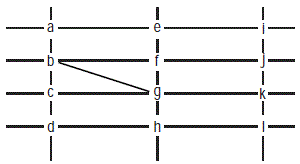
Six people U, V, W, X, Y, and Z, are standing at different intersections. No two people are standing at the same intersection.
The following additional facts are known.
1. X, U, and Z are standing at the three corners of a triangle formed by three street segments.
2. X can see only U and Z.
3. Y can see only U and W.
4. U sees V standing in the next intersection behind Z.
5. W cannot see V or Z.
6. No one among the six is standing at intersection d.
Let’s walk through how Case 5 (✅ the final valid configuration) was logically derived from the clues. We’ll go step-by-step, matching each clue to the grid and eliminating invalid placements.
🗺️ Grid Layout:
 a ─── e ─── i
 │    │    │
 b ─── f ─── j
 │    │    │
 c ─── g ─── k
 │    │    │
 d ─── h ─── l
👥 People: U, V, W, X, Y, Z
Each person must be placed at a unique intersection.
🔍 Step-by-step Clue Application:
🔎 Clue 1: X, U, and Z form a triangle using three street segments.
Only possible triangle on the grid is a right-angled one:
- X at b, Z at f, U at g
This forms:
- Segment 1: b — f (horizontal)
- Segment 2: f — g (vertical)
- Segment 3: g — b (diagonal via streets)
✅ So, X = b, Z = f, U = g
🔎 Clue 2: X can see only U and Z.
From b, X sees:
- Horizontally: a, f → f = Z ✅
- Vertically: c, d → empty
- Diagonals not counted unless straight streets
So, X at b can see:
- Z at f (right)
- U at g (down-right diagonal via f) ✅
- And no one else
✅ This fits the condition perfectly.
🔎 Clue 3: Y can see only U and W
So place Y where it can see only U (g) and W, and no one else.
- U is at g → look for intersections that can see g and one other person only (W).
Later we’ll determine that Y is at j, W is at l, so from j:
- Sees g (U) diagonally via h
- Sees l (W) horizontally
No one else in line of sight ✅
🔎 Clue 4: U sees V standing in the next intersection behind Z.
- Z is at f
- U is at g
The line is: f → g → k
So V must be at k — “behind Z from U’s perspective”
✅ V = k
🔎 Clue 5: W cannot see V or Z
V = k, Z = f
So W must be somewhere not in line with f or k
- Best location: l
- Sees j and h only — doesn’t see f or k
✅ W = l
🔎 Clue 6: No one is at intersection d
Easy to apply → d remains empty
✅ Done
🧩 Now complete the grid:
We’ve placed:
| Person | Location |
|---|---|
| X | b |
| Z | f |
| U | g |
| V | k |
| W | l |
Only person left: Y
Clue 3: Y sees only U and W
→ U = g, W = l
Try placing Y at j:
- From j, sees:
- l → W ✅
- g → U (via h) ✅
- f (Z) is blocked by wall → ✅
- Doesn’t see V (k) due to position
✅ Y = j
✅ Final Valid Configuration (Case 5):
| Person | Location |
|---|---|
| X | b |
| Z | f |
| U | g |
| V | k |
| W | l |
| Y | j |
🔒 All clues satisfied:
| Clue | Status | Why it holds |
|---|---|---|
| 1 | ✅ | X, U, Z at b, g, f form triangle |
| 2 | ✅ | X sees only U (g) and Z (f) |
| 3 | ✅ | Y at j sees only U (g) and W (l) |
| 4 | ✅ | U at g sees V at k, right behind Z at f |
| 5 | ✅ | W at l can’t see Z or V |
| 6 | ✅ | d is unoccupied |
Q1. Who is standing at intersection a?
Let’s look at Case 5 from the image again.
From the figure, intersection a is empty – no one is assigned there.
✅ Answer: 4) No one
Q2. Who can V see?
From the table:
- V is at
k
From the street map, a person at k can see:
- g (U), f (Z), j, l (horizontal and vertical lines)
Let’s check:
- g → U ✅
- f → Z ✅
- l → W ✅
- j → Y
But now check line of sight:
- From
ktojis blocked by intersectionl, where W is standing.
So k → j is blocked. V cannot see Y.
From Clue 4:
U sees V standing in the next intersection behind Z.
→ So line from Z → U → V should be along vertical path: f → g → k ✅
So:
- V can see U (at g) and Z (at f)
- Cannot see W (since W is at l, not in V’s line of sight due to position at corner)
✅ Answer: 1) U and Z only
Q3. Minimum number of street segments X must cross to reach Y
From the config:
- X is at
b - Y is at
j
Path from b to j:
→ b → c → g → h → j
btoc(horizontal) → 1ctog(vertical) → 2gtoh(horizontal) → 3htoj(vertical) → 4
✅ Answer: 2) 4
Q4. If a new person stands at intersection d, who would they see?
Intersection d is the bottom-left corner
From d, they can see:
- Vertical:
a,b,c - Horizontal:
e,h,l
Now check which people lie on these intersections:
- b → X ✅
- l → W ✅
Others:
- a → empty
- c → empty
- e, h → empty
So the person at d sees: X and W only
✅ Answer: 1) W and X only
✅ Final Answers Summary:
| Q | Question | Answer | Reason |
|---|---|---|---|
| 1 | Who is standing at intersection a? | 4) No one | From image Case 5, no one is at a |
| 2 | Who can V see? | 1) U and Z only | From k, line of sight reaches g (U) and f (Z) |
| 3 | Min segments X must cross to reach Y | 2) 4 | b → c → g → h → j = 4 segments |
| 4 | Who is visible from intersection d | 1) W and X only | d sees horizontal/vertical lines to b (X) and l (W) only |
Categorizing Route & Network Puzzle Questions and Solution Approaches
Logical reasoning puzzles involving routes, networks, and spatial layouts are common in exams like CAT/CSAT. We can segregate these questions by type and discuss the patterns and approaches to solve each type. Below are the major categories and the deep-dive strategies for each:
1. Route and Path-Finding Problems
These puzzles involve finding paths in a network of roads or routes, often asking for the number of distinct paths, the shortest distance or time, or an optimal route visiting multiple points. They typically provide a map or network diagram with nodes (cities, intersections, etc.) connected by edges (roads) with distances or directions.
Examples:
- Distinct path counting: CAT 2021 Routes – counting how many distinct ways to go from A to F on a directed network, possibly with conditions like avoiding a blocked node or including a certain node.
- Shortest route and travel planning: CSAT 2021 Road Distances – finding shortest paths between villages, or the shortest route that visits each village exactly once (a small Traveling Salesman problem).
- Grid distance puzzles: City Routes – computing straight-line distances using the Pythagorean theorem and road distances on a grid of sectors (e.g., distance from h to k, shortest path from a to g).
- Perimeter and path coverage: CAT 2024 Walkways – calculating the total length of outer perimeter paths in a gated area, or the longest walk without repeating a path.
- Route planning with constraints: CAT 2003 Rally Routes – scheduling political processions on city roads over two days such that routes don’t conflict (route selection under constraints).
Key Characteristics & Patterns:
- Represented by a graph (nodes and edges). May be directed (one-way streets) or undirected.
- Often ask for count of paths (combinatorial paths), shortest distance/time (optimization), or specific route order (sequence constraints).
- Constraints like closed roads, required stops, or no revisiting nodes introduce additional logic.
Approach to Solve Route/Path Problems:
- Visualize and Simplify the Network: Re-draw or label the graph clearly. Identify start and end points, and mark distances or directions on each edge.
- Path Counting: For counting distinct paths, use a systematic traversal. One approach is dynamic programming: start at the source and calculate the number of ways to each connected node. For example, in a directed acyclic graph, the number of paths to a node = sum of paths to its predecessors. Another approach is careful manual enumeration, ensuring you list paths without repetition.
- Example: In CAT 2021 Routes, list simple paths from A to F: start at A, explore each outgoing route depth-first, and track paths until F is reached. Use conditions (like “must pass through D” or “C is blocked”) to filter the list.
- Shortest Path Distance: Use shortest path algorithms logic for small networks by inspection. Calculate total distance/time of plausible routes and compare. Techniques include:
- Brute force for small graphs: enumerate all reasonable routes (especially if visiting multiple points like in CSAT road distances) and pick the minimum.
- Greedy or logical deduction: in a simple map, shortest path often avoids detours. Check direct vs. via intermediate nodes. Use given distances: sometimes the sum along one road equals another combination, etc.
- Dijkstra’s algorithm concept: incrementally find the shortest distance to each node from the start until the target is reached. (For exam puzzles, graphs are small enough to do this manually.)
- Example: In CSAT 2021 Road Distances, to find the shortest path from Pali to Neli when one road is under maintenance, compare alternate routes (Pali→Teli→Neli vs. Pali→Seli→Neli, etc.) and choose the least distance (36 km via Teli in that case).
- Visiting All Points (Tour Problems): These are like mini traveling salesman problems. Since the number of locations is small, try all permutations or apply logic: often a near-greedy approach works (go to nearest next). Ensure to return to start if required.
- Example: Raj’s route in CSAT 2021 visiting Neli, Teli, Seli from Pali: determine the only possible order that fits conditions (e.g., Pali–Teli–Neli–Seli–Pali with total 84 km as the minimal loop).
- Apply Constraints Carefully: If some road is blocked or a node must be included/excluded, eliminate those options and recalc. If two paths conflict in scheduling (like rally routes where two processions can’t share a road simultaneously), assign different days or sequences. This often turns into a constraint satisfaction problem:
- List out all route options for each entity.
- Use the constraints (no same road same day, specific road closed on Thursday, etc.) to eliminate invalid combinations.
- Sometimes a small table or matrix helps to slot routes into Day1/Day2 satisfying all conditions.
- Example: For Rally Routes (CAT 2003), first mark which procession routes share roads. Then schedule them on Thursday or Friday such that no two sharing a road land on the same day. Use the given clue that road B–D is unavailable on Thursday to further restrict placement.
Common Pitfalls & Tips:
- Missing Hidden Paths: In path counting, ensure you find all distinct routes. A systematic approach (like labeling intersections with the count of ways to get there) helps avoid missing or double-counting paths.
- Considering Via vs Direct: In distance problems, explicitly compare direct routes with going via intermediate points or even via the start (warehouse problems allow returning to base then out again if shorter). Always check if backtracking to a hub (like the warehouse or an intersection) yields a shorter path – many puzzles hide shorter “via” paths.
- Check Units and Conversions: Time-distance problems (like trains, cars) need consistent units (minutes vs hours, speeds). Convert and add correctly.
- Optimization vs Exhaustive: Small puzzles can often be solved by trying possibilities, but note conditions like “don’t revisit any node” or “each road at most once” which limit valid paths and simplify the search.
2. Network Flow and Distribution Problems
These involve moving quantities through a network or satisfying demand constraints. They often have a story of pipelines, traffic flow, or resource distribution with capacities and demands. The puzzle typically provides totals along certain lines (rows or columns) or at nodes, and sometimes partial flows, asking to deduce unknown flows or placements of values.
Examples:
- Pipeline flow distribution: CAT 2001 Pine Lines – a network of pipelines connecting locations (nodes) with certain demand at each node. Some flow values are given (e.g., Vaishali to Jyotishmati is 300 units) and capacities. The questions involve finding how much each source sends, which pipeline is at max capacity, etc., given that demands are exactly met.
- Traffic flow with tolls: CAT 2006 Road Traffic Flow – a road network from S to T with multiple paths. Drivers choose the least costly path (fuel + toll). The puzzle sets tolls such that traffic distributes evenly or avoids certain roads. Questions ask for toll values to equalize route costs, or what happens if a junction is closed, etc.
- Resource placement on grid with totals: CAT 2024 Roads & ATMs – a 3×3 grid of intersections (like a mini city) where 6 ATMs are placed. The sum of ATM cash requirements on each road (each row and column) is given. We have distinct cash values to assign to positions such that row/col totals match. Clues give relationships (e.g., the min and max values are on the same row, a certain distance condition between two ATMs).
- Delivery demand fulfillment: CAT 2022 Warehouse Supplies – a central warehouse supplies four locations (A, B, C, D) with uncertain daily demand (given probabilities). The supplier plans a route each day in decreasing order of demand, choosing shortest paths between stops (direct road or via warehouse). Questions involve expected total demand delivered, route distances based on a day’s demand combination, probability of certain total demand and route ending, etc.
Key Characteristics & Patterns:
- Can be modeled as a flow network or a grid with sums. There are usually conservation laws: e.g., total outflow from source equals sum of demands, each node’s inflow minus outflow equals demand, etc.
- In grid distribution (like the ATM puzzle), it’s akin to a matrix logic puzzle where row and column sums are fixed and specific values must fit uniquely.
- Often a constraint satisfaction or linear equation system underlies the problem, but they’re designed to be solved with logical reasoning more than heavy computation.
- “Minimum/Maximum” flow or cost conditions appear: e.g., which pipeline carries maximum flow (identifying the largest number among flows), or ensuring minimum cost paths (drivers choose cheapest route in the toll problem).
Approach to Solve Network Flow/Distribution Problems:
- Translate into a Diagram/Matrix: Make sure the network is clearly drawn and all given numerical data (demands, totals, distances) are noted at the right places (on nodes or edges, as appropriate). For grid problems, draw the grid and mark row/column totals.
- Use Conservation Laws: If it’s a flow problem (like Pine Lines), apply flow conservation at junctions: for each node, inflow + supply = outflow + demand. Start with known values to deduce unknown ones.
- Identify the sources (where material originates) and sinks (demands). Usually, source output = sum of all demands (e.g., Avanti’s total output equals sum of all location demands in Pine Lines).
- Use given partial flows: e.g., Vaishali→Jyotishmati = 300 in Pine Lines gives a baseline to compute what Vaishali receives from Avanti and forwards, etc. Work step by step through the network logically.
- Check for constraints like capacity (though in Pine Lines, no capacity was binding since max flow on any pipeline was asked and one did reach capacity 1000).
- Assign Variables/Systematic Trial: In distribution puzzles like the ATM grid, assign variables to unknown placements and write equations for each row and column total. Then use given clues to narrow possibilities:
- Distinct values: List the distinct cash values that must be placed (e.g., 7, 8, 9, 11, 12, 15 lakhs in the ATM puzzle). The highest and lowest being on the same row (clue) drastically limits which row can have both while still satisfying the sum for that row.
- Solve stepwise: find which row can host min & max without exceeding its total (R-A was the only option for 7 and 15 in one case). Then fill the remaining values to satisfy other row totals. Often there are only one or two consistent solutions; check each against all clues.
- Use elimination: if a tentative assignment violates a clue or sum, backtrack and try the alternative.
- Equate Path Costs for Equilibrium: In toll/traffic flow puzzles, set up equations where the total cost of certain routes are equal if traffic is to split between them, or one is higher to deter traffic.
- For CAT 2006 Road Traffic (toll), first compute base fuel costs for each path from S to T. Then use conditions: (Fact 1) motorists pick minimum cost route; (Fact 2) if multiple least-cost routes, traffic splits; (Fact 3) tolls can adjust costs.
- To ensure all motorists pay the same total regardless of route, set all least-cost route costs equal by adding tolls appropriately. This yields equations like: Cost(S–A–T) = Cost(S–B–C–T) = Cost(S–D–T) = … and so on. Solve for toll values that satisfy all required equalities.
- Apply any special conditions (road closed means that route isn’t available, etc.) and re-calculate if needed.
- Use Probability/Expectation for Demand Scenarios: In puzzles like Warehouse Supplies with probabilities, use expected value formulas and careful case analysis:
- Expected demand at a location = Σ(value × probability). For instance, expected demand at C = 70×0.3 + 100×0.7 = 91 units.
- For scenarios: list possible demand combinations that meet criteria (like total 260 units) and calculate each scenario’s probability by multiplying individual location probabilities. Sum them if needed.
- For route planning: given a specific day’s demands, determine the visit order (highest demand first) and then compute distance. Always compare direct distance between locations vs via warehouse if the puzzle allows going through W (the rule was “whichever path is shorter”). This can lead to non-obvious routes (sometimes returning to W can be shorter between two far-apart locations).
- Tip: Make a small table of distances: direct distances between every pair of locations (if given or can be derived) and via warehouse distances (Location1→W + W→Location2). Mark the shorter of the two for each pair – this helps quickly determine actual travel distances on the route.
Common Pitfalls & Tips:
- Overcomplicating math: These puzzles are designed so that simple logical reasoning or plugging small integers works. If you find yourself writing too many equations, step back and look for a logical insight or constraint to simplify.
- Unique vs Multiple Solutions: Some distribution puzzles have a unique solution (all values fixed), while others might have two possibilities that fit all clues. The question might ask for something that’s true in both possibilities. For example, in the Roads & ATMs puzzle, two arrangements of ATM values fit all clues – the question specifically asked for something like “which statement is definitely true?” implying we check both valid cases for a common truth. Always verify whether the question needs a single answer or if multiple configurations are possible.
- Boundary conditions: In flow networks, check extremes (min or max flows). E.g., which pipeline “carries the maximum possible capacity” – look for any edge that hits its capacity limit given the solved flows. Or if reducing flow somewhere, see how it must increase elsewhere to meet demand.
- Units and interpretation: If a clue says “distance between ATM X and ATM Y is 12 km”, be careful: this is road distance along the given grid, not direct Euclidean distance unless specified. Follow the roads and count kilometers, considering the Manhattan path (vertical + horizontal segments). Similarly, “road distance between second highest ATM and the ATM at (R-C, V3) is 12 km” implies follow the grid lines, not a straight line.
3. Scheduling and Frequency Problems
These puzzles revolve around time schedules, frequencies of service, and synchronization. They often present multiple routes or services running at different intervals and impose constraints about simultaneous usage or resource limits. The challenge is to figure out consistent schedules or counts of events in a time window.
Examples:
- Bus departure schedules: CAT 2015 Bus Routes – six bus routes with specific intervals (10, 12, 15, 20, 30 minutes etc.), each heading to certain destinations. Constraints include: no two buses to same destination start together; if two different routes to same destination coincide, the one with shorter interval skips that departure; and various clues linking routes to destinations and intervals. Questions ask maximum buses that can depart together, how many buses to Mehrauli in an hour, etc., given these rules.
- Train timetable and travel time: CAT 2022 Metro Stations – a city metro with East-West and North-South lines. Given travel times between stations (2 min per station E-W, 3 min N-S) and stoppage times (2 min at junctions, 1 min at others), plus schedule frequency (every 10 min on E-W lines, 15 min on N-S lines from 6 AM to midnight). Questions include: how long from one station to another, earliest arrival if you catch a certain train, how many departures from a terminal in a day, etc. Some require route planning with transfers (via junction station R), or the number of trains needed to maintain the schedule with rest requirements.
- Car route timing with congestion: CAT 2017 Car Routes – Four cars from A to B, with two possible paths (via M or N). Travel time per segment increases with more cars on it (congestion effect). The police assign routes to minimize each car’s travel time such that no single car can unilaterally switch route and improve its time (essentially a Nash equilibrium). Questions involve determining how many cars go on each route (A–M–B vs A–N–B) and the travel times, then adding a new road (M–N) and reassigning routes (A–M–N–B as third option). This is a scheduling/allocation puzzle combined with optimization.
- Flight scheduling and connectivity: CAT 2017 Flight Schedule – 10 cities, want morning-evening round trips for any city pair in a day. First, if every trip must be direct, how many flights needed (complete graph calculation). Then introducing 3 hub cities that connect to all others (flights only originate/end at hubs), asking for minimum flights to still reach anywhere with at most one stop. Another variant divides cities into groups with specific allowed connections (A to all in G2, B to all in G3, etc.) and asks for minimum flights for connectivity and how many flights can be reduced if one hub gets restricted. These are essentially graph connectivity problems framed as scheduling (morning and evening flights considered separately).
Key Characteristics & Patterns:
- Involve time intervals, cycles, or frequency. Often one needs to compute how many cycles fit in a period (e.g., departures in 18 hours), or the alignment of cycles (buses coinciding).
- Constraints about conflicts when events coincide (like buses skipping when times clash) introduce a layer of logical conditions beyond simple multiples of intervals.
- Often require finding a steady-state assignment (e.g., distributing cars on routes such that no one can reduce travel time by switching, which is like finding equilibrium).
- Some are essentially combinatorial designs (flight connections ensuring two-hop connectivity is enough for all pairs, or dividing routes among days to avoid conflict like rally routes which also fits here).
Approach to Solve Scheduling/Frequency Problems:
- Compute Cycle Alignment and Frequency: Determine how often events repeat and list a timeline for a representative period (like an hour or the full operating window).
- For bus intervals, a good strategy is to find the Least Common Multiple (LCM) of the intervals to understand when they coincide. However, due to rule (ii) in the bus puzzle (shorter interval bus skips if clash), direct LCM usage must be adjusted by that rule. Alternatively, simulate minute-by-minute (or use multiples of 1 minute as given) for one full cycle of all buses.
- Example: In Bus Routes, intervals might be assigned to specific routes/destinations by clues. Once you deduce which route has which interval and which destination, you can simulate departures. For instance, if two Uttam Nagar buses have 10 min and 15 min frequencies, they coincide every 30 min; the 10-min one would skip those times, effectively making its actual departures uneven. Counting departures in an hour requires careful inclusion/exclusion of those skipped times.
- For the Metro trains, calculate the travel time for a given route by summing segment times and stop times. To get the schedule: if first train is at 6:00 AM and frequency 10 min, then departures are at 6:00, 6:10, … until 12:00 AM. Count how many occurrences (e.g., 6 per hour * 18 hours = 108 trips from each terminal). Ensure you count both directions if needed or just one terminal’s departures as asked.
- Translate Word Conditions to Equations: In puzzles like the car route assignment with congestion (CAT 2017 Car Routes), convert the situation to equations or inequalities:
- Determine time formulas: e.g., on A→M segment: base 6 min for one car + 3 min per additional car, so *T(k) = 6 + 3(k–1)**. Do similarly for other segments (they gave those formulas).
- If X cars on one path and Y on another, write total travel time for a car on each path in terms of X and Y. The equilibrium condition “no car can reduce its time by switching” means the travel times on all used routes are equal, and any unused route would be longer. Set up equalities for used routes and inequalities for unused. Solve for integer numbers of cars.
- Example: Initially 2 routes (A–M–B and A–N–B) for 4 cars: let
xcars via M and4–xvia N. Solve T_M(x) = T_N(4–x) to balance times. With formulas: (6+3*(x–1)) + (20+0.9*(x–1)) = (20+1*((4–x)–1)) + (6+3*((4–x)–1)). Solve for x (which came out to 2 in that scenario). Then confirm stability: one more or less car would make one side faster, causing switch – equilibrium must hold at integer values. - For bus scheduling, use conditions (iii)–(viii) to assign interval values to destinations and specific routes. This often entails trial and error with elimination:
- Two routes to Mehrauli, one is 10 min (v) and the other must be different (vii) – likely 20 min given typical interval list.
- Two routes to Uttam Nagar, one given 15 min (viii), the other must differ (so maybe 10 or 12, etc.), and their difference equals the difference between one Mehrauli and one Uttam route (iv). This creates a few equation possibilities.
- Use the anchor clues: Route 414 is 30 min to Badarpur (vi) fixes one route’s interval and destination. Now fill others consistently.
- It becomes a puzzle of matching 6 interval values to 6 routes with 4 destinations, respecting all relations. Drawing a table of routes vs possible intervals and crossing out impossible ones helps.
- Maximize/Minimize Event Counts: Some questions ask for the maximal number of events (buses departing, processions in a day) or minimal. Tackle these by considering extreme schedules:
- Max simultaneous departures: Often limited by constraints like “no two same-destination at once” or physical limits. In Bus Routes, maximum buses at once would be one per destination at the same time (since two to same destination can’t coincide). There are 4 destinations, so max 4 at a time if schedules align perfectly. But check if intervals allow a moment when exactly 4 depart together without conflict (this requires solving the lcm alignment under skip rules).
- Max departures in an hour: For each route, floor(60/interval) gives how many departures, then adjust for any skipped ones due to clashes. Summing across routes or focusing on one destination as needed.
- Minimum or maximum distance/time routes: For travel schedule puzzles, sometimes you need to minimize time by catching the earliest possible train/bus. This often means catching the next available departure and possibly an efficient transfer:
- In the Metro Station puzzle, if someone arrives at 8:05 AM and trains run every 10 min, they catch the 8:10 train. Calculate ride duration to junction, waiting for connection if needed, etc. The “earliest arrival” problems require careful timeline: include waiting time for the next train if just missed.
- Identify critical departure times (like the last train available to meet a deadline). E.g., to reach by 1 AM, figure the last train one can catch en route. Work backwards: if the last segment takes X minutes, subtract from 1 AM to find latest start for that segment, and so on.
- Graph Connectivity Interpretation: In flight scheduling, treat cities as graph nodes and direct flights as edges. The principle “morning out and evening back” essentially doubles the flights (each route needs a morning and an evening flight). Solve by graph theory:
- All-pairs connectivity with direct flights requires a complete directed graph on 10 nodes → number of one-way flights = 10×9 = 90 (every ordered pair). Double for round trip (morning and evening) = 180.
- Introducing hubs limits edges: if 3 hubs connect to all others, you have star connections from each hub to 7 non-hubs (and vice versa) plus hub-to-hub among themselves. Count those edges carefully, then double for both directions/times. Use combinations (nC2 for hub-hub undirected, times 2 for directed), etc.
- Group restrictions (last part of flight schedule example) turn it into a custom network design: only certain inter-group flights allowed. To ensure connectivity (one-stop possible between any two cities), we find the minimal set of flights satisfying the conditions. This usually means all allowed connections are used. Use a bit of combinatorics and logic to ensure each city can reach any other (often hubs or connectors ensure this).
Common Pitfalls & Tips:
- Overlooking Skip Conditions: In bus schedules, don’t forget that if two different routes to the same destination would depart together, the faster-frequency bus skips. This means its effective departures are reduced. Always apply this rule after initially lining up times.
- Edge Cases in Time: Inclusive or exclusive counting of departures (if first is at 6:00 and last at 24:00, and frequency is 10 min, how many? Calculate end-to-end: from 6:00 to 24:00 inclusive is 18 hours = 1080 minutes, divide by 10 = 108 departures including the one at 6:00 and at midnight). It’s safer to count by sequence: e.g., 6:00, 6:10, … up to 23:50, 24:00.
- Rest/Resource Constraints: Some ask for number of vehicles needed given rest requirements. In the metro puzzle, if one train trip takes T minutes end-to-end and a train rests 15 min, effectively each train’s cycle is T + 15 minutes before it can restart. To maintain a departure every 10 minutes, calculate how many trains circulate. The formula is roughly
ceil((frequency cycle time) / departure interval). For example, if a full round trip plus rest is 56 min on line AB and departures are every 15 min, you needceil(56/15) = 4trains on each end to cover continuous departures, hence 8 total for both directions on that line. - Equilibria logic: In problems like traffic flow with tolls or car assignments, double-check stability: after finding a candidate solution (e.g., 2 cars on Route1 and 2 on Route2 with equal times), imagine one car switching and see if they’d improve time. If not, it’s stable. If yes, adjust. This mirrors game theory equilibrium thinking.
4. Spatial Grid and Visibility Puzzles
These puzzles give a spatial layout (grid, board, or map) and involve vision, reach, or movement constraints in that space. They may ask how many positions are visible, reachable, or safe given certain rules.
Examples:
- Queen’s attack on chessboard: CAT 2017 Chess Board – an 8×8 board with a queen’s movement. Questions include whether two squares align (same row, column, or diagonal), which squares a queen can attack or not, how many squares are safe from a queen, etc. Essentially testing understanding of queen’s line-of-sight and counting those positions (considering no blocking pieces except that direct line of sight stops only at board edge in this context, since only one queen and possibly one other piece in scenarios).
- Reachability in a height grid: CAT 2017 Square Layout – a 5×5 grid of platforms of various heights. An individual at a lower height can “reach” a taller individual in the same row/column if and only if everyone between them is even lower than the shorter person. The puzzle asks who can reach whom, how many people have exactly one person who can reach them, etc. This is about monotonic lines of sight (no taller blocker in between).
- Street map line-of-sight: CAT 2019 Street Map – an arrangement of intersections connected by straight streets (forming a grid-like pattern, but some missing connections). People stand at certain intersections. They can see each other if along a straight line with no turns (horizontal, vertical, or diagonal line of connected street) regardless of others in between (so people don’t block view). Clues give who can see whom and who cannot, to deduce where each person stands. This is a logical placement puzzle using visibility graph constraints.
- City walkways and lakes: CAT 2024 Walkways (also partly a route problem) – but also includes a spatial element with lakes (areas one cannot walk through, effectively removing some intersections). A question from this set: a person wants to walk as much as possible without repeating a path and always next to a lake – this is finding a trail covering perimeter of lakes without reuse. Another asks for the longest loop starting and ending at A without revisiting points – essentially finding a Hamiltonian cycle length in that graph (or the longest simple cycle). These involve spatial reasoning and sometimes Euler/Hamiltonian path concepts on the graph drawn by the walkways.
Key Characteristics & Patterns:
- Often structured on a grid or matrix with additional constraints (heights, lakes, missing roads).
- Vision/reach questions require analyzing straight-line directions (rows, columns, diagonals) and conditions on intermediate points (blocking by height or not).
- Solutions typically involve geometry or directional scanning rather than numeric computation. You may need to mark lines of sight on the diagram or do a systematic check in each direction for each relevant point.
- Some puzzles require placing individuals or objects such that all visibility clues match (a common logical deduction puzzle type, similar to Sudoku or Futoshiki in style but with geometric constraints).
Approach to Solve Spatial/Visibility Puzzles:
- Understand the Rule in Simple Terms: Restate the visibility or reachability rule clearly. For the queen: “same row, column, or diagonal means attack, unless blocked by another piece” (though in the CAT question, only one queen or just two pieces, so blocking wasn’t a factor except in one question with an intermediate). For the height reach: “A can reach B if A < B in height, they align horizontally or vertically, and everyone between is lower than A.” Grasp that this is essentially checking local maxima in that row/col segment.
- Apply to Specific Questions:
- For individual checks like “Can a queen at e4 attack a piece at e7?”, quickly verify: same column (e) → yes, it’s an attack. Or “Which square blocks queen’s line to b2 from d4?” – draw the diagonal d4–c3–b2, see c3 is between, so a piece at c3 would block it. These are straightforward once the rule is clear.
- For counting problems (e.g., how many squares can a queen attack or how many safe squares?), use symmetry or formula: A queen attacks all squares in its row (7 others), column (7 others), and diagonals. On an empty board, a queen’s attack count is a known formula (for d5 it’s 27). With other pieces present, just subtract those blocked beyond an intervening piece. If computing safe squares not attacked by a queen, do total minus attacked count. In the provided solution, they did: Queen at d5 attacks 27 of 63 other squares, so 36 safe. You can double-check by counting row+col+diag and subtracting double counts if any.
- For the reachability grid (Square Layout): Determine for each cell how many people can reach them. A practical method is to scan each row and each column: for each pair of people in that line, see if the shorter one has everyone in between shorter than themselves. It helps to identify local peaks: only a taller person beyond a lower “valley” can be reached. Mark reach relations, then answer queries. E.g., to find “how many have exactly one person who can reach them,” find all people who are reachable and count those with reach-count = 1. In the provided answer, they identified specific cells like (1,3), (3,3), (4,5) with exactly one reacher. This requires thorough scanning of the grid’s rows/columns.
- For placement puzzles like Street Map: Use the clues stepwise. Often one clue nails a particular configuration: here “X, U, Z are at corners of a triangle formed by street segments” hinted X, U, Z at specific intersections that form a small triangle on the map. Another clue “X can see only U and Z” identified X’s exact location (only one intersection had line-of-sight to exactly two others, isolating X). Continue clue by clue: it becomes a deduction sequence. Writing down who-sees-who in a table can help. This is solved when each person (U, V, W, X, Y, Z) is assigned uniquely to an intersection consistent with all seeing relations.
- Graph or Mark to Avoid Misses: Mark visible lines on the map or grid. For queen moves, sketch the row/col/diagonals. For reachability, draw arrows or simply list for each person who they can be reached by. Visualization prevents oversight in these puzzles.
- Use Process of Elimination: In placement puzzles, if a clue says “No one is at d”, eliminate d entirely. If Y sees only U and W, those three must be aligned appropriately – find a spot for Y that has exactly two other occupied intersections visible. Try possibilities and eliminate if a later clue contradicts. These are akin to solving a puzzle grid by filling possibilities and crossing out impossible ones.
Common Pitfalls & Tips:
- Misinterpreting “between” or “line of sight”: Make sure you know whether intermediate people block visibility. In the Street Map puzzle, people do not block line of sight, only the geometry of roads matters (turns or no direct line). In the Square Layout, intermediate people do block reach if they are taller than the one trying to reach. Clarify this for yourself with a simple example to avoid applying the rule incorrectly.
- Edge cases on grids: In queen problems, remember corner squares have fewer diagonal moves, etc., but formulae usually handle that. In reachability, someone at an extreme end of a row/col has no one on one side, which simplifies reach checks on that side.
- Large search space: If a placement puzzle has many possibilities, use each clue to prune aggressively. The triangle clue in the Street Map was key – identifying the only tiny triangle of streets (b–f–g intersections in solution) saved a ton of guesswork. Always leverage unique structural clues like “three corners of a triangle of street segments” or “two routes to the same destination” to narrow options early.
- Verify Final Arrangements: For placement or reach puzzles, once you think you have a solution (who is where, or who can reach whom), mentally double-check each original clue against your solution to ensure consistency. It’s easy in complex logic grids to satisfy most clues and overlook one.
In Summary: Each category of these puzzles has a distinct flavor – graph routes, network flows, time schedules, spatial visibility – but all require a mix of logical deduction, sometimes light math calculations, and often a step-by-step systematic approach. The key is to break the problem’s narrative into a structured representation (graph, table, timeline, matrix) and then apply constraints one by one. Look out for special conditions (like “at least one”, “exactly two”, “cannot exceed”, “must be unique”) as they often indicate the logical pivot points of the puzzle. With practice, you’ll also recognize patterns: for example, path counting often uses additive counting; flow puzzles often hinge on matching totals; scheduling problems reduce to finding common multiples or balancing equations; and spatial puzzles benefit from geometric visualization. By categorizing and practicing these approaches, you can confidently tackle similar questions with a clear strategy in mind.