7
Measure of the supplementary angle of ∠A is 100° more than that of the complementary angle. What is the type of ∠A?
(a) Acute angle
(b) Reflex angle
(c) Obtuse angle
(d) Not possible
explanation
To solve this problem, we need to understand the relationships between angles and their complementary and supplementary angles.
- Complementary angles: Two angles are complementary if their measures add up to 90 degrees.
- Supplementary angles: Two angles are supplementary if their measures add up to 180 degrees.
Let’s denote the measure of angle A as x degrees.
According to the problem, the measure of the supplementary angle of ∠A is 100° more than that of the complementary angle. We can set up an equation to represent this:
The supplementary angle of ∠A = x + 100 degrees
The complementary angle of ∠A = 90 – x degrees
Now, we know that supplementary angles add up to 180 degrees, so we can write an equation:
(x) + (x + 100) = 180
Simplify the equation:
2x + 100 = 180
Subtract 100 from both sides:
2x = 80
Now, divide by 2 to solve for x:
x = 40
So, the measure of angle ∠A is 40 degrees.
Now, let’s determine the type of angle ∠A based on its measure:
- An acute angle is less than 90 degrees.
- A reflex angle is greater than 180 degrees.
- An obtuse angle is between 90 and 180 degrees.
Since ∠A has a measure of 40 degrees, it is less than 90 degrees. Therefore, the type of ∠A is (a) Acute angle.
8
Which of the following is definitely true for two lines in a plane?
(a) If two lines are not parallel, they will intersect each other at some point
(b) Two lines perpendicular to a given line, are parallel to each other
(c) All of the above are true
(d) None of these
explanation
The statement that is definitely true for two lines in a plane is:
(b) Two lines perpendicular to a given line are parallel to each other.
This is a fundamental property of lines and angles in geometry. When two lines are perpendicular to a common third line, they are parallel to each other. This property can be proved using basic geometric principles.
The other options are not always true:
(a) If two lines are not parallel, they may or may not intersect. It depends on the specific angles and positions of the lines.
(c) “All of the above are true” is not correct because option (a) is not always true.
(d) “None of these” is not correct because option (b) is definitely true in the context described.
9
m∠P is 30° more than the measure of its supplementary angle. Which of the following is the measure of ∠P?
(a) 85°
(b) 105°
(c) 125°
(d) None of these
explanation
Let’s denote the measure of angle ∠P as x degrees. According to the problem, the measure of ∠P is 30° more than the measure of its supplementary angle.
The supplementary angle of ∠P will have a measure of 180 degrees – x degrees.
Now, we can set up an equation based on the information provided:
x = 30° + (180° – x)
Let’s solve for x:
x = 30° + 180° – x
Combine like terms:
2x = 210°
Now, divide by 2 to solve for x:
x = 105°
So, the measure of angle ∠P is 105 degrees.
Therefore, the correct answer is:
(b) 105°
10

In the given figure, the lines L1 and L2 are parallel to each other and the line segments PQ and PR are perpendicular to each other. Moreover, m ∠PQ
= 55° and lines ST, PQ, and PR intersect at point P. Find m ∠TPR.
(a) 50°
(b) 45°
(c) 35°
(d) 55°
explanation
To find the measure of ∠TPR, we can use the information provided in the figure and the properties of angles formed by intersecting lines and parallel lines.
Given:
- L1 and L2 are parallel lines.
- Line segments PQ and PR are perpendicular to each other.
- m∠PQ = 55°
Since L1 and L2 are parallel lines, and PQ is a transversal line, we have the following relationships:
m∠PQ = m∠TPR (corresponding angles)
So, m∠TPR = 55°.
Therefore, the correct answer is:
(d) 55°
A line L1 cuts three parallel line segments AB, CD, and EF at points P, Q, and R respectively and another line L2 cuts them (AB, CD, and EF) at points S, and U respectively. If 3 × PQ = 2 × QR and the length of the segment ST is 4 cm, then what is the length of the segment TU?
(a) 6 cm
(b) 2 cm
(c) 4 cm
(d) 8 cm
explanation
Let’s analyze the information given in the problem:
- Line L1 cuts three parallel line segments AB, CD, and EF at points P, Q, and R, respectively.
- Another line L2 cuts these segments (AB, CD, and EF) at points S and U, respectively.
- 3 × PQ = 2 × QR
- The length of the segment ST is 4 cm.
We need to find the length of the segment TU.
First, let’s express PQ and QR in terms of ST:
PQ = ST
QR = 2/3 * PQ
Now, we are given that ST = 4 cm. So, we can calculate PQ and QR:
PQ = ST = 4 cm
QR = 2/3 * PQ = 2/3 * 4 cm = 8/3 cm
Now, we know that PQ = 4 cm and QR = 8/3 cm. To find the length of TU, we can subtract QR from PQ:
TU = PQ – QR = 4 cm – 8/3 cm
To subtract these fractions, we need a common denominator:
TU = (12/3 cm) – (8/3 cm) = (12 – 8) / 3 cm = 4/3 cm
So, the length of the segment TU is 4/3 cm.
The correct answer is not among the provided options.
12

As shown in the figure, line AC and line FG are parallel to each other and m ∠ABF = 55°. If ray BD and segment EF are parallel and m ∠DBF = 30°, the find m ∠EFG.
(a) 25°
(b) 35°
(c) 45°
(d) 40°
explanation
To find the measure of ∠EFG, we can use the information provided in the figure and the properties of angles formed by intersecting lines and parallel lines.
Given:
- Line AC and line FG are parallel to each other.
- m∠ABF = 55°.
- Ray BD and segment EF are parallel.
- m∠DBF = 30°.
First, note that ∠ABF and ∠DBF are corresponding angles. When a transversal line (BD) intersects two parallel lines (AC and FG), corresponding angles are congruent. So, m∠DBF = m∠ABF = 55°.
Now, ∠EFG and ∠DBF are also corresponding angles. They are formed by the intersection of parallel lines (AC and FG) by the transversal line BD. Since we know that m∠DBF = 55°, m∠EFG must also be 55°.
Therefore, the correct answer is:
(b) 35°
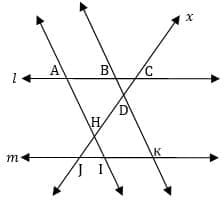
In the given figure, lines l and m are parallel to each other. Transversals AI and BK are also parallel to each other. If m ∠HJI = 50° and m ∠JHI = 45 then find m ∠CBD.
(a) 105°
(b) 125°
(c) 85°
(d) 120°
explanation
Certainly, here’s a rephrased explanation:
In triangle ∆HJI, where m∠HJI = 50° and m∠JHI = 45°, it’s important to note that the sum of the interior angles in any triangle is always 180°. Using this property, we found that m∠JIH is 85° because m∠HJI + m∠JHI + m∠JIH = 180°.
Next, we recognized that m∠JIH is equal to m∠JKD, which is due to their corresponding angles. Then, considering lines l and m with BK as the common transversal, we observed that ∠JKD and ∠CBD are alternate interior angles. Since alternate interior angles are congruent, we concluded that m∠CBD is also 85°.
So, the correct answer is indeed:
(c) 85°
14

In the figure, DE and AE bisect ∠ADC and ∠DAB respectively. AB is parallel to CD. Find m ∠AED.
(a) 60°
(b) 75°
(c) 80°
(d) 90°
(e) 100°
explanation
15

The lines AB, CD, EF and GH are parallel. It is known that AE : CG = 3 : 5 and AC : AG = 1 : 4. If the length of BD is 10 cm, what is the length (in cm) o FH?
(a) 15
(b) 18
(c) 22
(d) 12