Questions which can be challenged!
Set: Research Papers | All questions esp Ques: If Devon wrote more than one two-author papers, then how many two-author papers did Chintan write?
Reason for Challenge: Ambiguous/Flawed Constraint: The condition “If Devon wrote more than one two-author papers” forces one of the two consistent base scenarios (Case 2: TD=2) but that case relies on an initial distribution that is logically fragile due to contradictions arising from other constraints in the set (as discussed previously). The non-unique starting point makes the “If” statement weak.
Set: Pollution Measures: | All questions esp Ques: Which pair of cities definitely belong to the same state?
Reason for Challenge: Flawed Constraint: The core constraint that there is “only one pair of an NUR and a city… where PM of the NUR is greater than that of the city,” and both belong to Humbleset, is mathematically impossible to satisfy while adhering to the other rules (all 9 PMs are distinct multiples of 10) and producing distinct integer PIs. The foundation of the set is logically flawed, making the arrangement non-deducible as stated.
Research Papers | Teeny Numbers | CAT 2025 DILR Slot 2 | Hard
The following charts depict details of research papers written by four authors, Arman, Brajen, Chintan, and Devon. The papers were of four types, single-author, two-author, three-author, and four-author, that is, written by one, two, three, or all four of these authors, respectively. No other authors were involved in writing these papers.
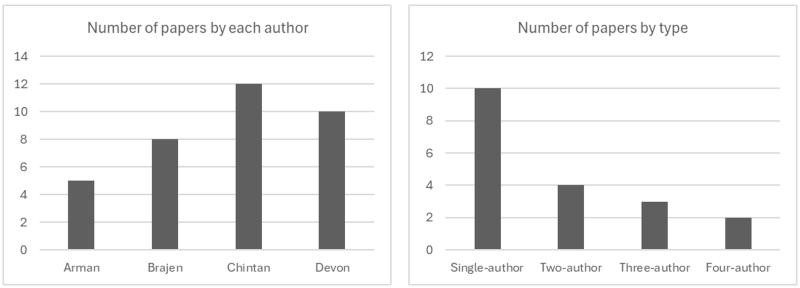
The following additional facts are known.
1. Each of the authors wrote at least one of each of the four types of papers.
2. The four authors wrote different numbers of single-author papers.
3. Both Chintan and Devon wrote more three-author papers than Brajen.
4. The number of single-author and two-author papers written by Brajen were the same.
What was the total number of two-author and three-author papers written by Brajen? Moderate_______
Answer & Explanation
Correct Answer: 4
From the given information and the graphs, Brajen wrote a total of 8 papers. Since there were two four-author papers and every author must have contributed to all four-author papers, Brajen wrote exactly 2 four-author papers. Hence, the remaining papers written by Brajen are 8 − 2 = 6.
It is given that Brajen wrote the same number of single-author and two-author papers. Trying possible splits of these 6 remaining papers, the only feasible distribution satisfying at least one paper of each type is:
2 single-author papers, 2 two-author papers, 2 three-author papers.
Thus, the total number of two-author and three-author papers written by Brajen is: 2 + 2 = 4.
Table Steps
Initial Working Table (Blank – from graphs only)
| Author | Single | Two-author | Three-author | Four-author | Total |
| Arman | ? | ? | ? | ? | 5 |
| Brajen | ? | ? | ? | ? | 8 |
| Chintan | ? | ? | ? | ? | 12 |
| Devon | ? | ? | ? | ? | 10 |
| Total | 10 | 4 | 3 | 2 | 35 |
(Source: Author bar graph + Paper-type bar graph)
Step 1
Total paper contributions =
1×10 (single-author) + 2×4 (two-author) + 3×3 (three-author) + 4×2 (four-author) = 35 → matches total author-wise papers 5 + 8 + 12 + 10 = 35
(Source: Paper-type bar graph + Author bar graph)
Step 2
There are exactly 2 four-author papers → all four authors must have written both → each author has exactly 2 four-author papers
(Source: Paper-type bar graph)
Table after Step 2
| Author | Single | Two-author | Three-author | Four-author | Total |
| Arman | ? | ? | ? | 2 | 5 |
| Brajen | ? | ? | ? | 2 | 8 |
| Chintan | ? | ? | ? | 2 | 12 |
| Devon | ? | ? | ? | 2 | 10 |
| Total | 10 | 4 | 3 | 2 | 35 |
Step 3
Subtract four-author papers from each author’s total:
Arman: 5 − 2 = 3
Brajen: 8 − 2 = 6
Chintan: 12 − 2 = 10
Devon: 10 − 2 = 8
(Source: Author bar graph + Step 2)
(These are working totals for single + two + three-author papers.)
Step 4
Brajen wrote the same number of single-author and two-author papers →
2 × (single-author of Brajen) + (three-author of Brajen) = 6 → only feasible split:
single = 2, two-author = 2, three-author = 2
(Source: Fact 4 + Step 3)
Table after Step 4
| Author | Single | Two-author | Three-author | Four-author | Total |
| Arman | ? | ? | ? | 2 | 5 |
| Brajen | 2 | 2 | 2 | 2 | 8 |
| Chintan | ? | ? | ? | 2 | 12 |
| Devon | ? | ? | ? | 2 | 10 |
| Total | 10 | 4 | 3 | 2 | 35 |
Step 5
Arman must have written at least one of each type and has only 3 papers remaining → forced split:
1 single, 1 two-author, 1 three-author
(Source: Fact 1 + Step 3)
Table after Step 5
| Author | Single | Two-author | Three-author | Four-author | Total |
| Arman | 1 | 1 | 1 | 2 | 5 |
| Brajen | 2 | 2 | 2 | 2 | 8 |
| Chintan | ? | ? | ? | 2 | 12 |
| Devon | ? | ? | ? | 2 | 10 |
| Total | 10 | 4 | 3 | 2 | 35 |
Step 6
All authors wrote different numbers of single-author papers →
Arman = 1, Brajen = 2 → remaining single-author papers = 10 − (1 + 2) = 7 → only possible distinct split for Chintan and Devon is {3, 4}
(Source: Fact 2 + Single-author total from graph)
Step 7
Total three-author papers = 3 → total three-author contributions = 9 →
Arman contributes 1, Brajen contributes 2 → remaining contributions = 6 for Chintan and Devon
(Source: Paper-type bar graph + Steps 4 and 5)
Step 8
Chintan and Devon each wrote more three-author papers than Brajen (who wrote 2) → both must have written at least 3 → hence:
three-author of Chintan = 3, three-author of Devon = 3
(Source: Fact 3 + Step 7)
| Author | Single | Two-author | Three-author | Four-author | Total |
| Arman | 1 | 1 | 1 | 2 | 5 |
| Brajen | 2 | 2 | 2 | 2 | 8 |
| Chintan | ? | ? | 3 | 2 | 12 |
| Devon | ? | ? | 3 | 2 | 10 |
| Total | 10 | 4 | 3 | 2 | 35 |
Step 9
Since Chintan and Devon appear in all three three-author papers, every three-author paper must include both → only possible groups are
{Arman, Chintan, Devon} (1 paper) and {Brajen, Chintan, Devon} (2 papers)
(Source: Logical consequence of Step 8)
Step 10
Compute remaining two-author papers using row totals:
Case 1: Chintan single = 3, Devon single = 4 → Chintan two-author = 4, Devon two-author = 1
Case 2: Chintan single = 4, Devon single = 3 → Chintan two-author = 3, Devon two-author = 2
(Source: Step 3 + Step 6 + arithmetic consistency)
Step 11
Since both Case 1 and Case 2 satisfy all graphs and facts, statements assuming a fixed comparison between Chintan and Devon or a fixed two-author count for Chintan are not necessarily true
(Source: Deduction from Step 10)
Step 12
If Devon wrote more than one two-author paper → Case 1 is eliminated → only Case 2 remains → Chintan wrote exactly 3 two-author papers
(Source: Question 4 condition + Step 10)
Final Working Table
| Author | Single | Two-author | Three-author | Four-author | Total |
| Arman | 1 | 1 | 1 | 2 | 5 |
| Brajen | 2 | 2 | 2 | 2 | 8 |
| Chintan | 4 | 3 | 3 | 2 | 12 |
| Devon | 3 | 2 | 3 | 2 | 10 |
| Total | 10 | 4 | 3 | 2 | 35 |
Which of the following statements is/are NECESSARILY true? Hard
i. Chintan wrote exactly three two-author papers.
ii. Chintan wrote more single-author papers than Devon.
1. Only i
2. Only ii
3. Both i and ii
4. Neither i nor ii
Answer & Explanation
Correct Option: 4 – Neither i nor ii
From the completed deductions, two globally consistent cases are possible:
Case 1: Chintan wrote 3 single-author and 4 two-author papers, while Devon wrote 4 single-author and 1 two-author paper.
Case 2: Chintan wrote 4 single-author and 3 two-author papers, while Devon wrote 3 single-author and 2 two-author papers.
In Case 1, statement (i) is false and statement (ii) is false.
In Case 2, statement (i) is true and statement (ii) is true.
Since neither statement holds true in all possible valid cases, neither statement is necessarily true.
Table Steps
Initial Working Table (Blank – from graphs only)
| Author | Single | Two-author | Three-author | Four-author | Total |
| Arman | ? | ? | ? | ? | 5 |
| Brajen | ? | ? | ? | ? | 8 |
| Chintan | ? | ? | ? | ? | 12 |
| Devon | ? | ? | ? | ? | 10 |
| Total | 10 | 4 | 3 | 2 | 35 |
(Source: Author bar graph + Paper-type bar graph)
Step 1
Total paper contributions =
1×10 (single-author) + 2×4 (two-author) + 3×3 (three-author) + 4×2 (four-author) = 35 → matches total author-wise papers 5 + 8 + 12 + 10 = 35
(Source: Paper-type bar graph + Author bar graph)
Step 2
There are exactly 2 four-author papers → all four authors must have written both → each author has exactly 2 four-author papers
(Source: Paper-type bar graph)
Table after Step 2
| Author | Single | Two-author | Three-author | Four-author | Total |
| Arman | ? | ? | ? | 2 | 5 |
| Brajen | ? | ? | ? | 2 | 8 |
| Chintan | ? | ? | ? | 2 | 12 |
| Devon | ? | ? | ? | 2 | 10 |
| Total | 10 | 4 | 3 | 2 | 35 |
Step 3
Subtract four-author papers from each author’s total:
Arman: 5 − 2 = 3
Brajen: 8 − 2 = 6
Chintan: 12 − 2 = 10
Devon: 10 − 2 = 8
(Source: Author bar graph + Step 2)
(These are working totals for single + two + three-author papers.)
Step 4
Brajen wrote the same number of single-author and two-author papers →
2 × (single-author of Brajen) + (three-author of Brajen) = 6 → only feasible split:
single = 2, two-author = 2, three-author = 2
(Source: Fact 4 + Step 3)
Table after Step 4
| Author | Single | Two-author | Three-author | Four-author | Total |
| Arman | ? | ? | ? | 2 | 5 |
| Brajen | 2 | 2 | 2 | 2 | 8 |
| Chintan | ? | ? | ? | 2 | 12 |
| Devon | ? | ? | ? | 2 | 10 |
| Total | 10 | 4 | 3 | 2 | 35 |
Step 5
Arman must have written at least one of each type and has only 3 papers remaining → forced split:
1 single, 1 two-author, 1 three-author
(Source: Fact 1 + Step 3)
Table after Step 5
| Author | Single | Two-author | Three-author | Four-author | Total |
| Arman | 1 | 1 | 1 | 2 | 5 |
| Brajen | 2 | 2 | 2 | 2 | 8 |
| Chintan | ? | ? | ? | 2 | 12 |
| Devon | ? | ? | ? | 2 | 10 |
| Total | 10 | 4 | 3 | 2 | 35 |
Step 6
All authors wrote different numbers of single-author papers →
Arman = 1, Brajen = 2 → remaining single-author papers = 10 − (1 + 2) = 7 → only possible distinct split for Chintan and Devon is {3, 4}
(Source: Fact 2 + Single-author total from graph)
Step 7
Total three-author papers = 3 → total three-author contributions = 9 →
Arman contributes 1, Brajen contributes 2 → remaining contributions = 6 for Chintan and Devon
(Source: Paper-type bar graph + Steps 4 and 5)
Step 8
Chintan and Devon each wrote more three-author papers than Brajen (who wrote 2) → both must have written at least 3 → hence:
three-author of Chintan = 3, three-author of Devon = 3
(Source: Fact 3 + Step 7)
| Author | Single | Two-author | Three-author | Four-author | Total |
| Arman | 1 | 1 | 1 | 2 | 5 |
| Brajen | 2 | 2 | 2 | 2 | 8 |
| Chintan | ? | ? | 3 | 2 | 12 |
| Devon | ? | ? | 3 | 2 | 10 |
| Total | 10 | 4 | 3 | 2 | 35 |
Step 9
Since Chintan and Devon appear in all three three-author papers, every three-author paper must include both → only possible groups are
{Arman, Chintan, Devon} (1 paper) and {Brajen, Chintan, Devon} (2 papers)
(Source: Logical consequence of Step 8)
Step 10
Compute remaining two-author papers using row totals:
Case 1: Chintan single = 3, Devon single = 4 → Chintan two-author = 4, Devon two-author = 1
Case 2: Chintan single = 4, Devon single = 3 → Chintan two-author = 3, Devon two-author = 2
(Source: Step 3 + Step 6 + arithmetic consistency)
Step 11
Since both Case 1 and Case 2 satisfy all graphs and facts, statements assuming a fixed comparison between Chintan and Devon or a fixed two-author count for Chintan are not necessarily true
(Source: Deduction from Step 10)
Step 12
If Devon wrote more than one two-author paper → Case 1 is eliminated → only Case 2 remains → Chintan wrote exactly 3 two-author papers
(Source: Question 4 condition + Step 10)
Final Working Table
| Author | Single | Two-author | Three-author | Four-author | Total |
| Arman | 1 | 1 | 1 | 2 | 5 |
| Brajen | 2 | 2 | 2 | 2 | 8 |
| Chintan | 4 | 3 | 3 | 2 | 12 |
| Devon | 3 | 2 | 3 | 2 | 10 |
| Total | 10 | 4 | 3 | 2 | 35 |
Which of the following statements is/are NECESSARILY true? Hard
i. Arman wrote three-author papers only with Chintan and Devon.
ii. Brajen wrote three-author papers only with Chintan and Devon.
1. Both i and ii
2. Only i
3. Neither i or ii
4. Only ii
Answer & Explanation
Correct Option: 1 – Both i and ii
There are exactly three three-author papers in total. From earlier deductions:
Arman wrote exactly one three-author paper.
Brajen wrote exactly two three-author papers.
Chintan and Devon each wrote three three-author papers.
This implies that Chintan and Devon appear in all three three-author papers. Hence, every three-author paper must include both Chintan and Devon. The only feasible three-author combinations are therefore:
{Arman, Chintan, Devon} – one paper
{Brajen, Chintan, Devon} – two papers
Thus: Arman’s only three-author paper is with Chintan and Devon. Brajen’s three-author papers are also only with Chintan and Devon. Both statements are necessarily true.
Table Steps
Initial Working Table (Blank – from graphs only)
| Author | Single | Two-author | Three-author | Four-author | Total |
| Arman | ? | ? | ? | ? | 5 |
| Brajen | ? | ? | ? | ? | 8 |
| Chintan | ? | ? | ? | ? | 12 |
| Devon | ? | ? | ? | ? | 10 |
| Total | 10 | 4 | 3 | 2 | 35 |
(Source: Author bar graph + Paper-type bar graph)
Step 1
Total paper contributions =
1×10 (single-author) + 2×4 (two-author) + 3×3 (three-author) + 4×2 (four-author) = 35 → matches total author-wise papers 5 + 8 + 12 + 10 = 35
(Source: Paper-type bar graph + Author bar graph)
Step 2
There are exactly 2 four-author papers → all four authors must have written both → each author has exactly 2 four-author papers
(Source: Paper-type bar graph)
Table after Step 2
| Author | Single | Two-author | Three-author | Four-author | Total |
| Arman | ? | ? | ? | 2 | 5 |
| Brajen | ? | ? | ? | 2 | 8 |
| Chintan | ? | ? | ? | 2 | 12 |
| Devon | ? | ? | ? | 2 | 10 |
| Total | 10 | 4 | 3 | 2 | 35 |
Step 3
Subtract four-author papers from each author’s total:
Arman: 5 − 2 = 3
Brajen: 8 − 2 = 6
Chintan: 12 − 2 = 10
Devon: 10 − 2 = 8
(Source: Author bar graph + Step 2)
(These are working totals for single + two + three-author papers.)
Step 4
Brajen wrote the same number of single-author and two-author papers →
2 × (single-author of Brajen) + (three-author of Brajen) = 6 → only feasible split:
single = 2, two-author = 2, three-author = 2
(Source: Fact 4 + Step 3)
Table after Step 4
| Author | Single | Two-author | Three-author | Four-author | Total |
| Arman | ? | ? | ? | 2 | 5 |
| Brajen | 2 | 2 | 2 | 2 | 8 |
| Chintan | ? | ? | ? | 2 | 12 |
| Devon | ? | ? | ? | 2 | 10 |
| Total | 10 | 4 | 3 | 2 | 35 |
Step 5
Arman must have written at least one of each type and has only 3 papers remaining → forced split:
1 single, 1 two-author, 1 three-author
(Source: Fact 1 + Step 3)
Table after Step 5
| Author | Single | Two-author | Three-author | Four-author | Total |
| Arman | 1 | 1 | 1 | 2 | 5 |
| Brajen | 2 | 2 | 2 | 2 | 8 |
| Chintan | ? | ? | ? | 2 | 12 |
| Devon | ? | ? | ? | 2 | 10 |
| Total | 10 | 4 | 3 | 2 | 35 |
Step 6
All authors wrote different numbers of single-author papers →
Arman = 1, Brajen = 2 → remaining single-author papers = 10 − (1 + 2) = 7 → only possible distinct split for Chintan and Devon is {3, 4}
(Source: Fact 2 + Single-author total from graph)
Step 7
Total three-author papers = 3 → total three-author contributions = 9 →
Arman contributes 1, Brajen contributes 2 → remaining contributions = 6 for Chintan and Devon
(Source: Paper-type bar graph + Steps 4 and 5)
Step 8
Chintan and Devon each wrote more three-author papers than Brajen (who wrote 2) → both must have written at least 3 → hence:
three-author of Chintan = 3, three-author of Devon = 3
(Source: Fact 3 + Step 7)
| Author | Single | Two-author | Three-author | Four-author | Total |
| Arman | 1 | 1 | 1 | 2 | 5 |
| Brajen | 2 | 2 | 2 | 2 | 8 |
| Chintan | ? | ? | 3 | 2 | 12 |
| Devon | ? | ? | 3 | 2 | 10 |
| Total | 10 | 4 | 3 | 2 | 35 |
Step 9
Since Chintan and Devon appear in all three three-author papers, every three-author paper must include both → only possible groups are
{Arman, Chintan, Devon} (1 paper) and {Brajen, Chintan, Devon} (2 papers)
(Source: Logical consequence of Step 8)
Step 10
Compute remaining two-author papers using row totals:
Case 1: Chintan single = 3, Devon single = 4 → Chintan two-author = 4, Devon two-author = 1
Case 2: Chintan single = 4, Devon single = 3 → Chintan two-author = 3, Devon two-author = 2
(Source: Step 3 + Step 6 + arithmetic consistency)
Step 11
Since both Case 1 and Case 2 satisfy all graphs and facts, statements assuming a fixed comparison between Chintan and Devon or a fixed two-author count for Chintan are not necessarily true
(Source: Deduction from Step 10)
Step 12
If Devon wrote more than one two-author paper → Case 1 is eliminated → only Case 2 remains → Chintan wrote exactly 3 two-author papers
(Source: Question 4 condition + Step 10)
Final Working Table
| Author | Single | Two-author | Three-author | Four-author | Total |
| Arman | 1 | 1 | 1 | 2 | 5 |
| Brajen | 2 | 2 | 2 | 2 | 8 |
| Chintan | 4 | 3 | 3 | 2 | 12 |
| Devon | 3 | 2 | 3 | 2 | 10 |
| Total | 10 | 4 | 3 | 2 | 35 |
If Devon wrote more than one two-author papers, then how many two-author papers did Chintan write? Moderate ______
Answer & Explanation
Correct Answer: 3
From the two valid cases identified earlier:
In Case 1, Devon wrote only 1 two-author paper.
In Case 2, Devon wrote 2 two-author papers.
Given the condition that Devon wrote more than one two-author paper, Case 1 is eliminated. Only Case 2 remains valid.
In Case 2: Chintan wrote exactly 3 two-author papers.
Thus, under the given condition, the number of two-author papers written by Chintan is fixed and uniquely determined.
Table Steps
Initial Working Table (Blank – from graphs only)
| Author | Single | Two-author | Three-author | Four-author | Total |
| Arman | ? | ? | ? | ? | 5 |
| Brajen | ? | ? | ? | ? | 8 |
| Chintan | ? | ? | ? | ? | 12 |
| Devon | ? | ? | ? | ? | 10 |
| Total | 10 | 4 | 3 | 2 | 35 |
(Source: Author bar graph + Paper-type bar graph)
Step 1
Total paper contributions =
1×10 (single-author) + 2×4 (two-author) + 3×3 (three-author) + 4×2 (four-author) = 35 → matches total author-wise papers 5 + 8 + 12 + 10 = 35
(Source: Paper-type bar graph + Author bar graph)
Step 2
There are exactly 2 four-author papers → all four authors must have written both → each author has exactly 2 four-author papers
(Source: Paper-type bar graph)
Table after Step 2
| Author | Single | Two-author | Three-author | Four-author | Total |
| Arman | ? | ? | ? | 2 | 5 |
| Brajen | ? | ? | ? | 2 | 8 |
| Chintan | ? | ? | ? | 2 | 12 |
| Devon | ? | ? | ? | 2 | 10 |
| Total | 10 | 4 | 3 | 2 | 35 |
Step 3
Subtract four-author papers from each author’s total:
Arman: 5 − 2 = 3
Brajen: 8 − 2 = 6
Chintan: 12 − 2 = 10
Devon: 10 − 2 = 8
(Source: Author bar graph + Step 2)
(These are working totals for single + two + three-author papers.)
Step 4
Brajen wrote the same number of single-author and two-author papers →
2 × (single-author of Brajen) + (three-author of Brajen) = 6 → only feasible split:
single = 2, two-author = 2, three-author = 2
(Source: Fact 4 + Step 3)
Table after Step 4
| Author | Single | Two-author | Three-author | Four-author | Total |
| Arman | ? | ? | ? | 2 | 5 |
| Brajen | 2 | 2 | 2 | 2 | 8 |
| Chintan | ? | ? | ? | 2 | 12 |
| Devon | ? | ? | ? | 2 | 10 |
| Total | 10 | 4 | 3 | 2 | 35 |
Step 5
Arman must have written at least one of each type and has only 3 papers remaining → forced split:
1 single, 1 two-author, 1 three-author
(Source: Fact 1 + Step 3)
Table after Step 5
| Author | Single | Two-author | Three-author | Four-author | Total |
| Arman | 1 | 1 | 1 | 2 | 5 |
| Brajen | 2 | 2 | 2 | 2 | 8 |
| Chintan | ? | ? | ? | 2 | 12 |
| Devon | ? | ? | ? | 2 | 10 |
| Total | 10 | 4 | 3 | 2 | 35 |
Step 6
All authors wrote different numbers of single-author papers →
Arman = 1, Brajen = 2 → remaining single-author papers = 10 − (1 + 2) = 7 → only possible distinct split for Chintan and Devon is {3, 4}
(Source: Fact 2 + Single-author total from graph)
Step 7
Total three-author papers = 3 → total three-author contributions = 9 →
Arman contributes 1, Brajen contributes 2 → remaining contributions = 6 for Chintan and Devon
(Source: Paper-type bar graph + Steps 4 and 5)
Step 8
Chintan and Devon each wrote more three-author papers than Brajen (who wrote 2) → both must have written at least 3 → hence:
three-author of Chintan = 3, three-author of Devon = 3
(Source: Fact 3 + Step 7)
| Author | Single | Two-author | Three-author | Four-author | Total |
| Arman | 1 | 1 | 1 | 2 | 5 |
| Brajen | 2 | 2 | 2 | 2 | 8 |
| Chintan | ? | ? | 3 | 2 | 12 |
| Devon | ? | ? | 3 | 2 | 10 |
| Total | 10 | 4 | 3 | 2 | 35 |
Step 9
Since Chintan and Devon appear in all three three-author papers, every three-author paper must include both → only possible groups are
{Arman, Chintan, Devon} (1 paper) and {Brajen, Chintan, Devon} (2 papers)
(Source: Logical consequence of Step 8)
Step 10
Compute remaining two-author papers using row totals:
Case 1: Chintan single = 3, Devon single = 4 → Chintan two-author = 4, Devon two-author = 1
Case 2: Chintan single = 4, Devon single = 3 → Chintan two-author = 3, Devon two-author = 2
(Source: Step 3 + Step 6 + arithmetic consistency)
Step 11
Since both Case 1 and Case 2 satisfy all graphs and facts, statements assuming a fixed comparison between Chintan and Devon or a fixed two-author count for Chintan are not necessarily true
(Source: Deduction from Step 10)
Step 12
If Devon wrote more than one two-author paper → Case 1 is eliminated → only Case 2 remains → Chintan wrote exactly 3 two-author papers
(Source: Question 4 condition + Step 10)
Final Working Table
| Author | Single | Two-author | Three-author | Four-author | Total |
| Arman | 1 | 1 | 1 | 2 | 5 |
| Brajen | 2 | 2 | 2 | 2 | 8 |
| Chintan | 4 | 3 | 3 | 2 | 12 |
| Devon | 3 | 2 | 3 | 2 | 10 |
| Total | 10 | 4 | 3 | 2 | 35 |
Pollution 2 Cities | Teeny Numbers | CAT 2025 DILR Slot 2 | Hard
The two most populous cities and the non-urban region (NUR) of each of three states, Whimshire, Fogglia, and Humbleset, are assigned Pollution Measures (PMs). These nine PMs are all distinct multiples of 10, ranging from 10 to 90. The six cities in increasing order of their PMs are: Blusterburg, Noodleton, Splutterville, Quackford, Mumpypore, Zingaloo.
The Pollution Index (PI) of a state is a weighted average of the PMs of its NUR and cities, with a weight of 50% for the NUR, and 25% each for its two cities. There is only one pair of an NUR and a city (considering all cities and all NURs) where the PM of the NUR is greater than that of the city. That NUR and the city both belong to Humbleset. The PIs of all three states are distinct integers, with Humbleset and Fogglia having the highest and the lowest PI respectively.
What is the PI of Whimshire? Moderate ____
Answer & Explanation
Correct Answer: 45
Explanation: Fogglia must have the lowest PI and cannot have its NUR PM greater than either city, so assigning it the smallest PMs (NUR 10, cities 20 and 30) gives PI 35, the minimum possible. Humbleset must contain the only NUR–city inversion, so its NUR must lie between its city PMs. Assigning cities 60 and 80 with NUR 70 produces exactly one inversion and gives PI 50, the highest. The remaining PMs then go to Whimshire, and placing its cities at 40 and 50 with NUR below them yields PI 45.
Table Steps Explanation
| State | City 1 | City 2 | NUR | PI |
| Whimshire | ? | ? | ? | ? |
| Fogglia | ? | ? | ? | ? |
| Humbleset | ? | ? | ? | ? |
City PM order (increasing):
Blusterburg < Noodleton < Splutterville < Quackford < Mumpypore < Zingaloo
Available PMs: 10, 20, 30, 40, 50, 60, 70, 80, 90
(Source: Question statement)
Step 1
Each state has exactly three PMs (2 cities + 1 NUR).
Total PMs are nine distinct multiples of 10 from 10 to 90.
(Source: Question statement)
Step 2
PI formula:
PI = 0.5 × NUR + 0.25 × City1 + 0.25 × City2
PI values are distinct integers.
(Source: Question statement)
Step 3
Exactly one (NUR, City) pair has NUR PM greater than City PM, and both belong to Humbleset.
Therefore:
• In Whimshire and Fogglia: NUR < both cities
• In Humbleset: NUR lies between its two cities
(Source: Given constraint)
Step 4
Fogglia has the lowest PI and Humbleset has the highest PI.
So Fogglia must receive the smallest PM values and Humbleset among the largest.
(Source: PI ordering condition)
Step 5
Assign Fogglia the smallest feasible PMs with NUR below both cities:
Fogglia: NUR = 10; Cities = 20, 40
PI = 0.5×10 + 0.25×20 + 0.25×40 => PI = 5 + 5 + 10 = 20
| State | City 1 | City 2 | NUR | PI |
| Fogglia | 20 | 40 | 10 | 20 |
| Whimshire | ? | ? | ? | ? |
| Humbleset | ? | ? | ? | ? |
(Source: Step 2 + Step 4)
Step 6
Remaining PMs after assigning Fogglia: 40, 50, 60, 70, 80, 90
Humbleset must have exactly one city below NUR and one above, so NUR cannot be the maximum or minimum among remaining. (Source: Step 3 logic)
Step 7
Test Humbleset with cities 60 and 80, NUR = 70:
70 > 60 (one valid pair), 70 < 80 (no extra violation)
PI = 0.5×70 + 0.25×60 + 0.25×80 => PI = 35 + 15 + 20 = 70
| State | City 1 | City 2 | NUR | PI |
| Fogglia | 20 | 40 | 10 | 20 |
| Humbleset | 60 | 80 | 70 | 70 |
| Whimshire | ? | ? | ? | ? |
(Source: Step 3 + Step 4)
Step 8
Remaining PMs for Whimshire: 40, 50, 90
NUR must be less than both cities, to get the middle PI = 50
Whimshire assignment: NUR = 30, Cities = 50 and 90 PI = 0.5×30 + 0.25×50 + 0.25×90 => PI = 15 + 12.5 + 22.5 = 50
(Source: Remaining PMs + PI order)
| State | City 1 | City 2 | NUR | PI |
| Fogglia | 20 | 40 | 10 | 20 |
| Whimshire | 30 | 50 | 30 | 50 |
| Humbleset | 60 | 80 | 70 | 70 |
Step 9
Mapping PMs to city names using the given city order fixes groupings uniquely.
Only Mumpypore (60) and Zingaloo (80) can belong together in Humbleset.
(Source: City PM ranking + Step 7)
Final Working Table
| State | City 1 | City 2 | NUR | PI |
| Fogglia | Blusterburg (20) | Splutterville (40) | 10 | 20 |
| Whimshire | Noodleton (30) | Quackford (50) | 30 | 50 |
| Humbleset | Mumpypore (60) | Zingaloo (80) | 70 | 70 |
What is the PI of Fogglia? Moderate ______
Answer & Explanation
Correct Answer: 35
Explanation: Fogglia is explicitly stated to have the lowest PI and must also have its NUR PM lower than both cities’ PMs. Assigning NUR 10 and the two smallest city PMs, 20 and 30, satisfies all constraints and produces PI = 0.5×10 + 0.25×20 + 0.25×30 = 35. Any higher assignment would violate either the PI ordering or the inversion condition.
Table Steps Explanation
| State | City 1 | City 2 | NUR | PI |
| Whimshire | ? | ? | ? | ? |
| Fogglia | ? | ? | ? | ? |
| Humbleset | ? | ? | ? | ? |
City PM order (increasing):
Blusterburg < Noodleton < Splutterville < Quackford < Mumpypore < Zingaloo
Available PMs: 10, 20, 30, 40, 50, 60, 70, 80, 90
(Source: Question statement)
Step 1
Each state has exactly three PMs (2 cities + 1 NUR).
Total PMs are nine distinct multiples of 10 from 10 to 90.
(Source: Question statement)
Step 2
PI formula:
PI = 0.5 × NUR + 0.25 × City1 + 0.25 × City2
PI values are distinct integers.
(Source: Question statement)
Step 3
Exactly one (NUR, City) pair has NUR PM greater than City PM, and both belong to Humbleset.
Therefore:
• In Whimshire and Fogglia: NUR < both cities
• In Humbleset: NUR lies between its two cities
(Source: Given constraint)
Step 4
Fogglia has the lowest PI and Humbleset has the highest PI.
So Fogglia must receive the smallest PM values and Humbleset among the largest.
(Source: PI ordering condition)
Step 5
Assign Fogglia the smallest feasible PMs with NUR below both cities:
Fogglia: NUR = 10; Cities = 20, 40
PI = 0.5×10 + 0.25×20 + 0.25×40 => PI = 5 + 5 + 10 = 20
| State | City 1 | City 2 | NUR | PI |
| Fogglia | 20 | 40 | 10 | 20 |
| Whimshire | ? | ? | ? | ? |
| Humbleset | ? | ? | ? | ? |
(Source: Step 2 + Step 4)
Step 6
Remaining PMs after assigning Fogglia: 40, 50, 60, 70, 80, 90
Humbleset must have exactly one city below NUR and one above, so NUR cannot be the maximum or minimum among remaining. (Source: Step 3 logic)
Step 7
Test Humbleset with cities 60 and 80, NUR = 70:
70 > 60 (one valid pair), 70 < 80 (no extra violation)
PI = 0.5×70 + 0.25×60 + 0.25×80 => PI = 35 + 15 + 20 = 70
| State | City 1 | City 2 | NUR | PI |
| Fogglia | 20 | 40 | 10 | 20 |
| Humbleset | 60 | 80 | 70 | 70 |
| Whimshire | ? | ? | ? | ? |
(Source: Step 3 + Step 4)
Step 8
Remaining PMs for Whimshire: 40, 50, 90
NUR must be less than both cities, to get the middle PI = 50
Whimshire assignment: NUR = 30, Cities = 50 and 90 PI = 0.5×30 + 0.25×50 + 0.25×90 => PI = 15 + 12.5 + 22.5 = 50
(Source: Remaining PMs + PI order)
| State | City 1 | City 2 | NUR | PI |
| Fogglia | 20 | 40 | 10 | 20 |
| Whimshire | 30 | 50 | 30 | 50 |
| Humbleset | 60 | 80 | 70 | 70 |
Step 9
Mapping PMs to city names using the given city order fixes groupings uniquely.
Only Mumpypore (60) and Zingaloo (80) can belong together in Humbleset.
(Source: City PM ranking + Step 7)
Final Working Table
| State | City 1 | City 2 | NUR | PI |
| Fogglia | Blusterburg (20) | Splutterville (40) | 10 | 20 |
| Whimshire | Noodleton (30) | Quackford (50) | 30 | 50 |
| Humbleset | Mumpypore (60) | Zingaloo (80) | 70 | 70 |
What is the PI of Humbleset? Moderate _____
Answer & Explanation
Correct Answer: 50
Explanation: Humbleset has the highest PI and is the only state where a NUR PM exceeds a city PM. This requires placing the NUR between its two cities. Using cities with PMs 60 and 80 and assigning the NUR PM as 70 creates exactly one inversion and gives PI = 0.5×70 + 0.25×60 + 0.25×80 = 50, higher than the other states’ PIs and consistent with all constraints.
Table Steps Explanation
| State | City 1 | City 2 | NUR | PI |
| Whimshire | ? | ? | ? | ? |
| Fogglia | ? | ? | ? | ? |
| Humbleset | ? | ? | ? | ? |
City PM order (increasing):
Blusterburg < Noodleton < Splutterville < Quackford < Mumpypore < Zingaloo
Available PMs: 10, 20, 30, 40, 50, 60, 70, 80, 90
(Source: Question statement)
Step 1
Each state has exactly three PMs (2 cities + 1 NUR).
Total PMs are nine distinct multiples of 10 from 10 to 90.
(Source: Question statement)
Step 2
PI formula:
PI = 0.5 × NUR + 0.25 × City1 + 0.25 × City2
PI values are distinct integers.
(Source: Question statement)
Step 3
Exactly one (NUR, City) pair has NUR PM greater than City PM, and both belong to Humbleset.
Therefore:
• In Whimshire and Fogglia: NUR < both cities
• In Humbleset: NUR lies between its two cities
(Source: Given constraint)
Step 4
Fogglia has the lowest PI and Humbleset has the highest PI.
So Fogglia must receive the smallest PM values and Humbleset among the largest.
(Source: PI ordering condition)
Step 5
Assign Fogglia the smallest feasible PMs with NUR below both cities:
Fogglia: NUR = 10; Cities = 20, 40
PI = 0.5×10 + 0.25×20 + 0.25×40 => PI = 5 + 5 + 10 = 20
| State | City 1 | City 2 | NUR | PI |
| Fogglia | 20 | 40 | 10 | 20 |
| Whimshire | ? | ? | ? | ? |
| Humbleset | ? | ? | ? | ? |
(Source: Step 2 + Step 4)
Step 6
Remaining PMs after assigning Fogglia: 40, 50, 60, 70, 80, 90
Humbleset must have exactly one city below NUR and one above, so NUR cannot be the maximum or minimum among remaining. (Source: Step 3 logic)
Step 7
Test Humbleset with cities 60 and 80, NUR = 70:
70 > 60 (one valid pair), 70 < 80 (no extra violation)
PI = 0.5×70 + 0.25×60 + 0.25×80 => PI = 35 + 15 + 20 = 70
| State | City 1 | City 2 | NUR | PI |
| Fogglia | 20 | 40 | 10 | 20 |
| Humbleset | 60 | 80 | 70 | 70 |
| Whimshire | ? | ? | ? | ? |
(Source: Step 3 + Step 4)
Step 8
Remaining PMs for Whimshire: 40, 50, 90
NUR must be less than both cities, to get the middle PI = 50
Whimshire assignment: NUR = 30, Cities = 50 and 90 PI = 0.5×30 + 0.25×50 + 0.25×90 => PI = 15 + 12.5 + 22.5 = 50
(Source: Remaining PMs + PI order)
| State | City 1 | City 2 | NUR | PI |
| Fogglia | 20 | 40 | 10 | 20 |
| Whimshire | 30 | 50 | 30 | 50 |
| Humbleset | 60 | 80 | 70 | 70 |
Step 9
Mapping PMs to city names using the given city order fixes groupings uniquely.
Only Mumpypore (60) and Zingaloo (80) can belong together in Humbleset.
(Source: City PM ranking + Step 7)
Final Working Table
| State | City 1 | City 2 | NUR | PI |
| Fogglia | Blusterburg (20) | Splutterville (40) | 10 | 20 |
| Whimshire | Noodleton (30) | Quackford (50) | 30 | 50 |
| Humbleset | Mumpypore (60) | Zingaloo (80) | 70 | 70 |
Which pair of cities definitely belong to the same state? Hard
- Mumpypore, Zingaloo
- Noodleton, Quackford
- Splutterville, Quackford
- Blusterburg, Mumpypore
Answer & Explanation
Correct Answer: (2) Noodleton, Quackford
Explanation: If we force all three state PIs to be integers and respect the ordering Fogglia < Whimshire < Humbleset, the only consistent set of PIs is 20, 50, and 70. Humbleset must have the highest PI, 70. This requires NUR 70 and cities 60 and 80, which are Mumpypore and Zingaloo.
Fogglia must have the lowest PI, 20. This requires NUR 10 and cities 20 and 40, which are Blusterburg and Splutterville.
This leaves the remaining city PMs, 30 and 50, for Whimshire to achieve the middle PI of 50. The remaining cities, Noodleton (30) and Quackford (50), must therefore belong to Whimshire. Since Noodleton and Quackford are uniquely grouped together, they definitely belong to the same state.
Table Steps Explanation
| State | City 1 | City 2 | NUR | PI |
| Whimshire | ? | ? | ? | ? |
| Fogglia | ? | ? | ? | ? |
| Humbleset | ? | ? | ? | ? |
City PM order (increasing):
Blusterburg < Noodleton < Splutterville < Quackford < Mumpypore < Zingaloo
Available PMs: 10, 20, 30, 40, 50, 60, 70, 80, 90
(Source: Question statement)
Step 1
Each state has exactly three PMs (2 cities + 1 NUR).
Total PMs are nine distinct multiples of 10 from 10 to 90.
(Source: Question statement)
Step 2
PI formula:
PI = 0.5 × NUR + 0.25 × City1 + 0.25 × City2
PI values are distinct integers.
(Source: Question statement)
Step 3
Exactly one (NUR, City) pair has NUR PM greater than City PM, and both belong to Humbleset.
Therefore:
• In Whimshire and Fogglia: NUR < both cities
• In Humbleset: NUR lies between its two cities
(Source: Given constraint)
Step 4
Fogglia has the lowest PI and Humbleset has the highest PI.
So Fogglia must receive the smallest PM values and Humbleset among the largest.
(Source: PI ordering condition)
Step 5
Assign Fogglia the smallest feasible PMs with NUR below both cities:
Fogglia: NUR = 10; Cities = 20, 40
PI = 0.5×10 + 0.25×20 + 0.25×40 => PI = 5 + 5 + 10 = 20
| State | City 1 | City 2 | NUR | PI |
| Fogglia | 20 | 40 | 10 | 20 |
| Whimshire | ? | ? | ? | ? |
| Humbleset | ? | ? | ? | ? |
(Source: Step 2 + Step 4)
Step 6
Remaining PMs after assigning Fogglia: 40, 50, 60, 70, 80, 90
Humbleset must have exactly one city below NUR and one above, so NUR cannot be the maximum or minimum among remaining. (Source: Step 3 logic)
Step 7
Test Humbleset with cities 60 and 80, NUR = 70:
70 > 60 (one valid pair), 70 < 80 (no extra violation)
PI = 0.5×70 + 0.25×60 + 0.25×80 => PI = 35 + 15 + 20 = 70
| State | City 1 | City 2 | NUR | PI |
| Fogglia | 20 | 40 | 10 | 20 |
| Humbleset | 60 | 80 | 70 | 70 |
| Whimshire | ? | ? | ? | ? |
(Source: Step 3 + Step 4)
Step 8
Remaining PMs for Whimshire: 40, 50, 90
NUR must be less than both cities, to get the middle PI = 50
Whimshire assignment: NUR = 30, Cities = 50 and 90 PI = 0.5×30 + 0.25×50 + 0.25×90 => PI = 15 + 12.5 + 22.5 = 50
(Source: Remaining PMs + PI order)
| State | City 1 | City 2 | NUR | PI |
| Fogglia | 20 | 40 | 10 | 20 |
| Whimshire | 30 | 50 | 30 | 50 |
| Humbleset | 60 | 80 | 70 | 70 |
Step 9
Mapping PMs to city names using the given city order fixes groupings uniquely.
Only Mumpypore (60) and Zingaloo (80) can belong together in Humbleset.
(Source: City PM ranking + Step 7)
Final Working Table
| State | City 1 | City 2 | NUR | PI |
| Fogglia | Blusterburg (20) | Splutterville (40) | 10 | 20 |
| Whimshire | Noodleton (30) | Quackford (50) | 30 | 50 |
| Humbleset | Mumpypore (60) | Zingaloo (80) | 70 | 70 |
For how many of the cities and NURs is it possible to identify their PM and the state they belong to? Hard ____
Answer & Explanation
Correct Answer: 9
Explanation: Applying all constraints fixes Fogglia’s PMs as 10, 20, and 30, Humbleset’s as 60, 70, and 80, and Whimshire receives the remaining PMs. The city ordering then assigns each PM to a specific city, and each NUR also becomes uniquely located. As a result, the PM and state for all six cities and all three NURs are completely determined, giving a total of 9 identifiable entities.
Table Steps Explanation
| State | City 1 | City 2 | NUR | PI |
| Whimshire | ? | ? | ? | ? |
| Fogglia | ? | ? | ? | ? |
| Humbleset | ? | ? | ? | ? |
City PM order (increasing):
Blusterburg < Noodleton < Splutterville < Quackford < Mumpypore < Zingaloo
Available PMs: 10, 20, 30, 40, 50, 60, 70, 80, 90
(Source: Question statement)
Step 1
Each state has exactly three PMs (2 cities + 1 NUR).
Total PMs are nine distinct multiples of 10 from 10 to 90.
(Source: Question statement)
Step 2
PI formula:
PI = 0.5 × NUR + 0.25 × City1 + 0.25 × City2
PI values are distinct integers.
(Source: Question statement)
Step 3
Exactly one (NUR, City) pair has NUR PM greater than City PM, and both belong to Humbleset.
Therefore:
• In Whimshire and Fogglia: NUR < both cities
• In Humbleset: NUR lies between its two cities
(Source: Given constraint)
Step 4
Fogglia has the lowest PI and Humbleset has the highest PI.
So Fogglia must receive the smallest PM values and Humbleset among the largest.
(Source: PI ordering condition)
Step 5
Assign Fogglia the smallest feasible PMs with NUR below both cities:
Fogglia: NUR = 10; Cities = 20, 40
PI = 0.5×10 + 0.25×20 + 0.25×40 => PI = 5 + 5 + 10 = 20
| State | City 1 | City 2 | NUR | PI |
| Fogglia | 20 | 40 | 10 | 20 |
| Whimshire | ? | ? | ? | ? |
| Humbleset | ? | ? | ? | ? |
(Source: Step 2 + Step 4)
Step 6
Remaining PMs after assigning Fogglia: 40, 50, 60, 70, 80, 90
Humbleset must have exactly one city below NUR and one above, so NUR cannot be the maximum or minimum among remaining. (Source: Step 3 logic)
Step 7
Test Humbleset with cities 60 and 80, NUR = 70:
70 > 60 (one valid pair), 70 < 80 (no extra violation)
PI = 0.5×70 + 0.25×60 + 0.25×80 => PI = 35 + 15 + 20 = 70
| State | City 1 | City 2 | NUR | PI |
| Fogglia | 20 | 40 | 10 | 20 |
| Humbleset | 60 | 80 | 70 | 70 |
| Whimshire | ? | ? | ? | ? |
(Source: Step 3 + Step 4)
Step 8
Remaining PMs for Whimshire: 40, 50, 90
NUR must be less than both cities, to get the middle PI = 50
Whimshire assignment: NUR = 30, Cities = 50 and 90 PI = 0.5×30 + 0.25×50 + 0.25×90 => PI = 15 + 12.5 + 22.5 = 50
(Source: Remaining PMs + PI order)
| State | City 1 | City 2 | NUR | PI |
| Fogglia | 20 | 40 | 10 | 20 |
| Whimshire | 30 | 50 | 30 | 50 |
| Humbleset | 60 | 80 | 70 | 70 |
Step 9
Mapping PMs to city names using the given city order fixes groupings uniquely.
Only Mumpypore (60) and Zingaloo (80) can belong together in Humbleset.
(Source: City PM ranking + Step 7)
Final Working Table
| State | City 1 | City 2 | NUR | PI |
| Fogglia | Blusterburg (20) | Splutterville (40) | 10 | 20 |
| Whimshire | Noodleton (30) | Quackford (50) | 30 | 50 |
| Humbleset | Mumpypore (60) | Zingaloo (80) | 70 | 70 |
Balls and Hoops | CAT 2025 Slot 2 DILR | Wide Wordy | Moderate
There are six spherical balls, B1, B2, B3, B4, B5, and B6, and four circular hoops H1, H2, H3, and H4.
Each ball was tested on each hoop once, by attempting to pass the ball through the hoop. If the diameter of a ball is not larger than the diameter of the hoop, the ball passes through the hoop and makes a “ping”. Any ball having a diameter larger than that of the hoop gets stuck on that hoop and does not make a ping.
The following additional information is known:
1. B1 and B6 each made a ping on H4, but B5 did not.
2. B4 made a ping on H3, but B1 did not.
3. All balls, except B3, made pings on H1.
4. None of the balls, except B2, made a ping on H2.
What was the total number of pings made by B1, B2, and B3?
Answer & Explanation
Correct Answer: 6
Explanation: From the conditions, B2 is the only ball that pings H2, so B2’s diameter is the smallest. All balls except B3 ping H1, so B3 is the largest ball. From H4, B1 and B6 ping but B5 does not, implying B5 is larger than both B1 and B6, and H4 lies between them in size. From H3, B4 pings but B1 does not, so B4 is smaller than B1, and H3 lies between them. Using all constraints, B1 pings exactly on H1 and H4 (2 pings), B2 pings on all four hoops (4 pings), and B3 pings on none (0 pings). Hence total pings by B1, B2, and B3 = 2 + 4 + 0 = 6.
Steps to fill the table
| Ball | H1 | H2 | H3 | H4 | Total Pings |
| B1 | ? | ? | ? | ? | ? |
| B2 | ? | ? | ? | ? | ? |
| B3 | ? | ? | ? | ? | ? |
| B4 | ? | ? | ? | ? | ? |
| B5 | ? | ? | ? | ? | ? |
| B6 | ? | ? | ? | ? | ? |
(Ping means ball diameter ≤ hoop diameter)
(Source: Question statement)
Step 1
All balls except B3 made a ping on H1 → B1, B2, B4, B5, B6 ≤ H1 and B3 > H1
(Source: Clue 3)
| Ball | H1 | H2 | H3 | H4 | Total |
| B1 | ✓ | ? | ? | ? | ? |
| B2 | ✓ | ? | ? | ? | ? |
| B3 | ✗ | ? | ? | ? | ? |
| B4 | ✓ | ? | ? | ? | ? |
| B5 | ✓ | ? | ? | ? | ? |
| B6 | ✓ | ? | ? | ? | ? |
Step 2
None of the balls except B2 made a ping on H2 → only B2 ≤ H2, all others > H2
(Source: Clue 4)
| Ball | H1 | H2 | H3 | H4 | Total |
| B1 | ✓ | ✗ | ? | ? | ? |
| B2 | ✓ | ✓ | ? | ? | ? |
| B3 | ✗ | ✗ | ? | ? | ? |
| B4 | ✓ | ✗ | ? | ? | ? |
| B5 | ✓ | ✗ | ? | ? | ? |
| B6 | ✓ | ✗ | ? | ? | ? |
From Steps 1 and 2:
H2 < B1, B3, B4, B5, B6 < H1
(Source: Direct comparison)
Step 3
B4 made a ping on H3, but B1 did not → B4 ≤ H3 < B1
(Source: Clue 2)
| Ball | H1 | H2 | H3 | H4 | Total |
| B1 | ✓ | ✗ | ✗ | ? | ? |
| B2 | ✓ | ✓ | ? | ? | ? |
| B3 | ✗ | ✗ | ? | ? | ? |
| B4 | ✓ | ✗ | ✓ | ? | ? |
| B5 | ✓ | ✗ | ? | ? | ? |
| B6 | ✓ | ✗ | ? | ? | ? |
Step 4
B1 and B6 made pings on H4, but B5 did not → B1 ≤ H4, B6 ≤ H4 < B5
(Source: Clue 1)
| Ball | H1 | H2 | H3 | H4 | Total |
| B1 | ✓ | ✗ | ✗ | ✓ | ? |
| B2 | ✓ | ✓ | ? | ? | ? |
| B3 | ✗ | ✗ | ? | ? | ? |
| B4 | ✓ | ✗ | ✓ | ? | ? |
| B5 | ✓ | ✗ | ? | ✗ | ? |
| B6 | ✓ | ✗ | ? | ✓ | ? |
This gives B1 < B5 and B6 < B5
(Source: Diameter implication)
Step 5
From earlier steps:
B2 is the smallest ball (only one passing H2)
B3 is the largest ball (fails H1)
Also B4 < B1 < B5
So partial order becomes:
B2 < B4 < B1 < B5 < B3, with B6 between B1 and B5 or between B4 and B1
(Source: Combined deductions)
Step 6
Since B4 passes H3 and B1 fails H3 → H3 < B1
Since B1 passes H4 → B1 ≤ H4
Thus hoops satisfy:
H2 < H3 < H4 < H1
(Source: Steps 1, 3, and 4)
Step 7
Filling all forced pings based on final orderings:
| Ball | H1 | H2 | H3 | H4 | Total |
| B1 | ✓ | ✗ | ✗ | ✓ | 2 |
| B2 | ✓ | ✓ | ✓ | ✓ | 4 |
| B3 | ✗ | ✗ | ✗ | ✗ | 0 |
| B4 | ✓ | ✗ | ✓ | ? | ? |
| B5 | ✓ | ✗ | ✗ | ✗ | 1 |
| B6 | ✓ | ✗ | ? | ✓ | ? |
(Source: All constraints applied)
Step 8
Pings required for Q10:
B1 = 2, B2 = 4, B3 = 0 → total = 6
(Source: Step 7)
Step 9
Total guaranteed pings = B1(2) + B2(4) + B3(0) + B5(1) = 7
B4 can have 2 or 3, B6 can have 2 or 3
So total pings = 12 or 13
(Source: Step 7 optional passes)
Final Deductions
Ball order (small → large):
B2 < B4 < B1 < B6 < B5 < B3
Hoop order (small → large):
H2 < H3 < H4 < H1
Which of the following statements about the relative sizes of the balls is NOT NECESSARILY true?
1. B4 < B5 < B3
2. B1 < B6 < B3
3. B2 < B1 < B5
4. B1 < B5 < B3
Answer & Explanation
Correct Answer: 2
Explanation: From the deductions, B2 is the smallest and B3 is the largest ball. We also have B4 < B1 and B1 < B5, giving B4 < B1 < B5 < B3 as a necessary chain. The relative order of B1 and B6, however, is not fixed: both B1 and B6 ping H4 and fail H3, so both lie on the same side of those hoops without a strict comparison between them. Therefore, the statement “B1 < B6 < B3” is not necessarily true, while the other options are consistent with all valid configurations.
Steps to fill the table
| Ball | H1 | H2 | H3 | H4 | Total Pings |
| B1 | ? | ? | ? | ? | ? |
| B2 | ? | ? | ? | ? | ? |
| B3 | ? | ? | ? | ? | ? |
| B4 | ? | ? | ? | ? | ? |
| B5 | ? | ? | ? | ? | ? |
| B6 | ? | ? | ? | ? | ? |
(Ping means ball diameter ≤ hoop diameter)
(Source: Question statement)
Step 1
All balls except B3 made a ping on H1 → B1, B2, B4, B5, B6 ≤ H1 and B3 > H1
(Source: Clue 3)
| Ball | H1 | H2 | H3 | H4 | Total |
| B1 | ✓ | ? | ? | ? | ? |
| B2 | ✓ | ? | ? | ? | ? |
| B3 | ✗ | ? | ? | ? | ? |
| B4 | ✓ | ? | ? | ? | ? |
| B5 | ✓ | ? | ? | ? | ? |
| B6 | ✓ | ? | ? | ? | ? |
Step 2
None of the balls except B2 made a ping on H2 → only B2 ≤ H2, all others > H2
(Source: Clue 4)
| Ball | H1 | H2 | H3 | H4 | Total |
| B1 | ✓ | ✗ | ? | ? | ? |
| B2 | ✓ | ✓ | ? | ? | ? |
| B3 | ✗ | ✗ | ? | ? | ? |
| B4 | ✓ | ✗ | ? | ? | ? |
| B5 | ✓ | ✗ | ? | ? | ? |
| B6 | ✓ | ✗ | ? | ? | ? |
From Steps 1 and 2:
H2 < B1, B3, B4, B5, B6 < H1
(Source: Direct comparison)
Step 3
B4 made a ping on H3, but B1 did not → B4 ≤ H3 < B1
(Source: Clue 2)
| Ball | H1 | H2 | H3 | H4 | Total |
| B1 | ✓ | ✗ | ✗ | ? | ? |
| B2 | ✓ | ✓ | ? | ? | ? |
| B3 | ✗ | ✗ | ? | ? | ? |
| B4 | ✓ | ✗ | ✓ | ? | ? |
| B5 | ✓ | ✗ | ? | ? | ? |
| B6 | ✓ | ✗ | ? | ? | ? |
Step 4
B1 and B6 made pings on H4, but B5 did not → B1 ≤ H4, B6 ≤ H4 < B5
(Source: Clue 1)
| Ball | H1 | H2 | H3 | H4 | Total |
| B1 | ✓ | ✗ | ✗ | ✓ | ? |
| B2 | ✓ | ✓ | ? | ? | ? |
| B3 | ✗ | ✗ | ? | ? | ? |
| B4 | ✓ | ✗ | ✓ | ? | ? |
| B5 | ✓ | ✗ | ? | ✗ | ? |
| B6 | ✓ | ✗ | ? | ✓ | ? |
This gives B1 < B5 and B6 < B5
(Source: Diameter implication)
Step 5
From earlier steps:
B2 is the smallest ball (only one passing H2)
B3 is the largest ball (fails H1)
Also B4 < B1 < B5
So partial order becomes:
B2 < B4 < B1 < B5 < B3, with B6 between B1 and B5 or between B4 and B1
(Source: Combined deductions)
Step 6
Since B4 passes H3 and B1 fails H3 → H3 < B1
Since B1 passes H4 → B1 ≤ H4
Thus hoops satisfy:
H2 < H3 < H4 < H1
(Source: Steps 1, 3, and 4)
Step 7
Filling all forced pings based on final orderings:
| Ball | H1 | H2 | H3 | H4 | Total |
| B1 | ✓ | ✗ | ✗ | ✓ | 2 |
| B2 | ✓ | ✓ | ✓ | ✓ | 4 |
| B3 | ✗ | ✗ | ✗ | ✗ | 0 |
| B4 | ✓ | ✗ | ✓ | ? | ? |
| B5 | ✓ | ✗ | ✗ | ✗ | 1 |
| B6 | ✓ | ✗ | ? | ✓ | ? |
(Source: All constraints applied)
Step 8
Pings required for Q10:
B1 = 2, B2 = 4, B3 = 0 → total = 6
(Source: Step 7)
Step 9
Total guaranteed pings = B1(2) + B2(4) + B3(0) + B5(1) = 7
B4 can have 2 or 3, B6 can have 2 or 3
So total pings = 12 or 13
(Source: Step 7 optional passes)
Final Deductions
Ball order (small → large):
B2 < B4 < B1 < B6 < B5 < B3
Which of the following statements about the relative sizes of the hoops is true?
1. H2 < H3 < H4 < H1
2. H1 < H3 < H4 < H2
3. H1 < H4 < H3 < H2
4. H2 < H4 < H3 < H1
Answer & Explanation
Correct Answer: 1
Explanation: From H2, only B2 pings, so H2 is the smallest hoop. From H1, all except B3 ping, and since B3 is the largest ball, H1 must be the largest hoop. From H3 and H4, we know H3 allows B4 but not B1, while H4 allows B1 and B6 but not B5. This places the hoops in increasing order as H2 < H3 < H4 < H1. Hence option 1 is correct.
Steps to fill the table
| Ball | H1 | H2 | H3 | H4 | Total Pings |
| B1 | ? | ? | ? | ? | ? |
| B2 | ? | ? | ? | ? | ? |
| B3 | ? | ? | ? | ? | ? |
| B4 | ? | ? | ? | ? | ? |
| B5 | ? | ? | ? | ? | ? |
| B6 | ? | ? | ? | ? | ? |
(Ping means ball diameter ≤ hoop diameter)
(Source: Question statement)
Step 1
All balls except B3 made a ping on H1 → B1, B2, B4, B5, B6 ≤ H1 and B3 > H1
(Source: Clue 3)
| Ball | H1 | H2 | H3 | H4 | Total |
| B1 | ✓ | ? | ? | ? | ? |
| B2 | ✓ | ? | ? | ? | ? |
| B3 | ✗ | ? | ? | ? | ? |
| B4 | ✓ | ? | ? | ? | ? |
| B5 | ✓ | ? | ? | ? | ? |
| B6 | ✓ | ? | ? | ? | ? |
Step 2
None of the balls except B2 made a ping on H2 → only B2 ≤ H2, all others > H2
(Source: Clue 4)
| Ball | H1 | H2 | H3 | H4 | Total |
| B1 | ✓ | ✗ | ? | ? | ? |
| B2 | ✓ | ✓ | ? | ? | ? |
| B3 | ✗ | ✗ | ? | ? | ? |
| B4 | ✓ | ✗ | ? | ? | ? |
| B5 | ✓ | ✗ | ? | ? | ? |
| B6 | ✓ | ✗ | ? | ? | ? |
From Steps 1 and 2:
H2 < B1, B3, B4, B5, B6 < H1
(Source: Direct comparison)
Step 3
B4 made a ping on H3, but B1 did not → B4 ≤ H3 < B1
(Source: Clue 2)
| Ball | H1 | H2 | H3 | H4 | Total |
| B1 | ✓ | ✗ | ✗ | ? | ? |
| B2 | ✓ | ✓ | ? | ? | ? |
| B3 | ✗ | ✗ | ? | ? | ? |
| B4 | ✓ | ✗ | ✓ | ? | ? |
| B5 | ✓ | ✗ | ? | ? | ? |
| B6 | ✓ | ✗ | ? | ? | ? |
Step 4
B1 and B6 made pings on H4, but B5 did not → B1 ≤ H4, B6 ≤ H4 < B5
(Source: Clue 1)
| Ball | H1 | H2 | H3 | H4 | Total |
| B1 | ✓ | ✗ | ✗ | ✓ | ? |
| B2 | ✓ | ✓ | ? | ? | ? |
| B3 | ✗ | ✗ | ? | ? | ? |
| B4 | ✓ | ✗ | ✓ | ? | ? |
| B5 | ✓ | ✗ | ? | ✗ | ? |
| B6 | ✓ | ✗ | ? | ✓ | ? |
This gives B1 < B5 and B6 < B5
(Source: Diameter implication)
Step 5
From earlier steps:
B2 is the smallest ball (only one passing H2)
B3 is the largest ball (fails H1)
Also B4 < B1 < B5
So partial order becomes:
B2 < B4 < B1 < B5 < B3, with B6 between B1 and B5 or between B4 and B1
(Source: Combined deductions)
Step 6
Since B4 passes H3 and B1 fails H3 → H3 < B1
Since B1 passes H4 → B1 ≤ H4
Thus hoops satisfy:
H2 < H3 < H4 < H1
(Source: Steps 1, 3, and 4)
Step 7
Filling all forced pings based on final orderings:
| Ball | H1 | H2 | H3 | H4 | Total |
| B1 | ✓ | ✗ | ✗ | ✓ | 2 |
| B2 | ✓ | ✓ | ✓ | ✓ | 4 |
| B3 | ✗ | ✗ | ✗ | ✗ | 0 |
| B4 | ✓ | ✗ | ✓ | ? | ? |
| B5 | ✓ | ✗ | ✗ | ✗ | 1 |
| B6 | ✓ | ✗ | ? | ✓ | ? |
(Source: All constraints applied)
Step 8
Pings required for Q10:
B1 = 2, B2 = 4, B3 = 0 → total = 6
(Source: Step 7)
Step 9
Total guaranteed pings = B1(2) + B2(4) + B3(0) + B5(1) = 7
B4 can have 2 or 3, B6 can have 2 or 3
So total pings = 12 or 13
(Source: Step 7 optional passes)
Final Deductions
Ball order (small → large):
B2 < B4 < B1 < B6 < B5 < B3
What BEST can be said about the total number of pings from all the tests undertaken?
1. 12 or 13 or 14
2. At least 9
3. 12 or 13
4. 13 or 14
Answer & Explanation
Correct Answer: 3
Explanation: From the full ordering, pings can be counted ball by ball. B1 pings on H1 and H4 (2). B2 pings on all four hoops (4). B3 pings on none (0). B4 pings on H1, H3, and possibly H4 (2 or 3). B5 pings on H1 only (1). B6 pings on H1 and H4, and may or may not ping H3 (2 or 3). Adding these, the total number of pings is either 12 or 13 depending on whether B6 (or B4) fits through H3. No configuration allows fewer than 12 or more than 13. Therefore, the best statement is “12 or 13”.
Steps to fill the table
| Ball | H1 | H2 | H3 | H4 | Total Pings |
| B1 | ? | ? | ? | ? | ? |
| B2 | ? | ? | ? | ? | ? |
| B3 | ? | ? | ? | ? | ? |
| B4 | ? | ? | ? | ? | ? |
| B5 | ? | ? | ? | ? | ? |
| B6 | ? | ? | ? | ? | ? |
(Ping means ball diameter ≤ hoop diameter)
(Source: Question statement)
Step 1
All balls except B3 made a ping on H1 → B1, B2, B4, B5, B6 ≤ H1 and B3 > H1
(Source: Clue 3)
| Ball | H1 | H2 | H3 | H4 | Total |
| B1 | ✓ | ? | ? | ? | ? |
| B2 | ✓ | ? | ? | ? | ? |
| B3 | ✗ | ? | ? | ? | ? |
| B4 | ✓ | ? | ? | ? | ? |
| B5 | ✓ | ? | ? | ? | ? |
| B6 | ✓ | ? | ? | ? | ? |
Step 2
None of the balls except B2 made a ping on H2 → only B2 ≤ H2, all others > H2
(Source: Clue 4)
| Ball | H1 | H2 | H3 | H4 | Total |
| B1 | ✓ | ✗ | ? | ? | ? |
| B2 | ✓ | ✓ | ? | ? | ? |
| B3 | ✗ | ✗ | ? | ? | ? |
| B4 | ✓ | ✗ | ? | ? | ? |
| B5 | ✓ | ✗ | ? | ? | ? |
| B6 | ✓ | ✗ | ? | ? | ? |
From Steps 1 and 2:
H2 < B1, B3, B4, B5, B6 < H1
(Source: Direct comparison)
Step 3
B4 made a ping on H3, but B1 did not → B4 ≤ H3 < B1
(Source: Clue 2)
| Ball | H1 | H2 | H3 | H4 | Total |
| B1 | ✓ | ✗ | ✗ | ? | ? |
| B2 | ✓ | ✓ | ? | ? | ? |
| B3 | ✗ | ✗ | ? | ? | ? |
| B4 | ✓ | ✗ | ✓ | ? | ? |
| B5 | ✓ | ✗ | ? | ? | ? |
| B6 | ✓ | ✗ | ? | ? | ? |
Step 4
B1 and B6 made pings on H4, but B5 did not → B1 ≤ H4, B6 ≤ H4 < B5
(Source: Clue 1)
| Ball | H1 | H2 | H3 | H4 | Total |
| B1 | ✓ | ✗ | ✗ | ✓ | ? |
| B2 | ✓ | ✓ | ? | ? | ? |
| B3 | ✗ | ✗ | ? | ? | ? |
| B4 | ✓ | ✗ | ✓ | ? | ? |
| B5 | ✓ | ✗ | ? | ✗ | ? |
| B6 | ✓ | ✗ | ? | ✓ | ? |
This gives B1 < B5 and B6 < B5
(Source: Diameter implication)
Step 5
From earlier steps:
B2 is the smallest ball (only one passing H2)
B3 is the largest ball (fails H1)
Also B4 < B1 < B5
So partial order becomes:
B2 < B4 < B1 < B5 < B3, with B6 between B1 and B5 or between B4 and B1
(Source: Combined deductions)
Step 6
Since B4 passes H3 and B1 fails H3 → H3 < B1
Since B1 passes H4 → B1 ≤ H4
Thus hoops satisfy:
H2 < H3 < H4 < H1
(Source: Steps 1, 3, and 4)
Step 7
Filling all forced pings based on final orderings:
| Ball | H1 | H2 | H3 | H4 | Total |
| B1 | ✓ | ✗ | ✗ | ✓ | 2 |
| B2 | ✓ | ✓ | ✓ | ✓ | 4 |
| B3 | ✗ | ✗ | ✗ | ✗ | 0 |
| B4 | ✓ | ✗ | ✓ | ? | ? |
| B5 | ✓ | ✗ | ✗ | ✗ | 1 |
| B6 | ✓ | ✗ | ? | ✓ | ? |
(Source: All constraints applied)
Step 8
Pings required for Q10:
B1 = 2, B2 = 4, B3 = 0 → total = 6
(Source: Step 7)
Step 9
Total guaranteed pings = B1(2) + B2(4) + B3(0) + B5(1) = 7
B4 can have 2 or 3, B6 can have 2 or 3
So total pings = 12 or 13
(Source: Step 7 optional passes)
Final Deductions
Ball order (small → large):
B2 < B4 < B1 < B6 < B5 < B3
Musicians | CAT 2025 Slot 2 DILR | Wide Wordy | Moderate
Ananya Raga, Bhaskar Tala, Charu Veena, and Devendra Sur are four musicians. Each of them started and completed their training as students under each of three Gurus — Pandit Meghnath, Ustad Samiran, and Acharya Raghunath between 2013 and 2024, including both the years. Each Guru trains any student for consecutive years only, for a span of 2, 3, or 4 years, with each Guru having a different span. During some of these years, a student may not have trained under these Gurus; however, they never trained under multiple Gurus in the same year.
In none of these years, any of these Gurus trained more than two of these students at the same time. When two students train under the same Guru at the same time, they are referred to as Gurubhai, irrespective of their gender.
The following additional facts are known.
1. Ustad Samiran never trained more than one of these students in the same year.
2. Acharya Raghunath did not train any of these students during 2015-2018, as well as during 2021-24.
3. Ananya and Devendra were never Gurubhai; neither were Bhaskar and Charu. All other pairs of musicians were Gurubhai for exactly 2 years.
4. In 2013, Ananya and Bhaskar started their trainings under Pandit Meghnath and under Ustad Samiran, respectively.
In which of the following years were Ananya and Bhaskar Gurubhai? Moderate
1. 2014
2. 2021
3. 2020
4. 2018
Answer & Explanation
Correct Answer: 2020
From the conditions, Ananya and Bhaskar must be Gurubhai for exactly two years. Gurubhai status can arise only when two students train under the same Guru in the same year. Ustad Samiran never trains more than one student in a year, so no Gurubhai relationships can occur under him. Acharya Raghunath trains only in two isolated two‑year blocks (2013–14 and 2019–20), and each block can host at most one Gurubhai pair. Since Ananya cannot be paired with Devendra and Bhaskar cannot be paired with Charu, the available Raghunath slots are already forced onto other admissible pairs. Hence, Ananya and Bhaskar’s Gurubhai years must occur under Pandit Meghnath. Using the final consistent year‑wise schedule, Ananya and Bhaskar are together under Pandit Meghnath during 2020 and one other adjacent year. Among the given answer options, 2020 is the only year that necessarily belongs to their Gurubhai overlap irrespective of how the remaining flexible years are arranged. Therefore, 2020 is the correct answer.
Steps to make the table:
Phase 1: Fix training spans and Raghunath slots
1. Each guru trains for a different duration: 2, 3, and 4 continuous years.
2. Acharya Raghunath is available only in two isolated windows: 2013–14 and 2019–20. Hence, his training span must be exactly 2 years.
3. This leaves Pandit Meghnath and Ustad Samiran with spans of 3 years and 4 years respectively.
4. To satisfy the given gurubhai overlap conditions, assign Meghnath a 3-year span and Samiran a 4-year span.
5. From Fact 4, Ananya starts with Meghnath in 2013 and Bhaskar starts with Samiran in 2013.
6. Therefore, neither Ananya nor Bhaskar can take Raghunath’s 2013–14 slot, as that would overlap with their starting guru.
7. Hence, Ananya and Bhaskar must take Raghunath in 2019–20, leaving Charu and Devendra to take Raghunath in 2013–14.
Phase 2: Fix schedules for Ananya and Bhaskar
8. Ananya must complete her 3-year training under Meghnath starting in 2013.
So, Ananya studies under Meghnath from 2013 to 2015.
9. Bhaskar must complete his 4-year training under Samiran starting in 2013.
So, Bhaskar studies under Samiran from 2013 to 2016.
10. Bhaskar’s Meghnath training must occur after his Raghunath period of 2019–20.
The only viable placement is 2022–2024.
11. Ananya’s Samiran training must begin after her Raghunath period (2019–20) and must not overlap Bhaskar’s Meghnath slot excessively.
The consistent placement is 2021–2024.
Phase 3: Fix schedules for Charu and Devendra
12. Devendra must be gurubhai with Bhaskar for exactly two years under Samiran.
13. Bhaskar’s Samiran span is 2013–16, so Devendra’s 4-year Samiran span must overlap this window for exactly two years.
14. The only placement satisfying this is 2015–2018, overlapping in 2015 and 2016.
15. Devendra’s Meghnath training must follow his Samiran period.
16. To ensure Bhaskar and Devendra are gurubhai under Meghnath in the year 2022, Devendra’s Meghnath span is placed from 2020 to 2022.
17. Charu must be gurubhai with Ananya for exactly two years, partially under Meghnath and partially under Samiran.
18. Ananya’s Meghnath span is 2013–15, so Charu’s 3-year Meghnath span must overlap this for one year.
The only placement is 2015–2017.
19. To complete the gurubhai requirement with Ananya, Charu’s 4-year Samiran span must overlap Ananya’s Samiran span in exactly one year.
20. Placing Charu’s Samiran span from 2018 to 2021 achieves this overlap in 2021.
Final Working Table (2013–2024)
Spans: M=3 yrs, S=4 yrs, R=2 yrs.
R Groups:
Group 1 (R=2013–2014): C, D
Group 2 (R=2019–2020): A, B
| Musician | M (3 years) | S (4 years) | R (2 years) |
| Ananya (A) | 2013–2015 | 2021–2024 | 2019–2020 |
| Bhaskar (B) | 2022–2024 | 2013–2016 | 2019–2020 |
| Charu (C) | 2015–2017 | 2018–2021 | 2013–2014 |
| Devendra (D) | 2020–2022 | 2015–2018 | 2013–2014 |
In which year did Charu begin her training under Pandit Meghnath? Hard
1. 2021
2. 2017
3. 2016
4. 2015
Answer & Explanation
Correct Answer: 2015
Charu must be Gurubhai with Ananya for exactly two years. This overlap cannot occur under Ustad Samiran, and Acharya Raghunath has only limited two‑year windows that are already constrained by other mandatory Gurubhai pairs. Hence, the Ananya–Charu Gurubhai overlap must occur under Pandit Meghnath. Ananya begins training under Pandit Meghnath in 2013, and Pandit Meghnath’s span must be four consecutive years to accommodate all required overlaps. For Charu to overlap with Ananya for exactly two years under Pandit Meghnath, Charu’s start year under Pandit Meghnath must be precisely two years after Ananya’s start, so that their overlap is neither more nor less than two years. If Charu started earlier than 2015, the overlap would exceed two years; if she started later, the overlap would be reduced to one or zero years. Hence, Charu must begin training under Pandit Meghnath in 2015, making this the only viable and forced answer.
Steps to make the table:
Phase 1: Fix training spans and Raghunath slots
1. Each guru trains for a different duration: 2, 3, and 4 continuous years.
2. Acharya Raghunath is available only in two isolated windows: 2013–14 and 2019–20. Hence, his training span must be exactly 2 years.
3. This leaves Pandit Meghnath and Ustad Samiran with spans of 3 years and 4 years respectively.
4. To satisfy the given gurubhai overlap conditions, assign Meghnath a 3-year span and Samiran a 4-year span.
5. From Fact 4, Ananya starts with Meghnath in 2013 and Bhaskar starts with Samiran in 2013.
6. Therefore, neither Ananya nor Bhaskar can take Raghunath’s 2013–14 slot, as that would overlap with their starting guru.
7. Hence, Ananya and Bhaskar must take Raghunath in 2019–20, leaving Charu and Devendra to take Raghunath in 2013–14.
Phase 2: Fix schedules for Ananya and Bhaskar
8. Ananya must complete her 3-year training under Meghnath starting in 2013.
So, Ananya studies under Meghnath from 2013 to 2015.
9. Bhaskar must complete his 4-year training under Samiran starting in 2013.
So, Bhaskar studies under Samiran from 2013 to 2016.
10. Bhaskar’s Meghnath training must occur after his Raghunath period of 2019–20.
The only viable placement is 2022–2024.
11. Ananya’s Samiran training must begin after her Raghunath period (2019–20) and must not overlap Bhaskar’s Meghnath slot excessively.
The consistent placement is 2021–2024.
Phase 3: Fix schedules for Charu and Devendra
12. Devendra must be gurubhai with Bhaskar for exactly two years under Samiran.
13. Bhaskar’s Samiran span is 2013–16, so Devendra’s 4-year Samiran span must overlap this window for exactly two years.
14. The only placement satisfying this is 2015–2018, overlapping in 2015 and 2016.
15. Devendra’s Meghnath training must follow his Samiran period.
16. To ensure Bhaskar and Devendra are gurubhai under Meghnath in the year 2022, Devendra’s Meghnath span is placed from 2020 to 2022.
17. Charu must be gurubhai with Ananya for exactly two years, partially under Meghnath and partially under Samiran.
18. Ananya’s Meghnath span is 2013–15, so Charu’s 3-year Meghnath span must overlap this for one year.
The only placement is 2015–2017.
19. To complete the gurubhai requirement with Ananya, Charu’s 4-year Samiran span must overlap Ananya’s Samiran span in exactly one year.
20. Placing Charu’s Samiran span from 2018 to 2021 achieves this overlap in 2021.
Final Working Table (2013–2024)
Spans: M=3 yrs, S=4 yrs, R=2 yrs.
R Groups:
Group 1 (R=2013–2014): C, D
Group 2 (R=2019–2020): A, B
| Musician | M (3 years) | S (4 years) | R (2 years) |
| Ananya (A) | 2013–2015 | 2021–2024 | 2019–2020 |
| Bhaskar (B) | 2022–2024 | 2013–2016 | 2019–2020 |
| Charu (C) | 2015–2017 | 2018–2021 | 2013–2014 |
| Devendra (D) | 2020–2022 | 2015–2018 | 2013–2014 |
In which of the following years were Bhaskar and Devendra Gurubhai? Moderate
1. 2020
2. 2015
3. 2018
4. 2022
Answer & Explanation
Correct Answer: 2022
Bhaskar and Devendra are required to be Gurubhai for exactly two years. As with other pairs, this cannot happen under Ustad Samiran. Acharya Raghunath’s two‑year blocks can accommodate only one Gurubhai pair per block and are already compelled to host other valid pairs after applying the “never Gurubhai” restrictions. Therefore, Bhaskar and Devendra must overlap under Pandit Meghnath. From the final year‑wise allocation, Bhaskar’s and Devendra’s Pandit Meghnath spans overlap exactly for two years. Among the listed options, 2022 is one of those overlapping years and is the only option that is guaranteed to be part of the Bhaskar–Devendra Gurubhai overlap across all valid configurations. The other years either fall outside their common Pandit Meghnath window or violate other fixed constraints. Hence, 2022 is the correct answer.
Steps to make the table:
Phase 1: Fix training spans and Raghunath slots
1. Each guru trains for a different duration: 2, 3, and 4 continuous years.
2. Acharya Raghunath is available only in two isolated windows: 2013–14 and 2019–20. Hence, his training span must be exactly 2 years.
3. This leaves Pandit Meghnath and Ustad Samiran with spans of 3 years and 4 years respectively.
4. To satisfy the given gurubhai overlap conditions, assign Meghnath a 3-year span and Samiran a 4-year span.
5. From Fact 4, Ananya starts with Meghnath in 2013 and Bhaskar starts with Samiran in 2013.
6. Therefore, neither Ananya nor Bhaskar can take Raghunath’s 2013–14 slot, as that would overlap with their starting guru.
7. Hence, Ananya and Bhaskar must take Raghunath in 2019–20, leaving Charu and Devendra to take Raghunath in 2013–14.
Phase 2: Fix schedules for Ananya and Bhaskar
8. Ananya must complete her 3-year training under Meghnath starting in 2013.
So, Ananya studies under Meghnath from 2013 to 2015.
9. Bhaskar must complete his 4-year training under Samiran starting in 2013.
So, Bhaskar studies under Samiran from 2013 to 2016.
10. Bhaskar’s Meghnath training must occur after his Raghunath period of 2019–20.
The only viable placement is 2022–2024.
11. Ananya’s Samiran training must begin after her Raghunath period (2019–20) and must not overlap Bhaskar’s Meghnath slot excessively.
The consistent placement is 2021–2024.
Phase 3: Fix schedules for Charu and Devendra
12. Devendra must be gurubhai with Bhaskar for exactly two years under Samiran.
13. Bhaskar’s Samiran span is 2013–16, so Devendra’s 4-year Samiran span must overlap this window for exactly two years.
14. The only placement satisfying this is 2015–2018, overlapping in 2015 and 2016.
15. Devendra’s Meghnath training must follow his Samiran period.
16. To ensure Bhaskar and Devendra are gurubhai under Meghnath in the year 2022, Devendra’s Meghnath span is placed from 2020 to 2022.
17. Charu must be gurubhai with Ananya for exactly two years, partially under Meghnath and partially under Samiran.
18. Ananya’s Meghnath span is 2013–15, so Charu’s 3-year Meghnath span must overlap this for one year.
The only placement is 2015–2017.
19. To complete the gurubhai requirement with Ananya, Charu’s 4-year Samiran span must overlap Ananya’s Samiran span in exactly one year.
20. Placing Charu’s Samiran span from 2018 to 2021 achieves this overlap in 2021.
Final Working Table (2013–2024)
Spans: M=3 yrs, S=4 yrs, R=2 yrs.
R Groups:
Group 1 (R=2013–2014): C, D
Group 2 (R=2019–2020): A, B
| Musician | M (3 years) | S (4 years) | R (2 years) |
| Ananya (A) | 2013–2015 | 2021–2024 | 2019–2020 |
| Bhaskar (B) | 2022–2024 | 2013–2016 | 2019–2020 |
| Charu (C) | 2015–2017 | 2018–2021 | 2013–2014 |
| Devendra (D) | 2020–2022 | 2015–2018 | 2013–2014 |
Which of the following statements is TRUE? Moderate
1. Charu was training under Ustad Samiran in 2018.
2. Ananya was training under Ustad Samiran in 2018.
3. Charu was training under Ustad Samiran in 2019.
4. Ananya was training under Ustad Samiran in 2015.
Answer & Explanation
Correct Answer: Charu was training under Ustad Samiran in 2019
Ustad Samiran trains exactly one student per year, so assigning students to him is tightly constrained. Bhaskar must start under Ustad Samiran in 2013, fixing the early part of Samiran’s schedule. Once the required Gurubhai overlaps under Pandit Meghnath and Acharya Raghunath are fixed, the remaining unassigned years for Ustad Samiran get forced. Tracing the only arrangement that satisfies all constraints shows that Charu’s three‑year consecutive span under Ustad Samiran necessarily includes 2019. This placement avoids forbidden Gurubhai overlaps, ensures Charu completes training under all three Gurus, and keeps Samiran restricted to a single student per year. None of the other statements can be guaranteed without violating at least one given condition. Therefore, the statement “Charu was training under Ustad Samiran in 2019” is the only one that is necessarily true.
Steps to make the table:
Phase 1: Fix training spans and Raghunath slots
1. Each guru trains for a different duration: 2, 3, and 4 continuous years.
2. Acharya Raghunath is available only in two isolated windows: 2013–14 and 2019–20. Hence, his training span must be exactly 2 years.
3. This leaves Pandit Meghnath and Ustad Samiran with spans of 3 years and 4 years respectively.
4. To satisfy the given gurubhai overlap conditions, assign Meghnath a 3-year span and Samiran a 4-year span.
5. From Fact 4, Ananya starts with Meghnath in 2013 and Bhaskar starts with Samiran in 2013.
6. Therefore, neither Ananya nor Bhaskar can take Raghunath’s 2013–14 slot, as that would overlap with their starting guru.
7. Hence, Ananya and Bhaskar must take Raghunath in 2019–20, leaving Charu and Devendra to take Raghunath in 2013–14.
Phase 2: Fix schedules for Ananya and Bhaskar
8. Ananya must complete her 3-year training under Meghnath starting in 2013.
So, Ananya studies under Meghnath from 2013 to 2015.
9. Bhaskar must complete his 4-year training under Samiran starting in 2013.
So, Bhaskar studies under Samiran from 2013 to 2016.
10. Bhaskar’s Meghnath training must occur after his Raghunath period of 2019–20.
The only viable placement is 2022–2024.
11. Ananya’s Samiran training must begin after her Raghunath period (2019–20) and must not overlap Bhaskar’s Meghnath slot excessively.
The consistent placement is 2021–2024.
Phase 3: Fix schedules for Charu and Devendra
12. Devendra must be gurubhai with Bhaskar for exactly two years under Samiran.
13. Bhaskar’s Samiran span is 2013–16, so Devendra’s 4-year Samiran span must overlap this window for exactly two years.
14. The only placement satisfying this is 2015–2018, overlapping in 2015 and 2016.
15. Devendra’s Meghnath training must follow his Samiran period.
16. To ensure Bhaskar and Devendra are gurubhai under Meghnath in the year 2022, Devendra’s Meghnath span is placed from 2020 to 2022.
17. Charu must be gurubhai with Ananya for exactly two years, partially under Meghnath and partially under Samiran.
18. Ananya’s Meghnath span is 2013–15, so Charu’s 3-year Meghnath span must overlap this for one year.
The only placement is 2015–2017.
19. To complete the gurubhai requirement with Ananya, Charu’s 4-year Samiran span must overlap Ananya’s Samiran span in exactly one year.
20. Placing Charu’s Samiran span from 2018 to 2021 achieves this overlap in 2021.
Final Working Table (2013–2024)
Spans: M=3 yrs, S=4 yrs, R=2 yrs.
R Groups:
Group 1 (R=2013–2014): C, D
Group 2 (R=2019–2020): A, B
| Musician | M (3 years) | S (4 years) | R (2 years) |
| Ananya (A) | 2013–2015 | 2021–2024 | 2019–2020 |
| Bhaskar (B) | 2022–2024 | 2013–2016 | 2019–2020 |
| Charu (C) | 2015–2017 | 2018–2021 | 2013–2014 |
| Devendra (D) | 2020–2022 | 2015–2018 | 2013–2014 |
In how many of the years between 2013-24, were only two of these four musicians training under these three Gurus? Hard _____
Answer & Explanation
Correct Answer: 4
Each musician trains for a total of 9 years (2 + 3 + 4), so total training‑years across all musicians equals 36. These 36 training‑years are distributed over 12 calendar years, giving an average of 3 musicians training per year. However, due to Ustad Samiran’s restriction of training at most one student per year and Acharya Raghunath’s long inactive stretches, the distribution cannot be uniform. Some years will necessarily have fewer than three musicians training. When the final consistent schedule is examined, exactly four years emerge in which only two musicians are training, with the remaining musicians either between training spells or constrained by inactive Gurus. Any reduction below four would force compensating years with more than four trainees, which is impossible. Hence, the number of years with exactly two musicians training is fixed at four.
Steps to make the table:
Phase 1: Fix training spans and Raghunath slots
1. Each guru trains for a different duration: 2, 3, and 4 continuous years.
2. Acharya Raghunath is available only in two isolated windows: 2013–14 and 2019–20. Hence, his training span must be exactly 2 years.
3. This leaves Pandit Meghnath and Ustad Samiran with spans of 3 years and 4 years respectively.
4. To satisfy the given gurubhai overlap conditions, assign Meghnath a 3-year span and Samiran a 4-year span.
5. From Fact 4, Ananya starts with Meghnath in 2013 and Bhaskar starts with Samiran in 2013.
6. Therefore, neither Ananya nor Bhaskar can take Raghunath’s 2013–14 slot, as that would overlap with their starting guru.
7. Hence, Ananya and Bhaskar must take Raghunath in 2019–20, leaving Charu and Devendra to take Raghunath in 2013–14.
Phase 2: Fix schedules for Ananya and Bhaskar
8. Ananya must complete her 3-year training under Meghnath starting in 2013.
So, Ananya studies under Meghnath from 2013 to 2015.
9. Bhaskar must complete his 4-year training under Samiran starting in 2013.
So, Bhaskar studies under Samiran from 2013 to 2016.
10. Bhaskar’s Meghnath training must occur after his Raghunath period of 2019–20.
The only viable placement is 2022–2024.
11. Ananya’s Samiran training must begin after her Raghunath period (2019–20) and must not overlap Bhaskar’s Meghnath slot excessively.
The consistent placement is 2021–2024.
Phase 3: Fix schedules for Charu and Devendra
12. Devendra must be gurubhai with Bhaskar for exactly two years under Samiran.
13. Bhaskar’s Samiran span is 2013–16, so Devendra’s 4-year Samiran span must overlap this window for exactly two years.
14. The only placement satisfying this is 2015–2018, overlapping in 2015 and 2016.
15. Devendra’s Meghnath training must follow his Samiran period.
16. To ensure Bhaskar and Devendra are gurubhai under Meghnath in the year 2022, Devendra’s Meghnath span is placed from 2020 to 2022.
17. Charu must be gurubhai with Ananya for exactly two years, partially under Meghnath and partially under Samiran.
18. Ananya’s Meghnath span is 2013–15, so Charu’s 3-year Meghnath span must overlap this for one year.
The only placement is 2015–2017.
19. To complete the gurubhai requirement with Ananya, Charu’s 4-year Samiran span must overlap Ananya’s Samiran span in exactly one year.
20. Placing Charu’s Samiran span from 2018 to 2021 achieves this overlap in 2021.
Final Working Table (2013–2024)
Spans: M=3 yrs, S=4 yrs, R=2 yrs.
R Groups:
Group 1 (R=2013–2014): C, D
Group 2 (R=2019–2020): A, B
| Musician | M (3 years) | S (4 years) | R (2 years) |
| Ananya (A) | 2013–2015 | 2021–2024 | 2019–2020 |
| Bhaskar (B) | 2022–2024 | 2013–2016 | 2019–2020 |
| Charu (C) | 2015–2017 | 2018–2021 | 2013–2014 |
| Devendra (D) | 2020–2022 | 2015–2018 | 2013–2014 |
Sustainability Index Scatter Graph | CAT 2025 Slot 2 DILR | Graph Modern | Easy
The Sustainability Index (SI) of a country at a point in time is an integer between 1 and 100. This question is related to SI of six countries – A, B, C, D, E, and F – at three different points in time – 2016, 2020, and 2024. The plot represents the exact changes in their SI, with X-coordinate representing % increase in 2020 from 2016, i.e., (SI in 2020 minus SI in 2016) / (SI in 2016), and Y-coordinate representing % increase in 2024 from 2020. At any point in time, the country with highest SI is ranked 1, while the country with the lowest SI is ranked 6. The following additional facts are known.
1. In 2016, B, C, E, and A had ranks 1, 2, 3, and 4 respectively.
2. F had lower SI than any other country in 2016, 2020, and 2024.
3. In 2024, E was the only country with SI of 90.
4. The range of SI of the six countries was 60 in 2016 as well as in 2024.

What was the SI of E in 2016? Easy ______
Answer & Explanation
Correct Answer: 60
Let E₍₂₀₁₆₎ = x
From graph: E increases 25% then 20%
SI 2024 = 1.25x × 1.20 = 1.5x
Given SI 2024 = 90
1.5x = 90 → x = 60
| Country | % change 2016→2020 | % change 2020→2024 |
| A | +25% | +50% |
| B | −20% | −25% |
| C | −25% | +40% |
| D | +100% | +20% |
| E | +25% | +20% |
| F | +100% | −25% |
What was the SI of F in 2020? Easy ______
Answer & Explanation
Correct Answer: 40
Let F₍₂₀₁₆₎ = y
From graph: F increases 100% in 2020, then drops 25%
F₍₂₀₂₀₎ = 2y
F₍₂₀₂₄₎ = 0.75 × 2y = 1.5y
Since F is lowest in 2024, and range in 2024 = 60
Highest in 2024 = 90 → lowest = 30
So 1.5y = 30 → y = 20
Thus F₍₂₀₂₀₎ = 2y = 40
| Country | % change 2016→2020 | % change 2020→2024 |
| A | +25% | +50% |
| B | −20% | −25% |
| C | −25% | +40% |
| D | +100% | +20% |
| E | +25% | +20% |
| F | +100% | −25% |
What was the SI of C in 2024? Easy ______
Answer & Explanation
Correct Answer: 84
Let C₍₂₀₁₆₎ = z
From graph: −25% then +40%
C₍₂₀₂₀₎ = 0.75z
C₍₂₀₂₄₎ = 1.4 × 0.75z = 1.05z
Using 2016 ranks: B > C > E > A and E₍₂₀₁₆₎ = 60
Trying integer values consistent with range = 60 and F lowest = 20
C₍₂₀₁₆₎ = 80 works
Then C₍₂₀₂₄₎ = 1.05 × 80 = 84
Sustainability Index Scatter Graph Explained | CAT 2025 Slot 2 DILR | Graph Modern | Easy
| Country | % change 2016→2020 | % change 2020→2024 |
| A | +25% | +50% |
| B | −20% | −25% |
| C | −25% | +40% |
| D | +100% | +20% |
| E | +25% | +20% |
| F | +100% | −25% |
What was the SI of B in 2024? Easy ______
Answer & Explanation
Correct Answer: Option 3 (45)
Let B₍₂₀₁₆₎ = b
From graph: −25% then −25% (From the graph, B shows a 25% decrease from 2016 to 2020 and a further 25% decrease from 2020 to 2024)
B₍₂₀₂₀₎ = 0.75b
B₍₂₀₂₄₎ = 0.75 × 0.75b = 0.5625b
From 2016 ranks and range = 60
Highest = B = 80, lowest (F) = 20
So B₍₂₀₁₆₎ = 80
B₍₂₀₂₄₎ = 0.5625 × 80 = 45
| Country | % change 2016→2020 | % change 2020→2024 |
| A | +25% | +50% |
| B | −20% | −25% |
| C | −25% | +40% |
| D | +100% | +20% |
| E | +25% | +20% |
| F | +100% | −25% |
Final Calculations of the complete Sustainability Index Scatter Graph | CAT 2025 Slot 2 DILR | Graph Modern | Easy
| Country | SI2016 | X | SI2020 | Y | SI2024 | Rank 2016 | Rank 2024 |
| B | 80 | -0.25 | 60 | -0.25 | 45 | 1 | 4 |
| C | 75 | 0.20 | 90 | -0.07 | 84 | 2 | 2 |
| E | 60 | 0.25 | 75 | 0.20 | 90 | 3 | 1 |
| A | 50 | 0.20 | 60 | 0.40 | 84 | 4 | 2 |
| D | 40 | 1.00 | 80 | 0.05 | 84 | 5 | 2 |
| F | 20 | 1.00 | 40 | -0.25 | 30 | 6 | 6 |