CAT 2020 Slot 3 Question 1-
How many of the integers 1, 2, … , 120, are divisible by none of 2, 5 and 7?
A.41
B.42
C.40
D.43
Explanation
We are aske dto find the number of numbers that are divisible by none of 2, 5 and 7. Instead, let us find the number of numbers that are divisible by atleast one of 2, 5 and 7.
Recall that n(A ∪ B ∪ C) = n(A) + n(B) + n(C) – n(A ∩ B) – n(B ∩ C) – n(C ∩ A) + n(A ∩ B ∩ C).
Therefore, Number of Multiples of (2 or 5 or 7) = Number of Multiples of (2) + Number of Multiples of (5) + Number of Multiples of (7) – Number of Multiples of (2 and 5) – Number of Multiples of (5 and 7) – Number of Multiples of (7 and 2) + Number of Multiples of (2 and 5 and 7)
Number of Multiples of (2 or 5 or 7) = Number of Multiples of (2) + Number of Multiples of (5) + Number of Multiples of (7) – Number of Multiples of (10) – Number of Multiples of (35) – Number of Multiples of (14) + Number of Multiples of (70)
Number of Multiples of (2 or 5 or 7) = 60 + 24 + 17 – 12 – 3 – 8 + 1 = 79
Since we know the number of integers that can be divided by atleast one of 2, 5 and 7 is 79. We can arrive at the number of integers that can be divided by none of 2, 5 and 7, by subtracting from the whole of 120.
No of integers of 1, 2, … , 120, that are divisible by none of 2, 5 and 7 = 120 – 79 = 41
CAT 2019 Slot 2 Question 2-
How many factors of 2^4 × 3^5 × 10^4 are perfect squares which are greater than 1?
Explanation
24 x 35 x 104
24 x 35 x 24 x 54
28 x 35 x 54
Now, for any number to be a perfect square, it must have an even number of factors.
So, if we consider 28, only powers of 0, 2, 4, 6, 8 can lead to perfect squares – 5 ways
If we consider 35, only powers of 0, 2, 4 can lead to perfect squares – 3 ways
If we consider 54, only powers of 0. 2, 4 can lead to perfect squares – 3 ways
So, total number of possibilities = 5 x 3 x 3 ways = 45 ways
Since we need to find the number of factors greater than 1,
Required number of ways = 45 -1 = 44 ways
CAT 2018 Slot 2 Question 3- If N and x are positive integers such that N^N = 2^160 and N^2 + 2^N is an integral multiple of 2^x, then the largest possible x is
Explanation
Given that N and X are positive integers such that NN = 2160 and N2 + 2N is an integral multiple of 2x
Now we have to find the largest possible value for x
NN = 2160
We can rewrite this 2160 as (2p)q
such that 2p = N = q
pq = 160
We can try by substituting p and q with 2 and 80 respectively
(22)80 = 480
This doesn’t work so we can try by substituting p and q with 4 and 40 respectively
(24)40 = 1640
This also doesn’t work so now we can substitute p and q with 5 and 32 respectively
Such that (25)32 = 3232
Now we can say that N = 32
N2 + 2N ⟹ 322 + 232 = 2x × k (where k is the integral multiple)
N2 + 2N ⟹ 210 + 232 = 2x × k since 322 = (25)2
N2 + 2N ⟹ 210 (1 + 222) = 2x × k
This (1 + 222) is an odd number so the number is going to be 210 × multiple of the odd number
Hence the largest power of 2 can be 10 i.e. 210
Xmax = 10
The largest possible x is 10
CAT 2018 Slot 1 Question 4- The number of integers x such that 0.25 < 2^x < 200, and 2^x + 2 is perfectly divisible by either 3 or 4, is
Explanation

Given 0.25 ≤ 2x
0.25 = 1414 =(1212)2 = 2-2
Similarly, 26 = 64, 27 = 128, 28 > 200
Substituting the values and checking for divisibility
Number of Integers x = 5
CAT 2021 Slot 3 Question 5- A four-digit number is formed by using only the digits 1, 2 and 3 such that both 2 and 3 appear at least once. The number of all such four-digit numbers is
Explanation
We will select the 4 digits first and arrange them later.
Out of the 4 digits, one of them should be 2 and one of them should be 3.
2, 3, , .
So, we just need to select the other two digits…
The two digits could be (1,1), (2, 2), (3, 3), (1, 2), (1, 3), or (2, 3).
So, the selection of numbers could be…
2, 3, 1, 1
2, 3, 2, 2
2, 3, 3, 3
2, 3, 1, 2
2, 3, 1, 3
2, 3, 2, 3
Each of these selections could be re-arranged in a number of ways.
2, 3, 1, 1 (4!2!4!2! = 12 ways)
2, 3, 2, 2 (4!3!4!3! = 4 ways)
2, 3, 3, 3 (4!3!4!3! = 4 ways)
2, 3, 1, 2 (4!2!4!2! = 12 ways)
2, 3, 1, 3 (4!2!4!2! = 12 ways)
2, 3, 2, 3 (4!2!∗2!4!2!∗2! = 6 ways)
So total number of possibilities = (12 + 4 + 4 + 12 + 12 + 6) = 50 ways.
Alternate method:
(Arrangements with at least one 2 and one 3) = (All possible arrangements) – (Arrangements with either 1 or 2) – (Arrangements with either 1 or 3) + (Arrangements with only 1)
Think why we need to add (Arrangements with only 1)!
_, _, _, _
(All possible arrangements) = 34
Each blank could be any one of 1, 2 or 3.
(Arrangements with either 1 or 2) = 24
Each blank could be any one of 1 or 2.
(Arrangements with either 1 or 3) = 24
Each blank could be any one of 1 or 3.
(Arrangements with only 1) = 1
Each blank is filled with 1.
(Arrangements with at least one 2 and one 3) = (All possible arrangements) – (Arrangements with either 1 or 2) – (Arrangements with either 1 or 3) + (Arrangements with only 1)
(Arrangements with at least one 2 and one 3) = 34 – 24 – 24 + 1
(Arrangements with at least one 2 and one 3) = 81 – 16 – 16 + 1
(Arrangements with at least one 2 and one 3) = 82 – 32 = 50
CAT 2021 Slot 2 Question 6- For a 4-digit number, the sum of its digits in the thousands, hundreds and tens places is 14, the sum of its digits in the hundreds, tens and units places is 15, and the tens place digit is 4 more than the units place digit. Then the highest possible 4-digit number satisfying the above conditions is
Explanation
For a 4-digit number we can make 4 placeholders to represent the four digits
__ __ __ __
Now, we know that the sum of the thousands, hundreds and the tens place digit is 14, and the sum of the hundreds, tens and the units place digit is 15.
So we can conclude that the unit’s digit is one unit greater than the thousandth place.

To maximize the 4-digit number the value of a should be as large as possible. And the value of the tens digit can be 9 at most. So the maximum value of a is 4.


To satisfy the sum of the thousands, hundreds and the tens place digit, the value of the hundreds place should be equal to 1.
Hence the largest possible number is 4195
CAT 2021 Slot 1 Question 7-
The natural numbers are divided into groups as (1), (2, 3, 4), (5, 6, 7, 8, 9), ….. and so on. Then, the sum of the numbers in the 15th group is equal to
A.6119
B.7471
C.4941
D.6090
Explanation
The natural numbers are divided into groups as (1), (2, 3, 4), (5, 6, 7, 8, 9), ….. and so on.
If you observe that the first group ends with 12, the second group ends with 22and the third group ends with 32
Hence, the 15th group ends with 152 = 225.
The 14th group ends with 142 = 196.
Therefore, the 15th group contains (197, 198, . . . . . . . . . . ,225)
The sum of the numbers in the 15th group =292292(197 + 225) = 6119.
CAT 2021 Slot 1 Question 8- How many three-digit numbers are greater than 100 and increase by 198 when the three digits are arranged in the reverse order?
Explanation
Let’s consider a three-digit number to be ‘abc’.
Given that, three-digit numbers increase by 198 when the three digits are arranged in the reverse order.
100c + 10b + a – 100a – 10b – c = 198
99c – 99a = 198
c – a = 2
So, the difference between the hundreds place digit and the units place digit is 2.
The possible combinations are:
1 _ 3, 2 _ 4, 3 _ 5, 4 _ 6, 5 _ 7, 6 _ 8, 7 _ 9.
We have 10 numbers for each combination.
Hence, the total numbers are 70.
CAT 2020 Slot 3 Question 9- Let N, x and y be positive integers such that N = x + y, 2 < x < 10 and 14 < y < 23. If N > 25, then how many distinct values are possible for N?
Explanation
2 < x < 10
x can take any of the values from the set {3, 4, 5, 6, 7, 8, 9}
14 < y < 23
y can take any of the values from the set {15, 16, 17, 18, 19, 20, 21, 22}
The highest value N (i.e x+y) can take = 9+22 = 31. (at x = 9; y = 22)
30 can be obtained at x = 9; y = 21
29 can be obtained at x = 9; y = 20
28 can be obtained at x = 9; y = 19
27 can be obtained at x = 9; y = 18
26 can be obtained at x = 9; y = 17
25 can be obtained at x = 9; y = 16
But, x+y=25 is not the desired sum, hence the different values of x+y are {31,30,29,28,27,26}.
Hence, x+y, and thereby N can take 6 distinct values.
CAT 2020 Slot 2 Question 10- How many 4-digit numbers, each greater than 1000 and each having all four digits distinct, are there with 7 coming before 3?
Explanation
_ _ _ on the 4 digit 7 has to come before 3
So, 4C2 possibilities for 7 coming before 3 into the spaces
7 ___ 3 ____, 2 numbers are already there and 2 remaining spots we have to fill in
From 8 digits available (Excluding 7 and 3)
So, 8C2 ways of choosing
After choosing two from 8, that two can be placed in any way
For example : 1 and 2 can be arranged as 12 and 21
So, 4C2 × 8C2 × 2
Now we need to subtract the possibility where 0 comes in the first position
0753, So these are in the form 0__ __ __
In this 3 places 7 before 3 can be placed in 3C2 ways and remaining 1 digit
Can be chosen from 7 (Excluding 0,3,7) digits.
3C2 × 7 = 21 numbers
Should subtract 21 from 4C2 × 8C2 × 2
= (6 × 28 × 2) – 21
= 315
CAT 2019 Slot 1 Question 11-
The product of two positive numbers is 616. If the ratio of the difference of their cubes to the cube of their difference is 157 : 3, then the sum of the two numbers is
A.50
B.85
C.95
D.58
Explanation
Let the two numbers be a and b
From the question, we know
a x b = 616
and  =
= 
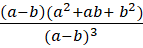 =
=  =
= 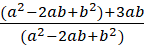 =
=  = – 1 =
  =
=  =
=  = 3 x 3 x 4 = 36
a – b = 6, ab = 616
616 can be rewritten as 22 x 28, where 28 – 22= 6 using trial and error
So, a + b = 28 + 22 = 50
CAT 2018 Slot 2 Question 12-
If the sum of squares of two numbers is 97, then which one of the following cannot be their product?
A.64
B.-32
C.16
D.48
Explanation
Given that the sum of squares of two numbers is 97 i.e. a2 + b2 = 97
From the given options we have to find which one cannot be their product i.e. ab
A. 64 ⟹ 2ab = 128
B. −32 ⟹ 2ab = -64
C. 16 ⟹ 2ab = 32
D. 48 ⟹ 2ab = 96
2ab is found because we know that
a2 + b2 + 2ab ≥ 0
a2 + b2 – 2ab ≥ 0
By this we can know that 97 + 128 works but 97 – 128 doesn’t works so we can understand option A cannot be the product and the rest can be.
a2 + b2 ≥ |2ab|
a2 + b2 ≥ 2ab
a2 + b2 ≥ -2ab
⟹ a2+b2+2 ≥ |ab|
So here 2ab should lie between +97 and -97 or ab should be less than 97/2 or greater than −97/2, so except option A all the other options works so option A 64 cannot be the product
CAT 2018 Slot 2 Question 13-
How many two-digit numbers, with a non-zero digit in the units place, are there which are more than thrice the number formed by interchanging the positions of its digits?
A.5
B.8
C.7
D.6
Explanation
Let the two-digit number be xy, which can be expressed as 10x + y
Given that the two-digit number is more than thrice the number obtained by interchanging the digits
So, 10x + y > 3 × (10y + x)
=> 10x + y > 30y + 3x
=> 7x > 29y
=> x > 297297 × y
Approximately, x > 4y
Let us fix values for y and check for conditions,
For y = 1, x can take the values of 5 , 6 , 7 , 8 , 9 (As, 51 > (3 × 15), 61 > (3 ×16), 71> (3 × 17), 81 > (3 × 18), 91 > (3 × 19))
Similarly, for y = 2, the condition satisfies only for x = 9 (As, 92 > (3 × 29))
The remaining values of y does not satisfy the given conditions.
So, Total = 5 + 1 = 6 numbers
CAT 2018 Slot 1 Question 14- While multiplying three real numbers, Ashok took one of the numbers as 73 instead of 37. As a result, the product went up by 720. Then the minimum possible value of the sum of squares of the other two numbers is
Explanation
Let the three real numbers be a, b, c. c is taken as 73 instead of 37
So, 73ab = 37ab + 720
36 ab = 720
ab = 720/36 = 20
We know, AM ≥ GM
(a2+b2)/2 ≥ ab
(a2 + b2) ≥ 2ab
(a2 + b2) ≥ 40
(Or)
ab = 20
(a,b) = (√20, √20)
(a2 + b2) = 20 + 20 = 40
CAT 2017 Slot 2 Question 15-
If the product of three consecutive positive integers is 15600 then the sum of the squares of these integers is
A.1777
B.1785
C.1875
D.1877
Explanation
Given that the product of three consecutive positive integers is 15600 and we have to find the sum of the squares of the integers
As we have two zeroes in 15600 we should have some number ending in zero or in five
156 = 12 × 13
15600 = 12 × 13 × 100 = 12 × 13 × 25 × 4
15600 = 24 × 25 × 26
The product of n (n+1)(n+2) should have a multiple of 52
The sum of the squares of these integers 24 , 25 , 26 is
242 + 262 + 252 = 576 + 625 + 676
242 + 262 + 252 = 1877