CAT 2022 Slot 3 Question1-
The minimum possible value of x^2−6x+10/3−x, for x<3, is
A.1/2
B.−1/2
C.2
D.−2
Explanation
x2−6x+103−x
x2−6x+9+13−x
x2−6x+93−x+13−x
(x−3)23−x+13−x
(x−3)2=(3−x)2
(3−x)23−x+13−x
3−x+13−x3
Since x<3x<3 is positive.
Let k = 3−x
Since k is positive, the minimum value of k+1is 2.
CAT 2022 Slot 2 Question 2-
Suppose for all integers x, there are two functions f and g
such that f(x)+f(x−1)−1=0
and g(x)=x^2. If f(x^2−x)=5, then the value of the sum f(g(5))+g(f(5)) is
Explanation
Let us look closely at “f(x) + f(x – 1) – 1 = 0”.
f(x) + f(x – 1) – 1 = 0
f(x) = 1 – f(x – 1)
This means if we know the value of f(n), we can find the value of f(n + 1), using the value of f(n + 1) we can find the value of f(n + 2)… So on and so forth, we can find the value of f(x) for any x if we find the value of f(x) for some x.
f(x2 – x) = 5
f(x(x – 1)) = 5
This means if any integer k can be expressed as a product of two consecutive integers, f(k) = 5
2 = 2 (2 – 1)
Therefore, f(2) = 5.
f(3) = 1 – f(2) = 1 – 5 = -4
f(4) = 1 – f(3) = 1 – (-4) = 5
f(5) = 1 – f(4) = 1- 5 = -4
This keeps on repeating…
Therefore,
f(odd) = -4
f(even) = 5
f(g(5)) + g(f(5))
= f(25) + g(f(5))
f(odd) = -4
f(g(5)) + g(f(5)) = f(25) + g(f(5)) = (-4) + (-4)2 = -4 + 16 = 12
CAT 2022 Slot 2 Question 3-
Let f(x) be a quadratic polynomial in x such that f(x)≥0 for all real numbers x. If f(2)=0 and f(4)=6, then f(−2) is equal to
A.12
B.36
C.24
D.6
Explanation
Let, f(x)=ax2+bx+c
Since, f(x)≥0
This means that graph of f(x) is U shaped and above the x-axis.
Since f(x) = 0 at x = 2, the graph is centered at x = 2.
This means f(2 – k) = f(2 + k).
f(2 – 2) = f(2 + 2)
f(0) = f(4)
f(0) = 6
f(0) = 6
c = 6
f(4) = 6
16 a + 4 b + 6 = 6
f(2) = 0
4 a + 2 b + 6 = 0
Solving the two equations…
a = 3232; b = -6
f(x) = 32×2−6x+6
f(-2) = 324+12+6=24324+12+6=24
CAT 2022 Slot 1 Question 4-
The largest real value of a for which the equation |x+a|+|x−1|=2 has an infinite number of solutions for x is
A.-1
B.0
C.1
D.2
Explanation
We are given |x+a| + |x−1| = 2
|x – y| signifies the distance between the points x and y.
|x – (-a)| + |x−1| = 2
Is telling you that the sum of distances between the points x and (-a) and x and 1 is 2.
This implicitly means that the distance between (-a) and 1 can’t be more than 2 in the first place.
Imagine the distance between (-a) and 1 being more than 2.
For this explanation, let us assume that (-a) is to the left of 1.
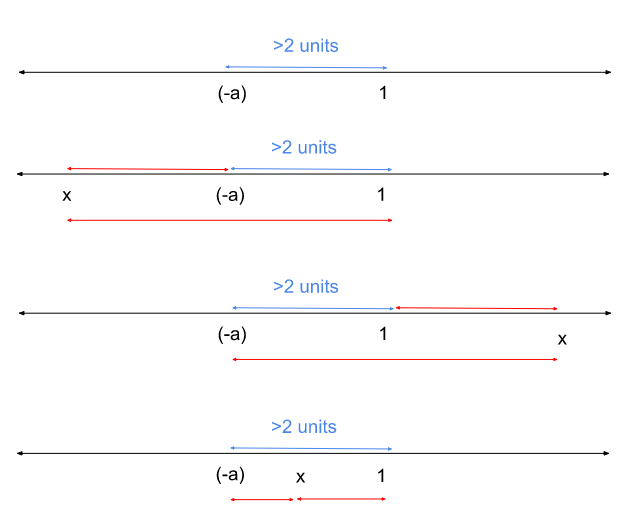
In this case |x – (-a)| + |x−1| can never be equal to 2 and it will always be greater than 2.
So, the distance between (-a) and 1 can be exactly 2 units or less than 2 units.
Case i: distance between (-a) and 1 is less than 2 units.
Assume the distance between (-a) and 1 is less than 2 units and equal to some ‘x’ units
First of all x can’t be between (-a) and 1, because then |x – (-a)| + |x−1| will be lesser than 2.
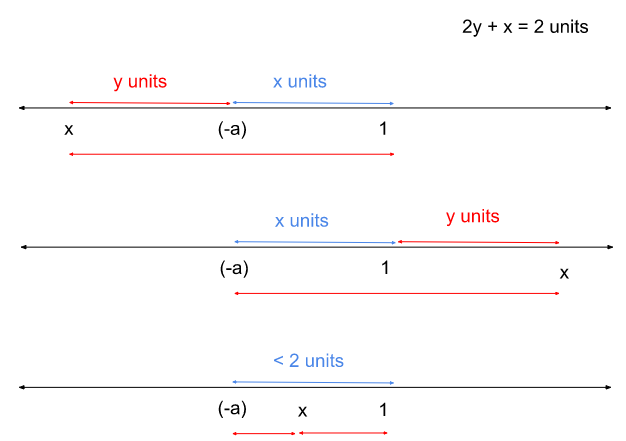
x can be y units to the left of (-a) or y units to the right of 1 such that 2y + x = 2 units. But there will just be 2 such solutions and not infinite solutions.
Case ii: distance between (-a) and 1 can be exactly 2 units.
x can only be between (-a) and 1 and can not be anywhere else.
Because if x is not between (-a) or 1, |x – (-a)| + |x−1| will be greater than 2.
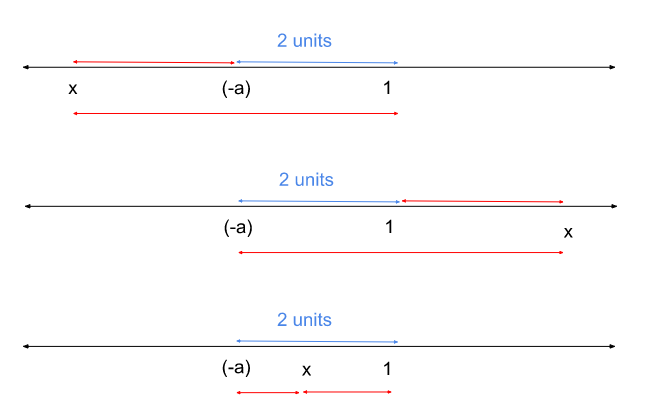
Since x can be anywhere between (-a) and 1, the value of |x – (-a)| + |x−1| will be exactly 2 units, this case satisfies the condition!
(-a) can be 2 units to the right of 1 or to the left of 1.
-a = -1
a = 1
(OR)
-a = 3
a = -3
The maximum value of a is 1.
CAT 2022 Slot 1 Question 5-
For any real number x, let [x]
be the largest integer less than or equal to x. If ∑Nn=1[15+n25]=25 then N is
Explanation
[15+n25]=[n+525]
| Range of n | Count of n | Value of [n+525][�+525] |
| 1 to 19 | 19 | 0 |
| 20 to 44 | 25 | 1 |
| 45 to 69 | 25 | 2 |
| … | … |
Clearly when N = 44, we see that ∑Nn=1[15+n25]=19(0)+25(1)=25=19(0)+25(1)=25.
Therefore, N = 44.
CAT 2022 Slot 1 Question 6-
Let 0≤a≤x≤100 and f(x)=|x−a|+|x−100|+|x−a−50|. Then the maximum value of f(x) becomes 100 when a is equal to
A.100
B.25
C.0
D.50
Explanation
f(x) = |x − a| + |x − 100| + |x − a − 50|
f(x) be re-written as |x − a| + |x − 100| + |x − (a+50)|
| x – a | signifies the distance between x and a.
| x – 100 | signifies the distance between x and 100.
| x – (a + 50) | signifies the distance between x and a + 50.
Since a≤x≤100
|x − a| + |x − 100| is just 100 – a and is independent of x
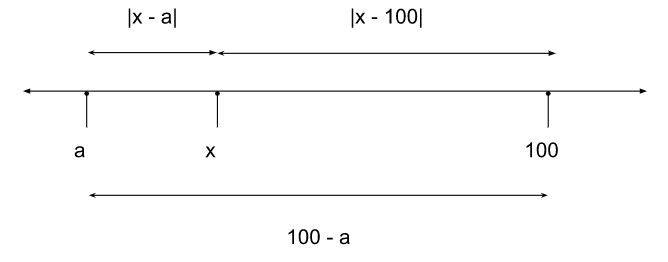
f(x) = |x − a| + |x − 100| + |x − (a+50)|
f(x) = (100 – a) + |x − (a+50)|
Now, let’s talk about |x − (a+50)|.
We know that x≥a�≥�, let us try to understand the maximum value that |x − (a+50)| can take.
x can be between a and (a + 50) or x can be to the right of (a + 50)
Case (i)
x is between a and (a + 50)
If this is the case, the maximum distance between a and (a+50) is just 50.
And this happens when x = a.
For any given value of ‘a’, We can just put ‘x’ at ‘a’ and make |x − (a+50)| equal to 50.
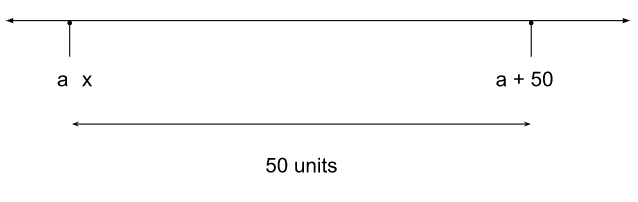
Case (ii)
x is to the right of (a + 50)
To find the maximum value that |x − (a+50)| can take, let us push x to the right most possible position and push (a + 50) to the left-most possible position.
The right-most value that x can take is 100.
It looks like there is no hold on the left-most value that (a + 50) can take, but there is!
The left-most value that (a + 50) can take is dependent on the left-most value that ‘a’ can take. And the left-most value that ‘a’ can take is 0.
So in this extreme case of maximizing the distance between x and (a + 50),
a is at 0, (a+50) will be at 50, x is at 100
And the distance between x and (a + 50) is 50.
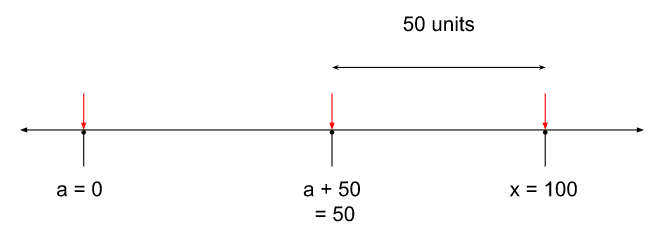
But why is understanding the maximum value that |x − (a+50)| can take important?
Once we establish the following two facts,
(i)|x − a| + |x − 100| is just 100 – a and is independent of x
(ii) For any given value of ‘a’, We can just put ‘x’ at ‘a’ and make |x − (a+50)| equal to 50.
For any given ‘a’, we can think of f(x) = |x − a| + |x − 100| + |x − (a+50)| as having a fixed part and a variable part.
Fixed part:|x − a| + |x − 100| = 100 – a
Whose value is fixed and does not change with the value of ‘x’
Variable part: |x − (a+50)|
Whose value can range from 0 to 50, based on the value of ‘x’
f(x) = (100 – a) + (something that reaches from 0 to 50)
If we need to fix the maximum value of f(x) at 100, we need to tackle the “worst-case scenario” that the ‘variable part’ can cause…
That is, we need to see f(x) = (100 – a) + (something that reaches from 0 to 50) as f(x) = (100 – a) + (something that is 50)
Now to cap f(x) at 100, (and also allow it take the value 100) we just need to set (100 – a) to 50, which happens when a = 50.
Therefore, a = 50.
CAT 2021 Slot 3 Question 7-
If f(x)=x^2−7x
and g(x)=x+3
, then the minimum value of f(g(x))−3x
is
A.- 20
B.- 15
C.- 12
D.- 16
Explanation
g(x) = x + 3
f(x) = x2 – 7x
f(g(x)) – 3x
= f(x + 3) – 3x
= (x + 3)2 – 7(x + 3) – 3x
= x2 + 9 + 6x – 7x – 21 – 3x
= x2 – 4x – 12
= x2 – 4x + 4 – 4 – 12
= x2 – 4x + 4 – 16
= (x – 2)2 – 16
f(g(x)) – 3x is minimum when (x – 2)2 – 16 is minimum.
(x – 2)2 – 16 is minimum when (x – 2)2 is minimum.
Since (x – 2)2 is non-negative, the minimum value it can take is 0.
Hence the minimum value of (x – 2)2 – 16 = 0 – 16 = -16
Therefore, the minimum value of f(g(x)) – 3x is -16
CAT 2021 Slot 2 Question 8-
For all real values of x, the range of the function f(x) = x^2+2x+4/2x^2+4x+9
is
A.[ 3/7 , 8/9 )
B.[ 4/9 , 8/9 ]
C.[ 3/7 , 1/2 )
D.( 3/7 , 1/2 )
Explanation
We have a function f(x) = x2+2x+42×2+4x+9
We can complete the squares in the numerator as
f(x) = x2+2x+1+32×2+4x+9
f(x) = (x+1)2+32×2+4x+9
Now we try to get (x + 1)2in the denominator as well
f(x) = (x+1)2+32(x+1)2+7
From here we can take out (x+1)2 + 3 from both, the numerator and the denominator and put it as ‘k’
Replacing (x+1)2 + 3 with k we get
f(x) = k/2k+1
The minimum value of k = 3, as the square part is always positive and another positive number is added to the equation.
So the fraction will have the minimum value when k = 3
f(x) = 3/2(3)+1= 3/7
And, the maximum value when k approaches its maximum value. We can observe that the fraction has a 2k + 1 in the denominator and so it will always be one more than twice the numerator. As the value of k increases the value of the addition of one gets less and less of a value to the overall denominator. The fraction approaches 1/2 , but never 1/2 itself.
Hence the range becomes [3/7,1/2)
CAT 2021 Slot 1 Question 9-
f(x) = x^2+2x−15/x^2−7x−18
is negative if and only if
A.-5 < x < -2 or 3 < x < 9
B.-2 < x < 3 or x > 9
C.x < -5 or 3 < x < 9
D.x < -5 or -2 < x < 3
Explanation
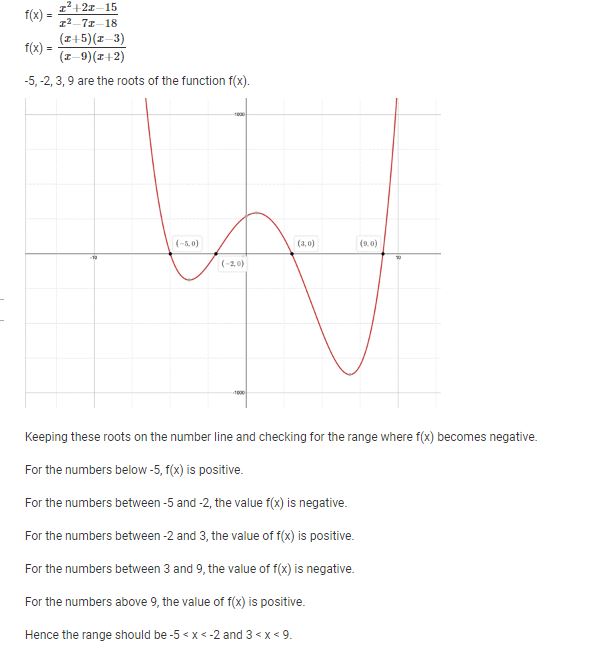
CAT 2020 Slot 3 Question 10-
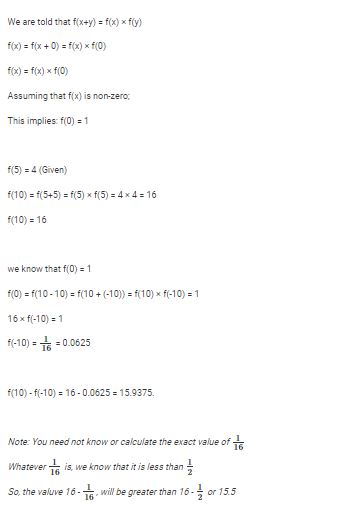
If f(x+y) = f(x)f(y) and f(5) = 4, then f(10) – f(-10) is equal to
A.3
B.0
C.14.0625
D.15.9375
Explanation
CAT 2020 Slot 1 Question 11-
If f(5 + x) = f(5 – x) for every real x and f(x) = 0 has four distinct real roots, then the sum of the roots is
A.0
B.40
C.10
D.20
Explanation
Given f (5 + x) = f (5 – x)
When x = 1, f(6) = f(4)
When x = 2, f(7) = f(3)
Imagine a graph and while joining (6,4) and (7,3) it looks symmetrical about 5
Given 4 distinct real roots. Assume 12 as one of the roots.
f(12) = 0 –> Then f(5 + 7) = 0 which is same as f(5 – 7) = f(-2) = 0
So the roots are in the form (5 + k) and (5 – k) {This is one pair}
Sum of the roots = 5 + k + 5 – k = 10
We have 4 roots, So two pairs =10 + 10 = 20
CAT 2019 Slot 2 Question 12- Let f be a function such that f (mn) = f (m) f (n) for every positive integers m and n. If f (1), f (2) and f (3) are positive integers, f (1) < f (2), and f (24) = 54, then f (18) equals
Explanation

CAT 2019 Slot 1 Question 13-
For any positive integer n, let f(n) = n(n + 1) if n is even, and f(n) = n + 3 if n is odd. If m is a positive integer such that 8f(m + 1) – f(m) = 2, then m equals
Explanation
If n is even, f(n) = n (n + 1)
So, f (2) = 2(2+1) = 2 (3) = 6
If n is odd, f(n) = n + 3
f (1) = 1 + 3 = 4
It is given that, 8 x f(m+1) – f(m) =2
So, m can either be even or odd
Case-1: If m were even and m+1 odd
So, 8 x f(m+1) – f(m) =2
8(m + 4) – m (m + 1) = 2
8m + 32 – m2 – m = 2
m2 – 7m – 30 = 0
(m-10) (m+3) = 0
m = 10 or -3
m = 10, since m is positive
Case-2: If m were even and m+1 odd
8 x f(m+1) – f(m) =2
8 (m +1) (m + 2) – (m + 3) = 2
Now, let us substitute m = 1 which is the minimum possible value
8 (1 + 1) (1 + 2) – (1 + 3)  3
3
Case 2 does not work
CAT 2019 Slot 1 Question 14- Consider a function f(x+y) = f(x) f(y) where x , y are positive integers, and f(1) = 2. If f (a+1) + f (a+2) + ….. + f(a+n) = 16 (2n – 1) then a is equal to.
Explanation

CAT 2018 Slot 2 Question 15- Let f(x)=max{5x, 52 – 2x^2}, where x is any positive real number. Then the minimum possible value of f(x) is
Explanation
Given that f(x) = max{5x , 52 – 2x2}, where x is any positive real number.
The minimum possible value of f(x) has to found.
The minimum possible value is obtained if the two curves intersect or
5x = 52 – 2x2
2x2 + 5x – 52 = 0
2x2 – 8x + 13x – 52 = 0
2x(x – 4) + 13(x – 4) = 0
(2x + 13)(x – 4) = 0
x = −132−132 or 4
One of these would be the minimum possible value
It is given that x is a positive real number. So, we have to consider only when x = 4
When x = 4
5x = 5 × 4 = 20
52 – 2x2 = 52 – 2(4)2 = 20
The minimum possible value of f(x) is 20
CAT 2018 Slot 1 Question 16- If f(x + 2) = f(x) + f(x + 1) for all positive integers x, and f(11) = 91, f(15) = 617, then f(10) equals
Explanation
Method of solving this CAT Question from Functions
Given, f(x+2) = f(x) + f(x+1) f(11) = 91, f(15) = 617
We get 91 + f(12) = f(13)
Let f(12) be equal to some value ‘a’
So, 91 + a = f(13).
f(12) + f(13) = f(14)
a + 91 + a = f(14)
So, f(14) = 2a + 91 f(13) + f(14) = 617
So, 91 + a + 2a + 91 = 617
3a + 182 = 617
a = 145
Substituting the value of a and f(11), we get
f(10)+ 91 = 145
f(10) = 54
CAT 2017 Slot 2 Question 17-
Let f(x) = x^2 and g(x) = 2x, for all real x. Then the value of f(f(g(x)) + g(f(x))) at x = 1 is
A.16
B.18
C.36
D.40
Explanation
Given that f(x) = x2 and g(x) = 2x.
We have to find the value of f(f(g(x)) + g(f(x))) at x = 1,
⟹ g(1) = 21 = 2 ; f(1) = 12 = 1
First, let us find the value of f(g(x)) + g(f(x)) at x = 1,
⟹ f(g(1)) + g(f(1)) = f(2) + g(1)
⟹ 22 + 2
⟹ 6
Therefore, f(g(1)) + g(f(1)) = 6.
The value of f(f(g(1)) + g(f(1))) = f(6)
⟹ f(6) = x2 = 62 = 36
CAT 2017 Slot 2 Question 18- If f(ab) = f(a)f(b) for all positive integers a and b, then the largest possible value of f(1) is
Explanation
Given that f(ab) = f(a) × f(b) for all possible integers a and b.
We have to find the largest possible value of f(1). We know that,
f(ab) = f(a) × f(b)
⟹ f(a × 1) = f(a) × f(1)
⟹ [f(a) × f(1)] – f(a) = 0
⟹ f(a)[f(1) – 1] = 0
There are two possibilities here, either f(a) = 0 or f(1) – 1 = 0.
If f(a) = 0, then it is a constant function. Hence, f(1) = 0.
But, if f(1) – 1 = 0, f(1) = 1.
Hence, f(1) = 0 or f(1) = 1.
Out of these, f(1) = 1 is the largest possible value.
CAT 2017 Slot 1 Question 19- If f1(x) = x^2 + 11x + n and f2(x) = x, then the largest positive integer n for which the equation f1(x) = f2(x) has two distinct real roots, is:
Explanation
Given that f1(x) = x2 + 11x + n and f2(x) = x,
Then we have to find the largest positive integer n for which the equation f1(x) = f2(x) has two distinct real roots.
⟹ x2 + 11x + n = x
⟹ x2 + 11x – x + n = 0
⟹ x2 + 10n + n = 0
The discriminant should be greater than zero, D > 0.
So, b2 – 4ac > 0.
⟹ 102 – 4n > 0
⟹ 100 – 4n > 0
⟹ 25 – n > 0
⟹ n = 24
Hence if f1(x) = x2 + 11x + n and f2(x) = x, then the largest positive integer n for which the equation
f1(x) = f2 (x) has two distinct real roots, is 24.
CAT 2017 Slot 1 Question 20-
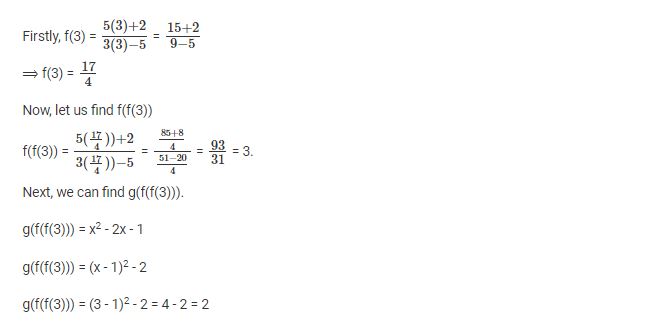
If f(x) = 5x+2/3x−5
and g(x) = x^2 – 2x – 1, then the value of g(f(f(3))) is:
A.2
B.1/3
C.6
D.2/3
Explanation