- CAT 2022 QA Slot 1 | Geometry – Coordinate Geometry CAT Question
Let ABCD be a parallelogram such that the coordinates of its three vertices A, B, C are (1, 1), (3, 4) and (−2, 8), respectively. Then, the coordinates o the vertex D are
(a) (4, 5)
(b) (0, 11)
(c) (-4, 5)
(d) (-3, 4)
Explanation
In a parallelogram, opposite sides are parallel, which means that the slopes of opposite sides are equal. We can use this property to find the coordinates of vertex D.
Let’s find the slope of side AB, which is the line passing through points A(1, 1) and B(3, 4):
Slope of AB (m_AB) = (y2 – y1) / (x2 – x1) = (4 – 1) / (3 – 1) = 3/2.
Now, since opposite sides of a parallelogram are parallel, the slope of side CD must also be 3/2. We can use this information to find the coordinates of D( x, y).
Let’s use point-slope form to find the equation of side CD, knowing the slope (m_CD) and one point (C(-2, 8)):
y – y1 = m_CD(x – x1)
y – 8 = (3/2)(x – (-2))
y – 8 = (3/2)(x + 2)
Now, let’s solve for y:
y = (3/2)(x + 2) + 8
y = (3/2)x + 3 + 8
y = (3/2)x + 11
So, the equation of side CD is y = (3/2)x + 11. Now, we can find the x-coordinate of point D by setting y = 4 (the y-coordinate of point B):
4 = (3/2)x + 11
Let’s solve for x:
(3/2)x = 4 – 11
(3/2)x = -7
Now, divide by 3/2 to find x:
x = (-7) / (3/2)
x = (-7) * (2/3)
x = -14/3
So, the x-coordinate of point D is -14/3. Now, we can find the y-coordinate of point D using the equation of side CD:
y = (3/2)x + 11
y = (3/2) * (-14/3) + 11
y = -7 + 11
y = 4
Therefore, the coordinates of vertex D are D(-14/3, 4), which is approximately (-4.67, 4).
The closest answer choice to D(-4.67, 4) is option (c) (-4, 5).
- CAT 2020 QA Slot 3 | Geometry – Coordinate Geometry CAT Question
The points (2, 1) and (-3, -4) are opposite vertices of a parallelogram. If the other two vertices lie on the line x + 9y + c = 0, then c is
- 15
- 12
- 13
- 14
Explanation
To find the value of ‘c’ in the equation x + 9y + c = 0 for the other two vertices of the parallelogram, you can use the fact that opposite sides of a parallelogram are parallel.
The given points (2, 1) and (-3, -4) are opposite vertices of the parallelogram. So, the line joining these two points is parallel to the line x + 9y + c = 0.
First, let’s find the slope of the line passing through the points (2, 1) and (-3, -4):
Slope (m) = (y2 – y1) / (x2 – x1)
Slope (m) = (-4 – 1) / (-3 – 2)
Slope (m) = (-5) / (-5)
Slope (m) = 1
Now, since this line is parallel to the line x + 9y + c = 0, it means that their slopes are equal. So, we have:
1 = the slope of x + 9y + c
Now, we need to find ‘c’ in the equation x + 9y + c = 0. We know that the coefficient of ‘y’ in this equation is 9, which is the slope. Therefore, we can write:
9 = 1
Now, solve for ‘c’:
c = 9 – 1
c = 8
So, the value of ‘c’ is 8. None of the provided options (15, 12, 13, 14) match the correct value of ‘c.’
- CAT 2020 QA Slot 3 | Geometry – Coordinate Geometry CAT Question
The vertices of a triangle are (0, 0), (4, 0) and (3, 9). The area of the circle passing through these three points is
(a) 123π/7
(b) 205π/9
(c) 14π/3
(d) 12π/5
Explanation

- CAT 2020 QA Slot 3 | Geometry – Coordinate Geometry CAT Question
The area, in sq. units, enclosed by the lines x = 2, y = |x – 2| + 4, the X-axis and the Y-axis is equal to
- 6
- 10
- 8
- 12
Explanation

- CAT 2019 QA Slot 1 | Geometry – Coordinate Geometry CAT Question
Let S be the set of all points (x, y) in the x-y plane such that |x| + |y| ≤ 2 and |x| ≥ 1. Then, the area, in square units, of the region represented by equals
Explanation

- CAT 2019 QA Slot 1 | Geometry – Coordinate Geometry CAT Question
Let T be the triangle formed by the straight line 3x + 5y − 45 = 0 and the coordinate axes. Let the circumcircle of T have radius of length L, measure in the same unit as the coordinate axes. Then, the integer closest to L is
Explanation

- CAT 2018 QA Slot 2 | Geometry – Coordinate Geometry CAT Question
A triangle ABC has area 32 sq units and its side BC, of length 8 units, lies on the line x = 4. Then the shortest possible distance between A and th point (0, 0) is
- 8 units
- 4 units
- 2 √ 2 units
- 2√4 units
Explanation

- CAT 2017 QA Slot 1 | Geometry – Coordinate Geometry CAT Question
The area of the closed region bounded by the equation | x | + | y | = 2 in the two-dimensional plane is

- 4π
- 4
- 8
- 2π
Explanation
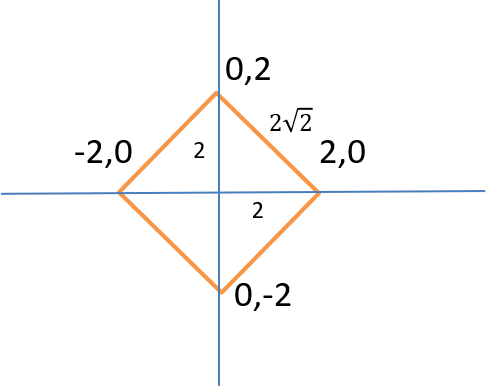
The area of the closed region bounded is given by the equation,
| x | + | y | = 2.
We can substitute x = 0 or y = 0.
The coordinates we obtain are as follows;
(2,2) , (-2,2) , (2,-2) and (-2,-2)
On joining these points you will get a square whose diagonal is 4 units. Therefore, the sides of the square will be 2√(2) and its area will be 2√(2) × 2√(2) = 8
The area of the closed region is 8 sq. units.
The question is “The area of the closed region bounded by the equation | x | + | y | = 2 in the two-dimensional plane is”
Hence, the answer is 8 sq. units
Choice C is the correct answer.
- CAT 2017 QA Slot 2 | Geometry – Coordinate Geometry CAT Question
The points (2, 5) and (6, 3) are two end points of a diagonal of a rectangle. If the other diagonal has the equation y = 3x + c, then c is
- -5
- -6
- -7
- -8
Explanation

- CAT 2005 QA | Geometry – Coordinate Geometry CAT Question
Consider a triangle drawn on the X-Y plane with its three vertices at (41, 0), (0, 41) and (0, 0), each vertex being represented by its (X, Y) coordinate The number of points with integer coordinates inside the triangle (excluding all the points on the boundary) is
(a) 780
(b) 800
(c) 820
(d) 741
Explanation

- CAT 2002 QA | Geometry – Coordinate Geometry CAT Question
The area of the triangle with the vertices (a, a), (a + 1, a) and (a, a + 2) is
- a3
- 1
- 0
- None of these
Explanation

The area bounded by the three curves |x + y| = 1, |x| = 1, and |y| = 1, is equal to
- 4
- 3
- 2
- 1
Explanation

- CAT 2000 QA | Geometry – Coordinate Geometry CAT Question
Choose 1; if the question can be answered by using one of the statements alone, but cannot be answered using the other statement alone.
Choose 2; if the question can be answered by using either statement alone.
Choose 3; if the question can be answered by using both statements together, but cannot be answered using either statement alone.
Choose 4; if the question cannot be answered even by using both statements together.
There are two straight lines in the x-y plane with equations ax + by = c , dx + ey = f. Do the two straight lines intersect?
- a, b, c, d, e and f are distinct real numbers.
- c and f are non-zero.
- 1
- 2
- 3
- 4
Explanation
Directions: Answer the questions based on the following information.
A robot moves on a graph sheet with X and Y-axis. The robot is moved by feeding it with a sequence of instructions. The different instructions that can be used in moving it, and their meanings are:

- CAT 1999 QA | Geometry – Coordinate Geometry CAT Question
The robot reaches point (6, 6) when a sequence of three instructions is executed, the first of which is a GOTO(x,y) instruction, the second is WALKX(2 and the third is WALKY(4). What are the value of x and y?
(a) 2, 4
(b) 0, 0
(c) 4, 2
(d) 2, 2
Explanation
The robot starts at the origin (0,0) on the graph sheet. Let’s break down the sequence of instructions:
- GOTO(x, y): This instruction moves the robot to the point (x, y).
- WALKX(n): This instruction moves the robot n units in the positive direction along the X-axis.
- WALKY(n): This instruction moves the robot n units in the positive direction along the Y-axis.
In this case, the robot executes the following instructions:
- GOTO(x, y): The robot moves to the point (x, y).
- WALKX(2): The robot moves 2 units to the right along the X-axis.
- WALKY(4): The robot moves 4 units up along the Y-axis.
Since the robot reaches the point (6, 6) after executing these instructions, we can determine the values of x and y:
x = 0 (initial position) + 2 (WALKX) = 2
y = 0 (initial position) + 4 (WALKY) = 4
So, the values of x and y are (2, 4).
Therefore, the correct answer is:
(a) 2, 4
- CAT 1999 QA | Geometry – Coordinate Geometry CAT Question
The robot is initially at (x, y), x > 0 and y < 0. The minimum number of instructions needed to be executed to bring it to the origin (0, 0) if you ar prohibited from using the GOTO instruction is
- 2
- 1
- x + y
- 0
Explanation
If the robot is initially at a point (x, y), where x > 0 and y < 0, and you are prohibited from using the GOTO instruction, you need to bring it to the origin (0, 0) using only the available instructions: WALKX and WALKY.
To do this, you can follow these steps:
- Move the robot to the x-axis (y = 0):
- Use WALKY(-y) to move the robot to the x-axis. This instruction will move the robot parallel to the Y-axis by a distance of -y in the negative direction. After this step, the robot will be on the x-axis.
- Move the robot to the origin (0, 0):
- Use WALKX(-x) to move the robot to the origin. This instruction will move the robot parallel to the X-axis by a distance of -x in the negative direction.
The minimum number of instructions needed is 2: WALKY(-y) and WALKX(-x).
So, with the prohibition on the GOTO instruction, the minimum number of instructions required to bring the robot from its initial position to the origin is 2.
- CAT 1991 QA | Geometry – Coordinate Geometry CAT Question
What is the distance between the points A(3, 8) and B(–2, –7)?
(a) 5√2
(b) 5
(c) 5√10
(d) 10√2
Explanation
To find the distance between two points A(3, 8) and B(-2, -7), you can use the distance formula, which is based on the Pythagorean theorem. The distance formula is:
Distance = √((x2 – x1)^2 + (y2 – y1)^2)
In this case:
- x1 = 3 (x-coordinate of point A)
- y1 = 8 (y-coordinate of point A)
- x2 = -2 (x-coordinate of point B)
- y2 = -7 (y-coordinate of point B)
Plug these values into the formula:
Distance = √((-2 – 3)^2 + (-7 – 8)^2)
Distance = √((-5)^2 + (-15)^2)
Distance = √(25 + 225)
Distance = √250
Now, you can simplify √250:
√250 = √(25 * 10) = 5√10
So, the distance between points A(3, 8) and B(-2, -7) is 5√10 units.