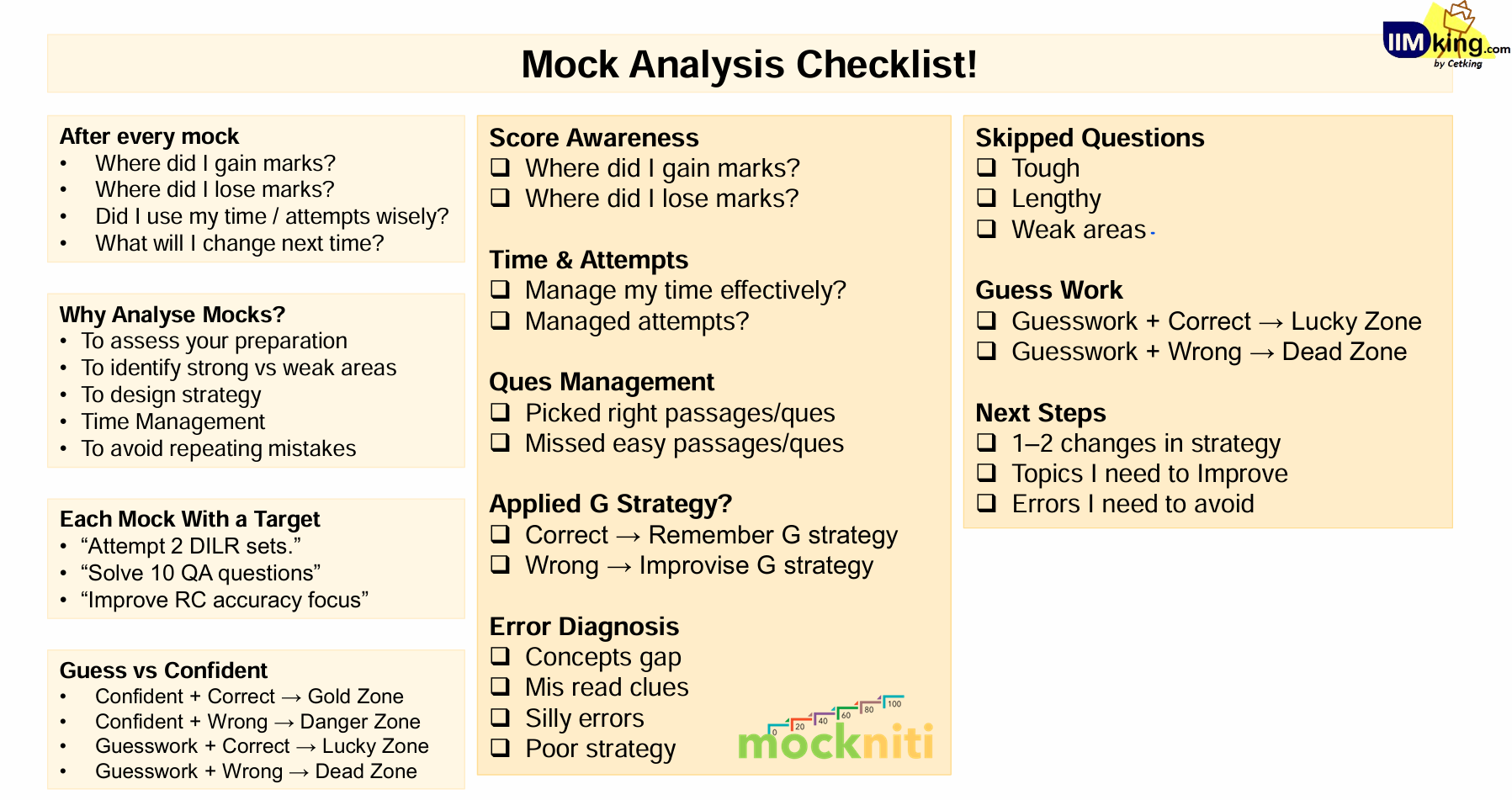
Mock Strategy & Analysis Guide for CAT
Mocks are the most powerful weapon in your CAT preparation toolkit. They simulate the actual exam pattern, test your stamina, and reveal your strengths and weaknesses.
But here’s the truth:
👉 Taking mocks alone will not raise your percentile.
👉 Many students get stuck in a score plateau because they never sharpen the axe — they keep cutting the tree with the same blunt blade.
👉 The real improvement comes from deep analysis, not from the number of mocks.
Why Analyse Mocks?
- To assess your current level of preparation
- To identify strong vs weak areas
- To maximize strengths and minimize weaknesses
- To design a personalised strategy
- To avoid repeating the same mistakes
Skipping analysis = repeating mistakes = stagnation.
Step 1: Appear for Mocks Consistently
- Start now — don’t delay thinking “I’m not ready yet.” There is no tomorrow.
- Begin with sectional tests if full-length mocks feel intimidating. Build confidence, then move to full mocks.
- Take 1–2 mocks per week, increase frequency closer to CAT.
- Always attempt mocks in the same slot as your actual exam (morning/afternoon/evening).
- Consistency is non-negotiable.
Step 2: Enter Each Mock With a Target
- Don’t attempt mocks aimlessly.
- Examples of micro-goals:
- “Attempt 2 DILR sets.”
- “Solve 10 QA questions with 80% accuracy.”
- “Improve RC accuracy by 10%.”
- Targets give direction and help you track progress.
Step 3: Build a CAT Mock Strategy (During the Mock)
Quant (QA)
- Round 1: Attempt sitters (easy ones).
- Round 2: Attempt “mark for review” questions.
- Round 3: Try tougher questions only if time permits.
👉 Rule: Don’t waste 10 minutes on one ego question.
VARC
- Decide your entry point: RCs or VA.
- Pick RCs you find interesting/familiar. Focus on main idea + author’s argument.
- If stuck between 2 options, mark and move on.
- Time split: ~30 mins RC, ~6–10 mins VA.
- TITA in VA = free hits → maximize them.
DILR
- If you solve <2 sets per mock: scan all sets for 5–6 mins, pick 1–2 easiest.
- If you solve 2+ sets per mock: skip scanning, dive straight in.
- If no progress in 4–5 mins, drop the set.
👉 Rule: Selection > Solving.
Step 4: Analyse the Mock (4 Hours of Real Work)
Yes, for a 2-hour mock and 2 hours for analysis needed. Why so much? Because you must revisit every single question: correct, wrong, skipped, guessed.
Step 5: Question-Wise Analysis
- Unattempted Questions
- Was it from a weak area?
- Too tough/lengthy?
- Confusing due to close options?
👉 This helps decide which to leave in real exam and which to prepare better.
- Wrong Questions
- VARC: Was your reasoning aligned with the author?
- DILR: Did you misinterpret clues?
- QA: Calculation slip or concept gap?
👉 Always pinpoint the root cause.
- Right Questions
- Check if your method was the best or too slow.
- Learn faster/alternative methods.
- Guess Questions
- Don’t guess randomly.
- Restrict to the end, after you hit attempt targets.
- Narrow to 2 options → make a calculated guess.
Step 6: Section-Wise Analysis
VARC
- Analyse immediately post-mock (memory fades fast).
- Re-read RCs → check if your main idea matched the author’s.
- For para jumbles/odd sentences/summaries → always try logic first, then check answer.
- Track passage selection accuracy and time spent per RC.
DILR
- Revisit all sets.
- Correct sets → find faster approaches.
- Incorrect/unsolved → re-solve for 15–30 mins before checking solutions.
- Focus on clue interpretation — most errors are due to misreading.
- Note unique sets in a diary for revision.
QA
- Evaluate every question equally.
- Classify:
- a) Correct & fast (<2 mins) → strong area
- b) Correct but slow → optimize with tricks/shortcuts
- c) Incorrect → re-solve, check concept
- d) Unsolved → attempt again, then verify
- Track time taken vs average time taken.
- Maintain a QA notebook for formulas, mistakes, and key questions → revise before every mock.
Step 7: Re-Solve the Entire Mock
- After 2-hour break, attempt the whole mock again without timer.
- Compare attempt 1 vs attempt 2.
👉 This reveals if the problem was knowledge gap or test pressure.
Step 8: Build a Personal Cheat-Sheet
As you analyse, keep adding:
- Formulas & shortcuts
- DI/LR tricks
- RC strategies
- Grammar rules & vocabulary
This becomes your last-week quick revision kit.
Step 9: Refine Your Strategy for the Next Mock
Every mock = feedback loop.
- What worked?
- What failed?
- Apply 1–2 specific changes in the next mock.
👉 Strategy is personal. The plan that works for someone else may not suit you. Refine until you find your personal blueprint.
Step 10: Repeat the Cycle
Mocks = net practice before the big match. There’s no magic number — just keep repeating the cycle:
Take → Analyse → Refine → Repeat.
Don’t be disheartened if your first mocks go poorly. Rome wasn’t built in a day. Improvement is gradual — but guaranteed if you analyse properly.
Extra Tools & Pro Tips
- Error Log: Maintain topic | mistake type | learning.
- Silly Mistakes Diary: Record careless slips (missed minus sign, misread variable).
- Energy Tracker: Note fatigue timings, plan diet/hydration.
- AI Analysis Tools: If available, use them to identify repeated error types and time sinks.
- Mock Comparison: Track progress across mocks — accuracy, attempts, strengths, weaknesses.
The Golden Rule
Don’t just say: “I scored 78 marks.”
Ask instead:
- Where did I gain marks?
- Where did I lose marks?
- What will I change next time?
Final Word
Mocks are your practice matches, but analysis is the coaching session that makes you sharper.
Remember:
- Hard work = taking mocks.
- Smart work = analysing mocks.
By combining both, you’ll break past stagnation and move closer to your dream B-school.
Mock tests are the most effective way to prepare for CAT, but taking them alone will not improve your score. The key is thorough analysis after every mock. Many students experience stagnant scores because they focus only on the number of mocks attempted rather than learning from mistakes. Proper analysis helps you identify strengths, weaknesses, and the right strategy for exam day.
Start by revisiting all questions. For unattempted ones, ask why you skipped them—were they from weak areas, too lengthy, or confusing? For incorrect answers, check if the issue was a conceptual gap, a calculation slip, or misinterpretation. For correct answers, look for faster or smarter methods. Even guesses should be reviewed to ensure they were calculated eliminations rather than random choices.
Section-wise analysis is essential. In VARC, check if your understanding matched the author’s reasoning, whether you selected the right passages, and if you managed time well. In DILR, review set selection and whether you followed clues properly. Note unique sets for future revision. In QA, classify questions into four types—fast and correct, slow and correct, incorrect, and unsolved. Optimize slow ones, fix concept gaps, and attempt unsolved questions again.
After the mock, take a short break and then reattempt the paper without a timer. This helps you distinguish knowledge gaps from issues caused by pressure or fatigue. Maintain an error log for recurring issues, keep a silly mistakes diary, and build a personal cheat-sheet of shortcuts, formulas, and tricks.
Finally, use each mock as feedback. Ask: Where did I gain marks? Where did I lose marks? What should I change next time? Continuous cycles of taking, analyzing, refining, and repeating mocks will ensure consistent improvement and push your percentile closer to your target B-school cutoff.
CAT 2025 mock analysis, CAT 2026 mock analysis, CAT mock test strategy, how to analyse CAT mocks, CAT preparation tips, CAT mock test analysis guide, CAT exam strategy, CAT percentile improvement, CAT VARC DILR QA analysis, CAT question wise analysis, CAT section wise analysis, CAT 2025 preparation plan, CAT 2026 preparation plan, mock test tips for CAT, CAT exam preparation 2025, CAT exam preparation 2026, how to improve CAT score, CAT mock test mistakes, CAT mock test review, CAT preparation YouTube description, CAT exam percentile booster, CAT mock strategy 2025, CAT mock strategy 2026, MBA entrance exam preparation