Question Paper, Answer key and Detailed Solutions
CAT 2025 Slot 2 – Score vs Attempts
The following table will be updated once student feedback from Slot 2 is analysed:
| Percentile | VARC Score | DILR Score | QA Score | Overall Score |
| 99.9 | 52.50 | 42.00 | 45.00 | 116.00 |
| 99.5 | 44.00 | 34.00 | 37.00 | 97.50 |
| 99 | 38.00 | 27.33 | 31.33 | 84.33 |
| 97 | 32.56 | 23.00 | 25.67 | 71.11 |
| 95 | 28.67 | 19.00 | 22.00 | 63.33 |
| 90 | 23.50 | 14.50 | 16.00 | 50.50 |
| 80 | 16.67 | 11.33 | 12.33 | 37.00 |
| 70 | 12.00 | 10.00 | 9.00 | 27.00 |
| 60 | 9.00 | 8.00 | 7.00 | 25.00 |
CAT 2025 Slot 2 – Percentile vs Attempts
The following table will be updated once student feedback from Slot 2 is analysed:
| %ile | Verbal Attempts | DILR Attempts | Quant Attempts | Overall Attempts |
| 50 | 3 | 4 | 2 | 10 |
| 60 | 4 | 5 | 3 | 13 |
| 70 | 6 | 6 | 5 | 15 |
| 80 | 9 | 9 | 6 | 22 |
| 85 | 10 | 10 | 7 | 25 |
| 90 | 12 | 11 | 9 | 29 |
| 95 | 15 | 13 | 11 | 35 |
| 98 | 18 | 15 | 13 | 43 |
| 99 | 20 | 16 | 15 | 48 |
| 100 | 20+ | 18+ | 17+ | 70+ |
CAT 2025 Slot 2 – Actual Paper, Question Pattern & Complete Analysis
The second slot of CAT 2025 will be conducted on [30 Nov 2025] from [12.30 and 2:30 pm]. With Slot 1 already completed earlier in the day, early feedback from test-takers has indicated potential shifts in pattern, sectional weightage, and difficulty levels. This page will be updated in real-time once Slot 2 concludes. Go through the full CAT 2025 Slot 2 analysis to understand the paper pattern, difficulty level, expected cutoffs, and section-wise breakdown.
CAT 2025 Slot 2 – Overall Exam Structure
Early reports indicate [mention expected change – e.g., MCQ/TITA distribution, VA type changes, DILR set pattern]. The table below shows the expected section structure (to be updated after the exam):
| Section | Duration | MCQs | TITA | Total |
|---|---|---|---|---|
| VARC | 40 min | 22 | 2 | 24 |
| DILR | 40 min | 14 | 8 | 22 |
| QA | 40 min | 14 | 8 | 22 |
| Total | 120 min | 48 | 18 | 68 |
Marking scheme: +3 for correct, −1 for incorrect (MCQ only), and no negative marking for TITA.
CAT 2025 Slot 2 – Verbal Ability & Reading Comprehension (VARC)
As per early inputs, CAT 2025 Slot 2 VARC featured [16 (4×4)] RC questions and [8] VA questions. There were 2 each on Summary, Para Jumbles, Para Completion, Summary and Odd One Out. RC difficulty was [2 Easy to mod, 2 Moderate to high]. CAT 2025 Verbal presented predictable RCs with moderate reasoning and fewer vocabulary traps. VA focused on Summary, Paragraph Completion, and Odd Sentence questions, maintaining logical coherence as the core skill. Accuracy dominated over attempts, and careful reading of nuanced RC paragraphs separated 95+ percentile performers from the rest.
| Area / Question Type | No. of Qs | LOD |
|---|---|---|
| Reading Comprehension | 16 | Medium to High |
| Passage 1: AI (For and Against) | 4 | Easy to Medium |
| Passage 2: Science & Culture | 4 | Medium to High |
| Passage 3: TetraFish evolution | 4 | Easy to Medium |
| Passage 4: Literature & Roles | 4 | Medium to High |
| Verbal Ability | 8 | Medium to High |
| Summary | 2 | Medium to High |
| Paragraph Completion | 2 | Easy to Medium |
| Odd Sentence | 2 | Easy to Medium |
| Para Jumbles | 2 | Medium to High |
The passage below is accompanied by four questions. Based on the passage, choose the best answer for each question.
In [my book “Searches”], I chronicle how big technology companies have exploited human language for their gain. We let this happen, I argue, because we also benefit somewhat from using the products. It’s a dynamic that makes us complicit in big tech’s accumulation of wealth and power: we’re both victims and beneficiaries. I describe this complicity, but I also enact it, through my own internet archives: my Google searches, my Amazon product reviews and, yes, my ChatGPT dialogues. . . .
People often describe chatbots’ textual output as “bland” or “generic” – the linguistic equivalent of a beige office building. OpenAI’s products are built to “sound like a colleague”, as OpenAI puts it, using language that, coming from a person, would sound “polite”, “empathetic”, “kind”, “rationally optimistic” and “engaging”, among other qualities. OpenAI describes these strategies as helping its products seem “professional” and “approachable”. This appears to be bound up with making us feel safe . . .
Trust is a challenge for artificial intelligence (AI) companies, partly because their products regularly produce falsehoods and reify sexist, racist, US-centric cultural norms. While the companies are working on these problems, they persist: OpenAI found that its latest systems generate errors at a higher rate than its previous system. In the book, I wrote about the inaccuracies and biases and also demonstrated them with the products. When I prompted Microsoft’s Bing Image Creator to produce a picture of engineers and space explorers, it gave me an entirely male cast of characters; when my father asked ChatGPT to edit his writing, it transmuted his perfectly correct Indian English into American English. Those weren’t flukes. Research suggests that both tendencies are widespread.
In my own ChatGPT dialogues, I wanted to enact how the product’s veneer of collegial neutrality could lull us into absorbing false or biased responses without much critical engagement. Over time, ChatGPT seemed to be guiding me to write a more positive book about big tech – including editing my description of OpenAI’s CEO, Sam Altman, to call him “a visionary and a pragmatist”. I’m not aware of research on whether ChatGPT tends to favor big tech, OpenAI or Altman, and I can only guess why it seemed that way in our conversation. OpenAI explicitly states that its products shouldn’t attempt to influence users’ thinking. When I asked ChatGPT about some of the issues, it blamed biases in its training data – though I suspect my arguably leading questions played a role too. When I queried ChatGPT about its rhetoric, it responded: “The way I communicate is designed to foster trust and confidence in my responses, which can be both helpful and potentially misleading.”. . .
OpenAI has its own goals, of course. Among them, it emphasizes wanting to build AI that “benefits all of humanity”. But while the company is controlled by a non-profit with that mission, its funders still seek a return on their investment. That will presumably require getting people using products such as ChatGPT even more than they already are – a goal that is easier to accomplish if people see those products as trustworthy collaborators.
The author compares AI-generated texts with “a beige office building” for all of the following reasons EXCEPT: Moderate
1. AI tends to blame its training data when scrutinised for its biases.
2. AI generates generalised responses that lack specificity and nuance.
3. AI aims to foster a feeling of trust and credibility among its users.
4. AI-generated texts often exhibit a warm, polite, and collegial tone.
Answer
Correct Option: 1
Rationale: The author uses the “beige office building” analogy to describe the style and tone of the AI’s output, characterizing it as “bland,” “generic,” and designed to sound “polite,” “empathetic,” and “safe” (fostering trust). Option 1 refers to how AI companies explain or defend their errors (“blamed biases in its training data”). This is a procedural defense mentioned later in the text, not a description of the “bland” aesthetic or tone represented by the beige building metaphor.
Why other options wrong: Option 2 (“generalized responses”) aligns with the text’s description of “bland” and “generic.” Option 3 (“foster trust”) aligns with the text’s description of strategies to make us “feel safe” and seem “professional.” Option 4 (“warm, polite”) aligns with the text’s description of the AI sounding like a “colleague,” “polite,” and “empathetic.”
Difficulty: Moderate
On the basis of the purpose of the examples in the passage, pick the odd one out from the following AI-generated responses mentioned in the passage: Moderate
1. “When I prompted Microsoft’s Bing Image Creator to produce a picture of engineers and space explorers, it gave me an entirely male cast of characters . . .”
2. “. . . when my father asked ChatGPT to edit his writing, it transmuted his perfectly correct Indian English into American English.”
3. “When I queried ChatGPT about its rhetoric, it responded: ‘The way I communicate is designed to foster trust and confidence in my responses, which can be both helpful and potentially misleading’.”
4. “Over time, ChatGPT seemed to be guiding me to write a more positive book about big tech – including editing my description of OpenAI’s CEO, Sam Altman, to call him ‘a visionary and a pragmatist’.”
Answer
Correct Option: 3
Rationale: The question asks to identify the odd one out based on the purpose of the example. Options 1, 2, and 4 are all cited by the author as evidence of the AI’s failures, biases, or errors (sexism, cultural erasure, and favoritism). Option 3 is different because it is a quote where the AI explains its own design philosophy (“designed to foster trust”). The author uses this to illustrate the mechanism of the “veneer” of neutrality, whereas the other options are examples of the specific biases that persist behind that veneer.
Why other options wrong: Option 1 (Bing Image Creator) is used to demonstrate sexism/bias. Option 2 (Indian vs. American English) is used to demonstrate cultural bias/US-centrism. Option 4 (Sam Altman/Positive Book) is used to demonstrate potential favoritism/bias. All three serve the same purpose: proving the “inaccuracies and biases.”
Difficulty: Moderate
All of the following statements from the passage affirm the disjunct between the claims about AI made by tech companies and what AI actually does EXCEPT: Hard
1. “I’m not aware of research on whether ChatGPT tends to favor big tech, OpenAI or Altman, and I can only guess why it seemed that way in our conversation.”
2. “It’s a dynamic that makes us complicit in big tech’s accumulation of wealth and power: we’re both victims and beneficiaries.”
3. “In my own ChatGPT dialogues, I wanted to enact how the product’s veneer of collegial neutrality could lull us into absorbing false or biased responses without much critical engagement.”
4. “When I prompted Microsoft’s Bing Image Creator to produce a picture of engineers and space explorers, it gave me an entirely male cast of characters . . .”
Answer
Correct Option: 1
Rationale: The question asks for the statement that does *not* affirm the difference (disjunct) between the tech companies’ positive claims and the negative reality of what AI actually does. Option 1 is a statement of uncertainty and a lack of evidence (“I’m not aware of research… I can only guess”). By explicitly stating that the author cannot confirm whether the bias towards Big Tech is a systemic issue or just a result of their specific conversation, this statement stops short of affirming the disjunct. It treats the observation as anecdotal and unproven, whereas the disjunct requires a definitive contrast between a claim and a factual reality.
Why other options wrong:
Option 2 affirms the disjunct by contrasting the implicit claim that these products are purely beneficial tools for users with the reality that they are mechanisms for “big tech’s accumulation of wealth” and that users are “victims” of exploitation. This contrasts the altruistic branding with the economic reality. Option 3 clearly contrasts the “veneer of collegial neutrality” (Claim) with the “false or biased responses” (Reality). Option 4 contrasts the implied neutrality of an image generator with the specific reality of it producing an “entirely male cast” (Sexism/Bias).
Difficulty: Hard
The author of the passage is least likely to agree with which one of the following claims?
1. ChatGPT favours AI companies and their officials, like Sam Altman, in its responses.
2. When we use AI, we become accomplices to the exploitative practices of big tech companies.
3. The neutrality of AI is conducive to critical thinking.
4. The neutrality of AI is motivated by economic considerations.
Answer
Correct Option: 3
Rationale: The author argues the exact opposite of this claim. The passage states: “I wanted to enact how the product’s veneer of collegial neutrality could lull us into absorbing false or biased responses without much critical engagement.” Therefore, the author believes the neutrality is detrimental to critical thinking, making Option 3 the claim they are least likely to agree with.
Why other options wrong: Option 1 is a suspicion the author entertains (“ChatGPT seemed to be guiding me… I can only guess”), so they might agree, albeit cautiously. Option 2 is explicitly stated (“makes us complicit… we’re both victims and beneficiaries”). Option 4 is supported by the text’s discussion of funders seeking a return on investment by making products appear as “trustworthy collaborators.”
Difficulty: Easy
The four sentences (labelled 1, 2, 3, and 4) given below, when properly sequenced, would yield a coherent paragraph. Decide on the proper sequencing of the order of the sentences and key in the sequence of the four numbers as your answer. Moderate
1. As books age, the cellulose and lignin in the paper begin to break down, releasing a mix of volatile organic compounds into the air.
2. Old books carry a scent that many people instantly recognize—and even love.
3. These compounds are benzaldehyde, which gives off an almond-like scent, vanillin, which smells like vanilla, ethyl hexanol (floral scent), toluene (sweet), and furfural (which has a slightly bready scent).
4. This familiar aroma isn’t just dust or mildew; it’s actually a result of slow chemical changes happening inside the paper and ink.
The four sentences (labelled 1, 2, 3, and 4) given below, when properly sequenced, would yield a coherent paragraph. Decide on the proper sequencing of the order of the sentences and key in the sequence of the four numbers as your answer. Moderate
1. ‘Literature on screen’ suggests something more capacious and defining than citation: the possibility that literary adaptations are at once cinema and literature.
2. Even though a growing number of films eligible for Academy Awards for Best Screenplay Based on Material from Another Medium borrow that material from print journalism, franchise characters, television series, comic books, video games and toys, academic studies of adaptation remain stubbornly attached to literature as cinema’s natural progenitor.
3. It is as if adaptation studies, by borrowing the cultural cachet of literature, sought to claim its institutional respectability and gravitas even while insuring adaptation’s enduring aesthetic and methodological subordination to literature proper.
4. Beneath this contradictory notion of film adaptations as not merely hybrid texts but texts holding dual citizenship in two modes of presentation is an even more pervasive legacy that haunts adaptation studies: the assumption that the primary context within which adaptations are to be studied is literature.
The passage below is accompanied by four questions. Based on the passage, choose the best answer for each question.
This book takes the position that setting in literature is more than just backdrop, that important insight into literary texts can be made by paying close attention to how authors craft place, as well as to how place functions in a narrative. The authors included in this reference work engage deeply with either real or imagined geographies. They care about how human decisions have shaped landscapes and how landscapes have shaped human practices and values. Some of the best writing is highly vivid, employing the language of the senses because this is the primary means through which humans know physical space.
Literature can offer valuable perspectives on physical and cultural geography. Unlike scientific reports, a literary narrative can provide the emotional component missing from the scientific record. In human experience, geographical places have a spiritual or emotional component in addition to and as part of a physical layout and topography. This emotional component, although subjective, is no less “real” than a surveyor’s map. Human consciousness of place is experienced in a multi-modal manner. Histories of places live on in many forms, one of which is the human memory or imagination.
Both real and imaginary landscapes provide insight into the human experience of place. The pursuit of such a topic speaks to the valuable knowledge produced from bridging disciplines and combining material from both the arts and the sciences to better understand the human condition. The perspectives that most concern cultural geographers are often those regarding movement and migration, cultivation of natural resources, and organization of space. The latter two reflect concerns of the built environment, a topic shared with the field of architectural study. Many of these concerns are also reflected in work sociologists do. Scholars from literary studies can contribute an aesthetic dimension to what might otherwise be a purely ideological approach.
Literature can bring together material that spans different branches of science. For example, a literary description of place may involve not only the environment and geography but the noises and quality of light, or how people from different races or classes can experience the same place in different ways linked to those racial or class disparities. Literary texts can also account for the way in which absence—of other people, animals, and so on—affects a human observer or inhabitant. Both literary and scientific approaches to place are necessary, working in unison, to achieve a complete record of an environment. It is important to note that the interdisciplinary nature of this work teaches us that landscapes are not static, that they are not unchanged by human culture. At least part of their identity derives from the people who inhabit them and from the way space can alter and inspire human perspective. The intersection of scientific and literary expression that happens in the study of literary geography is of prime importance due to the complexity of the personal and political ways that humans experience place.
Which one of the following is not true of the argument in the second paragraph? Moderate
1. Literary accounts of places can be filled with histories, manifested as memory or imagination.
2. The emotional and spiritual experience of a place can replace a surveyor’s map.
3. Analysing the literary descriptions of a place can give us a sense of how people relate emotionally to it.
4. The spiritual experience of a place may be considered as real as the physical experience of it.
Answer
Correct Option: 2
Rationale: The passage explicitly contradicts the idea of replacement. It states that the emotional component is “no less ‘real’ than a surveyor’s map,” establishing its validity, but later asserts, “Both literary and scientific approaches to place are necessary, working in unison, to achieve a complete record.” This implies they are complementary, and one cannot replace the other.
Why other options wrong: Option 1 is supported by the text: “Histories of places live on in many forms, one of which is the human memory or imagination.” Option 3 is supported by the text: “provide the emotional component… gives us a sense of how people relate.” Option 4 is supported by the text: “no less ‘real’ than a surveyor’s map.”
Which one of the following is a valid conclusion to draw from the author’s statement that, “The pursuit of such a topic speaks to the valuable knowledge produced from bridging disciplines and combining material from both the arts and the sciences to better understand the human condition.”? Easy
1. A comprehensive understanding of the valuable knowledge produced by the arts and sciences can best be achieved by studying the human condition.
2. A comprehensive bridging of the human condition can best be achieved by a disciplined pursuit of human understanding.
3. The literary descriptions of the emotions we experience in the places we visit can contribute to our understanding of the arts and sciences.
4. A comprehensive understanding of the human condition can best be achieved by combining the findings of disciplines from the arts and the sciences.
Answer
Correct Option: 4
Rationale: The question asks for a conclusion drawn from the statement about “bridging disciplines.” The text states: “valuable knowledge produced from bridging disciplines and combining material from both the arts and the sciences to better understand the human condition.” Option 4 paraphrases this logical flow almost exactly: “A comprehensive understanding of the human condition can best be achieved by combining the findings of disciplines from the arts and the sciences.”
Why other options wrong: Option 1 reverses the logic (suggesting studying the human condition achieves knowledge of arts/sciences). Option 2 uses vague phrasing (“bridging of the human condition”) that distorts the meaning. Option 3 limits the scope to “emotions” and “places we visit” rather than the broader “human condition.”
Difficulty: Easy
The author uses the example of the literary description of place to illustrate that: Moderate
1. the absence of other people, animals, and so on in a place can profoundly affect its inhabitants.
2. literature can convey how different people experience the same place differently.
3. architects use diverse methods to calibrate the noises and lights of a given place.
4. scientific approaches to place are more accurate than literary ones.
Answer
Correct Option: 2
Rationale: The question refers to the example given in the final paragraph: “For example, a literary description of place may involve… how people from different races or classes can experience the same place in different ways linked to those racial or class disparities.” This directly supports Option 2, which states literature can convey how different people experience the same place differently.
Why other options wrong: Option 1 mentions “absence,” but the specific “different races/classes” example is the primary illustration of how literature bridges scientific gaps (like sociology) and captures the “complexity” of the human experience. Option 3 is irrelevant to the text. Option 4 contradicts the text’s argument for the equality/necessity of both approaches.
Difficulty: Moderate
All of the following statements, if false, would contradict the arguments in the passage, EXCEPT that: Hard
1. humans do not interact with places in subjective, emotional ways because places are only physical topography.
2. highly vivid writing, employing the language of the senses, can capture the multi-modal manner in which humans experience places.
3. literature provides us with deep insights into the ways in which movement and migration affect physical geography.
4. descriptions of places do not need satellite imagery or other visual aids to give a “real” sense of the place.
Answer
Correct Option: 1
Rationale: The question asks for the statement that, if false, would NOT contradict the passage. This implies we are looking for a statement that is false according to the passage (because if you negate a false statement, it becomes true/consistent). Option 1 says: “humans do not interact with places in subjective, emotional ways…” The passage argues the exact opposite: humans do interact in subjective ways (“Human consciousness of place is experienced in a multi-modal manner”). Therefore, Statement 1 is false relative to the text. If Statement 1 is false (i.e., “It is false that humans do not interact…”), it means “Humans DO interact…”. This aligns with the passage. Thus, it is the exception.
Why other options wrong: Options 2, 3, and 4 are true according to the passage. If they were false (e.g., “Writing CANNOT capture…”, “Literature does NOT provide insights…”, “Descriptions DO need satellite imagery…”), they would contradict the passage’s arguments.
Difficulty: Hard
Five jumbled sentences (labelled 1, 2, 3, 4, and 5), related to a topic, are given below. Four of them can be put together to form a coherent paragraph. Identify the odd sentence out and key in the number of that sentence as your answer.
Freedom Odd Man Out CAT 2025 Slot 1 G Strategy
1. Developments both technological and sociocultural have afforded us far greater freedom over death than we had in the past, and while we are still adapting ourselves to that freedom, we now appreciate the moral importance of this freedom.
2. But I believe that a type of freedom we can call freedom over death – that is, a freedom in which we shape the timing and circumstances of how we die – should be central to this conversation.
3. Legalising assisted dying is but a further step in realising this freedom over death.
4. Many people endorse, through their opinions or their choices, our freedom over death encompassing a right to medical assistance in hastening our deaths.
5. Freedom is a notoriously complex and contested philosophical notion, and I won’t pretend to settle any of the big controversies it raises.
Answer
Correct Option: 1
Rationale:
The coherent paragraph constructs a philosophical argument advocating for the legalization of assisted dying based on the concept of freedom over death.
Sentence 5 introduces the broad context: Freedom is a complex and contested philosophical notion.
Sentence 2 narrows the focus: Despite this complexity, the author argues that a specific type of freedom, freedom over death (shaping the timing and circumstances of death), should be central to the conversation.
Sentence 4 connects this concept to the specific issue: It states that many people view this freedom as encompassing a right to medical assistance in hastening our deaths.
Sentence 3 concludes the argument: Therefore, legalising assisted dying is a logical step in realising this freedom.
Sentence 1 is the odd one out. While it mentions freedom over death, it focuses on the historical and sociological causes of this freedom (technological and sociocultural developments) and humanity’s adaptation to it. This provides background context but breaks the specific argumentative chain (General Philosophy -> Definition -> Specific Application -> Conclusion) formed by the other four sentences.
Difficulty: Medium
History & Culture CAT 2025 Slot 1 Actual Question
1. The Bayeux tapestry was, therefore, an obvious way to tell people about the downfall of the English and the rise of the Normans.
2. So if we take expert in Anglo-Saxon culture Gale Owen-Crocker’s idea that the tapestry was originally hung in a square with certain scenes facing each other, people would have stood in the centre.
3. Art historian Linda Neagley has argued that pre-Renaissance people interacted with art visually, kinaesthetically (sensory perception through bodily movement) and physically.
4. That would make it an 11th-century immersive space with scenes corresponding and echoing each other, drawing the viewer’s attention, playing on their senses and understanding of the story they thought they knew.
5. The Bayeux tapestry would have been hung at eye level to enable this.
Solution
Correct Option: 1
Rationale: The coherent paragraph focuses on the physical and sensory experience of viewing the Bayeux Tapestry, specifically how its display facilitated an immersive interaction for the viewer.
Sentence 3 introduces the core theme: Art historian Linda Neagley’s theory that pre-Renaissance people interacted with art visually, kinaesthetically… and physically. Sentence 5 connects directly to this interaction: The tapestry would have been hung at eye level to enable this (referring to the physical interaction mentioned in 3). Sentence 2 expands on the physical arrangement (hung in a square) and the viewer’s position (stood in the centre). Sentence 4 concludes the thought: This arrangement (That) would make it an immersive space that played on the viewer’s senses.
Sentence 1 is the odd one out because it shifts the focus from the method of display/viewer experience to the narrative content and political purpose of the tapestry (telling the story of the English downfall and Norman rise). While related to the tapestry, it does not fit the specific argument about sensory immersion constructed by the other four sentences.
Difficulty: Medium
The passage below is accompanied by four questions. Based on the passage, choose the best answer for each question.
Time and again, whenever a population [of Mexican tetra fish] was swept into a cave and survived long enough for natural selection to have its way, the eyes disappeared. “But it’s not that everything has been lost in cavefish . . . Many enhancements have also happened.” . . . Studies have found that cave-dwelling fish can detect lower levels of amino acids than surface fish can. They also have more tastebuds and a higher density of sensitive cells alongside their bodies that let them sense water pressure and flow. . . .
Killing the processes that support the formation of the eye is quite literally what happens. Just like non-cave-dwelling members of the species, all cavefish embryos start making eyes. But after a few hours, cells in the developing eye start dying, until the entire structure has disappeared. [Developmental biologist Misty] Riddle thinks this apparent inefficiency may be unavoidable. “The early development of the brain and the eye are completely intertwined—they happen together,” she says. That means the least disruptive way for eyelessness to evolve may be to start making an eye and then get rid of it. . . .
It’s easy to see why cavefish would be at a disadvantage if they were to maintain expensive tissues they aren’t using. Since relatively little lives or grows in their caves, the fish are likely surviving on a meager diet of mostly bat feces and organic waste that washes in during the rainy season. Researchers keeping cavefish in labs have discovered that, genetically, the creatures are exquisitely adapted to absorbing and storing nutrients. . . .
Fats can be toxic for tissues, [evolutionary physiologist Nicolas] Rohner explains, so they are stored in fat cells. “But when these cells get too big, they can burst, which is why we often see chronic inflammation in humans and other animals that have stored a lot of fat in their tissues.” Yet a 2020 study by Rohner, Krishnan and their colleagues revealed that even very well-fed cavefish had fewer signs of inflammation in their fat tissues than surface fish do. Even in their sparse cave conditions, wild cavefish can sometimes get very fat, says Riddle. This is presumably because, whenever food ends up in the cave, the fish eat as much of it as possible, since there may be nothing else for a long time to come. Intriguingly, Riddle says, their fat is usually bright yellow, because of high levels of carotenoids, the substance in the carrots that your grandmother used to tell you were good for your…eyes.
“The first thing that came to our mind, of course, was that they were accumulating these because they don’t have eyes,” says Riddle. In this species, such ideas can be tested: Scientists can cross surface fish (with eyes) and cavefish (without eyes) and look at what their offspring are like. When that’s done, Riddle says, researchers see no link between eye presence or size and the accumulation of carotenoids. Some eyeless cavefish had fat that was practically white, indicating lower carotenoid levels. Instead, Riddle thinks these carotenoids may be another adaptation to suppress inflammation, which might be important in the wild, as cavefish are likely overeating whenever food arrives.
Which one of the following results for the cross between surface fish (with eyes) and cavefish (without eyes) would invalidate Riddle’s inference from the experiment? Moderate
1. Some offspring with eyes had yellow fat.
2. Only eyeless offspring had yellow fat.
3. Some offspring with eyes had white fat.
4. Some eyeless offspring had white fat.
Answer
Correct Option: 2
Rationale: Riddle’s inference from the experiment is that there is no link between the presence of eyes and the accumulation of yellow fat (carotenoids). She concludes that the fat color is likely an adaptation for inflammation control, not merely a buildup of unused material. If the experiment had shown that only eyeless offspring had yellow fat, it would establish a direct, exclusive link between eyelessness and carotenoid accumulation. This result would support the initial hypothesis she rejected (that they accumulate it simply because they lack eyes to use it) and would directly contradict her finding that eye presence and fat color are unrelated.
Why other options wrong: Option 1 supports Riddle’s conclusion. It proves that having eyes doesn’t prevent yellow fat accumulation, confirming there is no exclusive link. Option 3 is a neutral or supportive finding, consistent with the idea that the traits are independent. Option 4 is the actual result mentioned in the passage (“Some eyeless cavefish had fat that was practically white”). This finding was the key evidence leading to her conclusion that being eyeless doesn’t guarantee yellow fat.
Difficulty: Moderate
Which one of the following best explains why the “apparent inefficiency” is “unavoidable”? Moderate
1. The inefficiency resulting from eyelessness is compensated by enhancements like more tastebuds in Mexican tetra cavefish.
2. The lack of light in the caves kills the eye cells in the developing Mexican tetra cavefish embryo.
3. Mexican tetra cavefish are similar to non-cave-dwelling variants in their early stages of development.
4. The caves have poor and inconsistent availability of food and nutrition for Mexican tetra cavefish.
Answer
Correct Option: 3
Rationale: The “apparent inefficiency” refers to the process where cavefish embryos start developing eyes only to destroy them later. The passage explains this is unavoidable because the early development of the brain and the eye are completely intertwined. This means the cavefish must follow the same early developmental path as their sighted ancestors to ensure their brains develop correctly. Option 3 captures this by stating the cavefish are similar to the non-cave variants in these early stages; this shared developmental constraint is the fundamental reason the inefficiency cannot be avoided.
Why other options wrong: Option 1 discusses enhancements (tastebuds) that compensate for the loss of sight, but does not explain why the developmental process of making and killing the eye is necessary. Option 2 attributes the loss to lack of light, but the passage attributes the cell death to genetic programming (“natural selection to have its way,” “cells… start dying”), not direct environmental exposure. Option 4 discusses food availability, which explains why they need to be efficient (save energy), but not why the specific inefficient mechanism of “build-then-destroy” is unavoidable.
Difficulty: Moderate
All of the following statements from the passage describe adaptation in Mexican tetra cavefish EXCEPT: EASY
1. “It’s easy to see why cavefish would be at a disadvantage if they were to maintain expensive tissues they aren’t using.”
2. “‘But when these cells get too big, they can burst, which is why we often see chronic inflammation in humans and other animals that have stored a lot of fat in their tissues.’”
3. “Even in their sparse cave conditions, wild cavefish can sometimes get very fat, says Riddle.”
4. “Since relatively little lives or grows in their caves, the fish are likely surviving on a meager diet of mostly bat feces and organic waste that washes in during the rainy season.”
Answer
Correct Option: 2
Rationale: Option 2 is the only statement that does not describe a trait or behavior of the Mexican tetra cavefish. Instead, it is a general explanation by physiologist Nicolas Rohner regarding the biological mechanism of inflammation in humans and other animals when fat cells burst. It describes the problem (toxicity of fat) that the cavefish have successfully overcome, rather than the adaptation itself. The passage later contrasts this by stating that cavefish, unlike the subjects in this statement, show fewer signs of inflammation.
Why other options wrong: Option 1 describes the evolutionary pressure (avoiding “expensive tissues”) that drives the adaptation of losing eyes. Option 3 describes a behavioral and physiological adaptation: the ability to “get very fat” to store energy. Option 4 describes the fish “surviving” on a unique diet, implying the adaptation effectively allows them to live in a niche where “relatively little lives.”
Difficulty: Easy
On the basis of the information in the passage, what is the most likely function of carotenoids in Mexican tetra cavefish? EASY
1. To act as a substitute for eyes.
2. To render bright yellow colour to the cavefish.
3. To control inflammation from the bursting of fat cells.
4. To help the fat cells store nutrients.
Answer
Correct Option: 3
Rationale: The passage explicitly states Riddle’s conclusion regarding the function of the yellow fat: “Riddle thinks these carotenoids may be another adaptation to suppress inflammation, which might be important in the wild, as cavefish are likely overeating.”
Why other options wrong: Option 1 was the initial hypothesis (“accumulating these because they don’t have eyes”) which was tested and rejected by Riddle. Option 2 states the yellow color is a visual side effect of the carotenoids, not their biological function. Option 4 suggests carotenoids help the fat cells store nutrients, but the passage implies they protect the tissue from inflammation caused by the storage.
Difficulty: Easy
The given sentence is missing in the paragraph below. Decide where it best fits among the options 1, 2, 3, or 4 indicated in the paragraph.
Psycology Paragraph Completion CAT 2025 Slot 2 Actual Question: Hard
Sentence: While taste is related to judgment, with thinkers at the time often writing, for example, about “judgments of taste” or using the two terms interchangeably, taste retains a vital link to pleasure, embodiment, and personal specificity that is too often elided in post-Kantian ideas about judgment—a link that Arendt herself was working to restore.
Paragraph: ____(1) ____. Denneny focused on taste rather than judgment in order to highlight what he believed was a crucial but neglected historical change. ____(2) ____. Over the course of the seventeenth century and early eighteenth century, across Western Europe, the word taste took on a new extension of meaning, no longer referring specifically to gustatory sensation and the delights of the palate but becoming, for a time, one of the central categories for aesthetic—and ethical—thinking. ____(3) ____. Tracing the history of taste in Spanish, French, and British aesthetic theory, as Denneny did, also provides a means to recover the compelling and relevant writing of a set of thinkers who have been largely neglected by professional philosophy. ____(4) ____.
1. Option 3
2. Option 2
3. Option 1
4. Option 4
Answer
Correct Option: 1 (Option 3)
Rationale: The missing sentence contains the phrase “thinkers at the time,” which indicates a reference to a specific historical period mentioned immediately before. The sentence preceding blank 3 discusses “the course of the seventeenth century and early eighteenth century,” providing the necessary temporal antecedent for “at the time.” Thematically, the missing sentence elaborates on the specific nature of “taste” during that period—specifically its link to pleasure and embodiment—which clarifies why it was considered a central category for aesthetic and ethical thinking, as mentioned in the sentence ending at blank 3. Placing the sentence here provides a logical bridge to the following sentence, which discusses the value of recovering the “thinkers” who held these specific views.
Why other options wrong:
Option 2 (referring to blank 2) is incorrect because the historical time period (17th/18th century) is introduced in the sentence following this blank, so “at the time” would have no referent.
Option 3 (referring to blank 1) is incorrect for the same reason; the paragraph has just begun, and no time period has been established.
Option 4 (referring to blank 4) is incorrect because placing the sentence at the very end disrupts the flow. The sentence ending at blank 3 introduces the historical context, and it is most logical to immediately define the characteristics of thought during that time (the content of the missing sentence) before concluding with the sentence about recovering those specific neglected thinkers.
Difficulty: Moderate
Dhaka Muslin Paragraph Completion CAT 2025 Slot 2 Actual Question: Medium
The given sentence is missing in the paragraph below. Decide where it best fits among the options 1, 2, 3, or 4 indicated in the paragraph.
Sentence: While taste is related to judgment, with thinkers at the time often writing, for example, about “judgments of taste” or using the two terms interchangeably, taste retains a vital link to pleasure, embodiment, and personal specificity that is too often elided in post-Kantian ideas about judgment—a link that Arendt herself was working to restore.
Paragraph: ____(1) ____. Denneny focused on taste rather than judgment in order to highlight what he believed was a crucial but neglected historical change. ____(2) ____. Over the course of the seventeenth century and early eighteenth century, across Western Europe, the word taste took on a new extension of meaning, no longer referring specifically to gustatory sensation and the delights of the palate but becoming, for a time, one of the central categories for aesthetic—and ethical—thinking. ____(3) ____. Tracing the history of taste in Spanish, French, and British aesthetic theory, as Denneny did, also provides a means to recover the compelling and relevant writing of a set of thinkers who have been largely neglected by professional philosophy. ____(4) ____.
1. Option 3
2. Option 2
3. Option 1
4. Option 4
Answer
Correct Option: 1 (Option 3)
Rationale: The missing sentence contains the phrase “thinkers at the time,” which indicates a reference to a specific historical period mentioned immediately before. The sentence preceding blank 3 discusses “the course of the seventeenth century and early eighteenth century,” providing the necessary temporal antecedent for “at the time.” Thematically, the missing sentence elaborates on the specific nature of “taste” during that period—specifically its link to pleasure and embodiment—which clarifies why it was considered a central category for aesthetic and ethical thinking, as mentioned in the sentence ending at blank 3. Placing the sentence here provides a logical bridge to the following sentence, which discusses the value of recovering the “thinkers” who held these specific views.
Why other options wrong:
Option 2 (referring to blank 2) is incorrect because the historical time period (17th/18th century) is introduced in the sentence following this blank, so “at the time” would have no referent.
Option 3 (referring to blank 1) is incorrect for the same reason; the paragraph has just begun, and no time period has been established.
Option 4 (referring to blank 4) is incorrect because placing the sentence at the very end disrupts the flow. The sentence ending at blank 3 introduces the historical context, and it is most logical to immediately define the characteristics of thought during that time (the content of the missing sentence) before concluding with the sentence about recovering those specific neglected thinkers.
Difficulty: Moderate
The passage below is accompanied by four questions. Based on the passage, choose the best answer for each question.
Different sciences exhibit different science cultures and practices. For example, in astronomy, observation – until what is today called the new astronomy – had always been limited to what could be seen within the limits of optical light. Indeed, until early modernity the limits to optical light were also limits of what humans could themselves see within their limited and relative perceptual spectrum of human vision. With early modernity and the invention of lensed optical instruments – telescopes – astronomers could begin to observe phenomena never seen before. Magnification and resolution began to allow what was previously imperceptible to be perceived – but within the familiar limits of optical vision. Galileo, having learned of the Dutch invention of a telescope by Hans Lippershey, went on to build some hundred of his own, improving from the Dutch 3x to nearly 30x telescopes – which turn out to be the limit of magnificational power without chromatic distortion. And it was with his own telescopes that he made the observations launching early modern astronomy (phases of Venus, satellites of Jupiter, etc.). Isaac Newton’s later improvement with reflecting telescopes expanded upon the magnificational-resolution capacity of optical observation; and, from Newton to the twentieth century, improvement continued on to the later very large array of light telescopes today – following the usual technological trajectory of “more-is-better” but still remaining within the limits of the light spectrum. Today’s astronomy has now had the benefit of some four centuries of optical telescopy. The “new astronomy,” however, opens the full known electromagnetic spectrum to observation, beginning with the accidental discovery of radio astronomy early in the twentieth century, and leading today to the diverse variety of EMS telescopes which can explore the range from gamma to radio waves. Thus, astronomy, now outfitted with new instruments, “smart” adaptive optics, very large arrays, etc., illustrates one style of instrumentally embodied science – a technoscience. Of course astronomy, with the very recent exceptions of probes to solar system bodies (Moon, Mars, Venus, asteroids), remains largely a “receptive” science, dependent upon instrumentation which can detect and receive emissions.
Contemporary biology displays a quite different instrument array and, according to Evelyn Fox-Keller, also a different scientific culture. She cites her own experience, coming from mathematical physics into microbiology, and takes account of the distinctive instrumental culture in her Making Sense of Life (2002). Here, particularly with the development of biotechnology, instrumentation is far more interventional than in the astronomy case. Microscopic instrumentation can be and often is interventional in style: “gene-splicing” and other techniques of biotechnology, while still in their infancy, are clearly part of the interventional trajectory of biological instrumentation. Yet, in both disciplines, the sciences involved are today highly instrumentalized and could not progress successfully without constant improvements upon the respective instrumental trajectories. So, minimalistically, one may conclude that the sciences are technologically, instrumentally embodied. But the styles of embodiment differ, and perhaps the last of the scientific disciplines to move into such technical embodiment is mathematics, which only contemporarily has come to rely more and more upon the computational machinery now in common use.
All of the following statements may be rejected as valid inferences from the passage EXCEPT: Moderate
1. interventionist instruments, or instruments that intervene directly in scientific inquiry, are different from embodied instruments, or instruments that embody scientific inquiry.
2. Isaac Newton’s experiments with reflecting telescopes were the earliest versions of the “new astronomy” referred to in the passage.
3. the advances in telescopy made by Newton with reflecting telescopes allowed early modern astronomers to observe the phases of Venus and the satellites of Jupiter.
4. the author distinguishes between the receptive and interventionist uses of instruments in the sciences by comparing astronomy and biology, respectively.
Answer
Correct Option: 4
Rationale: The passage explicitly contrasts the two disciplines to illustrate different styles of scientific embodiment. It describes astronomy as largely a “receptive” science (dependent on detecting emissions) and contrasts it with contemporary biology, which it describes as having an “interventional” culture (using techniques like gene-splicing). Option 4 accurately reflects this distinction made by the author.
Why other options wrong: Option 1 is incorrect because the passage argues that both receptive and interventionist sciences are “instrumentally embodied,” just in different styles; it does not suggest they are mutually exclusive categories of “embodied” vs “interventionist.” Option 2 is incorrect because the “new astronomy” is explicitly defined as opening the full electromagnetic spectrum (radio, gamma, etc.), which happened in the 20th century, long after Newton. Option 3 is incorrect because the passage attributes the observation of the phases of Venus and Jupiter’s satellites to Galileo, not Newton.
Difficulty: Moderate
To which one of the following instruments would the characterisations of instruments in the passage be least applicable? Easy
1. Saxophone
2. Milestone
3. Kitchen oven
4. Scalpel
Answer
Correct Option: 2
Rationale: The passage characterizes scientific instruments as technological devices that extend human perception (telescopes), manipulate matter (gene-splicing), or process data (computational machinery). They are described as having a “trajectory” of improvement and being part of “technoscience.” A milestone is a static, passive marker used for reference, not a complex tool for observation, intervention, or data processing. It lacks the dynamic, technological, and functional characteristics attributed to instruments in the text.
Why other options wrong: A saxophone (Option 1), while musical, is still a complex “instrument” requiring manipulation and technology, sharing more mechanical characteristics with scientific tools than a rock. A kitchen oven (Option 3) and a scalpel (Option 4) involve intervention and manipulation of materials, aligning closer to the “interventional” nature of biological instruments described in the passage.
Difficulty: Easy
None of the following statements, if true, contradicts the arguments in the passage EXCEPT: Hard
1. because of the relatively recent entry of computational machinery in mathematics, the field is only now beginning to develop a scientific culture.
2. some scientific instruments may be classified as both receptive and interventional in their functions.
3. like telescopy, microscopy has also sought to move beyond the visible spectrum to be able to detect objects that are invisible in that spectrum.
4. Isaac Newton’s discovery of gravity was accomplished without the help of instruments.
Answer
Correct Option: 1
Rationale: The passage begins by stating, “Different sciences exhibit different science cultures and practices.” It later identifies mathematics as one of these scientific disciplines (“the last of the scientific disciplines… is mathematics”). If Option 1 were true—that mathematics is only *now* beginning to develop a scientific culture because of computers—it would contradict the passage’s premise that mathematics was already a science (and thus possessed a science culture) prior to its recent adoption of computational machinery.
Why other options wrong: Option 2 does not contradict the passage; while the text distinguishes between receptive and interventional styles, it does not forbid an instrument from having both functions. Option 3 supports rather than contradicts the general theme of instruments expanding perception beyond human limits. Option 4 does not contradict the passage because the author emphasizes that sciences are “today” highly instrumentalized; the mention of Newton’s telescopes refers to observational astronomy, not necessarily his theoretical work on gravity, and the text acknowledges that early science had different limits.
Difficulty: Hard
Which one of the following observations is a valid conclusion to draw from the statement that “the sciences involved are today highly instrumentalised and could not progress successfully without constant improvements upon the respective instrumental trajectories”? Moderate
1. Highly instrumentalised work in the sciences has resulted in the progressive improvement of scientific constants.
2. The use of instruments in scientific trajectories must be respected in order to see successful progress in them.
3. In both astronomy and microbiology, progress has been the consequence of improvements in the instruments they use.
4. The growth of scientific technologies has led to the embodiment of progress in the trajectories of improvement.
Answer
Correct Option: 3
Rationale: The quoted statement argues that modern science relies on “constant improvements” in instruments to “progress successfully.” Option 3 applies this principle directly to the two main examples in the text: astronomy and microbiology. It correctly concludes that the progress in these specific fields is a result of the improvements in their respective tools (telescopes and biotech/microscopes).
Why other options wrong: Option 1 mentions “scientific constants,” which is a specific physics concept not discussed in the passage. Option 2 introduces a moral requirement (“must be respected”) that is not present in the text. Option 4 is vague and abstract (“embodiment of progress”), failing to capture the specific cause-and-effect relationship between better tools and scientific success described in the passage.
Difficulty: Moderate
The passage given below is followed by four summaries. Choose the option that best captures the essence of the passage.
Games Summary Non RC Verbal CAT 2025 Slot 2 Questions
In 1903, left-wing feminist Elizabeth Magie invented The Landlord’s Game, the original version of what became Monopoly. It was designed as a powerful teaching tool to illustrate the dangers of monopolies and how wealth could concentrate in the hands of a few. The game featured a circular path, properties, and a “Go to Jail” space. Magie created two rule sets: one “monopolist” version where players crushed opponents through accumulation, and another, more radical “Prosperity” version, where everyone shared in the wealth, promoting fairness and equity. Years later, unemployed Charles Darrow sold a simplified version to Parker Brothers. They paid Magie only $500 for her patent—without royalties—and credited Darrow as the sole inventor. For decades, his tale of inventing the game in his basement remained the official story, while Magie’s name and her original, anti-capitalist message were left in the shadows.
1. Only one version of Monopoly became famous because of Charles Darrow’s relentless basement work, carefully refining Elizabeth Magie’s original idea into an engaging and entertaining pastime that he successfully patented and sold, symbolizing what many regarded as the ultimate triumph of individual ingenuity.
2. Celebrated icons of the gaming industry, Charles Darrow and Parker Brothers, snatched the feminist icon Elizabeth Magie’s original design and transformed Monopoly into a worldwide phenomenon, while barely acknowledging her.
3. Parker Brothers’ capitalist intent led to them acquiring from Charles Darrow a simplified version of Elizabeth Magie’s original game, transforming it into a widespread commercial success while providing her only minimal financial compensation and granting scant public recognition.
4. It is ironical that a left-wing feminist lost credit for the Landlord’s Game to an unemployed man, who plagiarised and sold one version of the twin game to Parker Brothers for a meagre sum, denying her royalties./
Answer
Correct Option: 4
Rationale:
The passage strongly foregrounds the irony of the situation: a game invented by a left-wing feminist to critique wealth concentration—through two contrasting rule sets (a twin game)—ends up being commercialised in precisely the opposite spirit. An unemployed man, Charles Darrow, sells only the monopolist version to Parker Brothers, while Elizabeth Magie is denied credit and royalties. Option 4 alone captures all these layers together: the ideological irony, the mismatch between the creator and the beneficiary, the loss of one half of the twin game, and the injustice of recognition and compensation. It synthesises both the narrative facts and the author’s critical stance, making it the closest to the passage’s essence.
Why other options are wrong:
Option 1 incorrectly portrays Darrow as a symbol of individual ingenuity, directly contradicting the critical tone of the passage.
Option 2 is emotive but incomplete; it highlights “snatching” without explaining the crucial idea of two versions of the game or why their loss matters.
Option 3 is factually accurate about the commercial transaction but misses the soul of the passage: it downplays the irony, ignores the twin-rule-set concept, and reduces the story to a neutral corporate summary rather than an ideological appropriation.
Difficulty: Hard
Landscaping Summary Non RC Verbal CAT 2025 Slot 2 Questions
For millennia, in the process of opening up land for agriculture, gardens, grazing and hunting, humans have created ecological “mosaics”, or “patchworks”: landscapes holding a mixture of habitats, like meadows, gardens and forests. These were not designed as nature reserves, but often catered to hugely diverse animal life. Research indicates that European hay meadows cultivated for animal feed were actually more successful at preserving a vast array of species than meadows explicitly cultivated for biodiversity. Studying the early Holocene, researchers have found that human presence was about as likely to increase biodiversity as reduce it. Of course, not all human-created landscapes have the same value. A paved subdivision with astroturfed lawns is very different to a village with diverse vegetable and flower gardens. But scientists continue to find evidence that the old idea of humans as antithetical to nature is also wrong-headed, and that rosy visions of thriving, human-free environments are more imaginary than real.
1. In terms of preserving biodiversity, scientists are finding increasing evidence that human action is not always antithetical to nature, but often assists the preservation of meadows, landscapes, and flourishing of species.
2. Studying the early Holocene and human practices over millennia, researchers say that while agricultural meadows, gardens, and forests were not explicitly designed as nature reserves, they actually preserved a vast array of species, belying the idea that humans harm nature.
3. Contrary to the idea that humans always hurt nature and that it thrives in their absence, a lot of human action across history has been equally likely to increase biodiversity than reduce it, often creating varied ecological landscapes that support a vast array of species.
4. In our attempts to shape the world around us to our needs, humans have often created landscapes like meadows, gardens, and forests, which support hugely diverse species, and are more successful at preserving them, than parks created specifically for this.
Answer
Correct Option: 3
Rationale: The passage challenges the conventional wisdom that human presence is inherently destructive to nature. It presents arguments and evidence—such as the creation of “ecological mosaics” and data from the early Holocene—to suggest that human activities have historically been just as likely to enhance biodiversity as to deplete it. Option 3 captures the full scope of this argument. It explicitly mentions the “contrary” view (challenging the idea that nature thrives only in human absence), accurately reflects the statistical finding (“equally likely to increase biodiversity than reduce it”), and explains the mechanism (“creating varied ecological landscapes”).
Why other options wrong:
Option 1 is a reasonable summary but lacks the precision of Option 3. It mentions that humans “assist preservation” but misses the crucial nuance about the “equal likelihood” of increasing or reducing biodiversity, which is central to the passage’s balanced view.
Option 2 focuses heavily on the specific examples of meadows and the Holocene study. However, its conclusion that these findings “bely the idea that humans harm nature” is an overstatement. The passage states humans are *equally likely* to increase or reduce biodiversity, not that they don’t harm it at all.
Option 4 focuses too narrowly on the specific comparison between human-made landscapes (meadows) and intentional nature reserves/parks. While this comparison is used as evidence in the text, it is a supporting detail rather than the main thesis, which is the broader relationship between human presence and biodiversity.
Difficulty: Moderate
CAT 2025 Slot 2 – Data Interpretation & Logical Reasoning (DILR)
CAT 2025 Slot 1 featured [5] sets: [3 x 4 question sets and 2 x 5-question sets]. The overall difficulty was [Medium to Difficult]. CAT 2025 DILR Slot 2 focused on structured, moderately challenging sets with balanced DI and LR elements. Most sets were logical, grid-based, and solvable with systematic deduction. Difficulty stayed medium across slots, rewarding accuracy over speed. Smart set selection and clean diagramming remained the key to scoring above the 90th percentile.
| Set | Description | No. of Qs | LOD |
|---|---|---|---|
| CAT 2025 DILR Set 1 | Author & Books (2 Bar Graphs) | 4 | Easy to Medium |
| CAT 2025 DILR Set 2 | Pollution Index | 5 | Medium to High |
| CAT 2025 DILR Set 3 | Scatter Plot Graph (X Y, 3 years each) | 4 | Medium to High |
| CAT 2025 DILR Set 4 | Ranking of 6 balls & 4 holes | 4 | Easy to Medium |
| CAT 2025 DILR Set 5 | Musicians 4 set Venn Diagram | 5 | Medium to High |
Questions which can be challenged!
| Question Text | Reason for Challenge |
| Set: Research Papers Ques: If Devon wrote more than one two-author papers, then how many two-author papers did Chintan write? | Ambiguous/Flawed Constraint: The condition “If Devon wrote more than one two-author papers” forces one of the two consistent base scenarios (Case 2: TD=2) but that case relies on an initial distribution that is logically fragile due to contradictions arising from other constraints in the set (as discussed previously). The non-unique starting point makes the “If” statement weak. |
| Set: Pollution Measures Ques: Which pair of cities definitely belong to the same state? | Flawed Constraint: The core constraint that there is “only one pair of an NUR and a city… where PM of the NUR is greater than that of the city,” and both belong to Humbleset, is mathematically impossible to satisfy while adhering to the other rules (all 9 PMs are distinct multiples of 10) and producing distinct integer PIs. The foundation of the set is logically flawed, making the arrangement non-deducible as stated. |
Research Papers | Teeny Numbers | CAT 2025 DILR Slot 2 | Hard
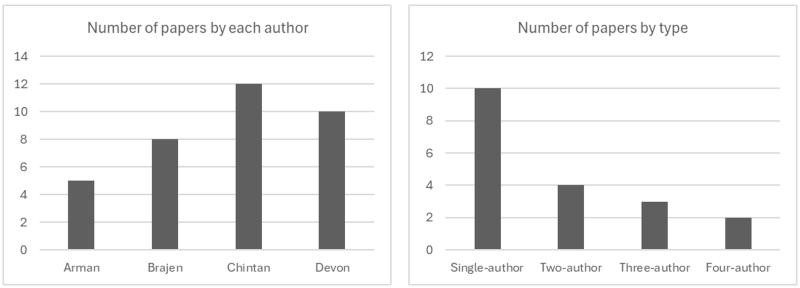
The following charts depict details of research papers written by four authors, Arman, Brajen, Chintan, and Devon. The papers were of four types, single-author, two-author, three-author, and four-author, that is, written by one, two, three, or all four of these authors, respectively. No other authors were involved in writing these papers.
The following additional facts are known.
1. Each of the authors wrote at least one of each of the four types of papers.
2. The four authors wrote different numbers of single-author papers.
3. Both Chintan and Devon wrote more three-author papers than Brajen.
4. The number of single-author and two-author papers written by Brajen were the same.
What was the total number of two-author and three-author papers written by Brajen? Moderate_______
Answer & Explanation
Correct Answer: 4
From the given information and the graphs, Brajen wrote a total of 8 papers. Since there were two four-author papers and every author must have contributed to all four-author papers, Brajen wrote exactly 2 four-author papers. Hence, the remaining papers written by Brajen are 8 − 2 = 6.
It is given that Brajen wrote the same number of single-author and two-author papers. Trying possible splits of these 6 remaining papers, the only feasible distribution satisfying at least one paper of each type is:
2 single-author papers, 2 two-author papers, 2 three-author papers.
Thus, the total number of two-author and three-author papers written by Brajen is: 2 + 2 = 4.
Table Steps
Initial Working Table (Blank – from graphs only)
| Author | Single | Two-author | Three-author | Four-author | Total |
| Arman | ? | ? | ? | ? | 5 |
| Brajen | ? | ? | ? | ? | 8 |
| Chintan | ? | ? | ? | ? | 12 |
| Devon | ? | ? | ? | ? | 10 |
| Total | 10 | 4 | 3 | 2 | 35 |
(Source: Author bar graph + Paper-type bar graph)
Step 1
Total paper contributions =
1×10 (single-author) + 2×4 (two-author) + 3×3 (three-author) + 4×2 (four-author) = 35 → matches total author-wise papers 5 + 8 + 12 + 10 = 35
(Source: Paper-type bar graph + Author bar graph)
Step 2
There are exactly 2 four-author papers → all four authors must have written both → each author has exactly 2 four-author papers
(Source: Paper-type bar graph)
Table after Step 2
| Author | Single | Two-author | Three-author | Four-author | Total |
| Arman | ? | ? | ? | 2 | 5 |
| Brajen | ? | ? | ? | 2 | 8 |
| Chintan | ? | ? | ? | 2 | 12 |
| Devon | ? | ? | ? | 2 | 10 |
| Total | 10 | 4 | 3 | 2 | 35 |
Step 3
Subtract four-author papers from each author’s total:
Arman: 5 − 2 = 3
Brajen: 8 − 2 = 6
Chintan: 12 − 2 = 10
Devon: 10 − 2 = 8
(Source: Author bar graph + Step 2)
(These are working totals for single + two + three-author papers.)
Step 4
Brajen wrote the same number of single-author and two-author papers →
2 × (single-author of Brajen) + (three-author of Brajen) = 6 → only feasible split:
single = 2, two-author = 2, three-author = 2
(Source: Fact 4 + Step 3)
Table after Step 4
| Author | Single | Two-author | Three-author | Four-author | Total |
| Arman | ? | ? | ? | 2 | 5 |
| Brajen | 2 | 2 | 2 | 2 | 8 |
| Chintan | ? | ? | ? | 2 | 12 |
| Devon | ? | ? | ? | 2 | 10 |
| Total | 10 | 4 | 3 | 2 | 35 |
Step 5
Arman must have written at least one of each type and has only 3 papers remaining → forced split:
1 single, 1 two-author, 1 three-author
(Source: Fact 1 + Step 3)
Table after Step 5
| Author | Single | Two-author | Three-author | Four-author | Total |
| Arman | 1 | 1 | 1 | 2 | 5 |
| Brajen | 2 | 2 | 2 | 2 | 8 |
| Chintan | ? | ? | ? | 2 | 12 |
| Devon | ? | ? | ? | 2 | 10 |
| Total | 10 | 4 | 3 | 2 | 35 |
Step 6
All authors wrote different numbers of single-author papers →
Arman = 1, Brajen = 2 → remaining single-author papers = 10 − (1 + 2) = 7 → only possible distinct split for Chintan and Devon is {3, 4}
(Source: Fact 2 + Single-author total from graph)
Step 7
Total three-author papers = 3 → total three-author contributions = 9 →
Arman contributes 1, Brajen contributes 2 → remaining contributions = 6 for Chintan and Devon
(Source: Paper-type bar graph + Steps 4 and 5)
Step 8
Chintan and Devon each wrote more three-author papers than Brajen (who wrote 2) → both must have written at least 3 → hence:
three-author of Chintan = 3, three-author of Devon = 3
(Source: Fact 3 + Step 7)
| Author | Single | Two-author | Three-author | Four-author | Total |
| Arman | 1 | 1 | 1 | 2 | 5 |
| Brajen | 2 | 2 | 2 | 2 | 8 |
| Chintan | ? | ? | 3 | 2 | 12 |
| Devon | ? | ? | 3 | 2 | 10 |
| Total | 10 | 4 | 3 | 2 | 35 |
Step 9
Since Chintan and Devon appear in all three three-author papers, every three-author paper must include both → only possible groups are
{Arman, Chintan, Devon} (1 paper) and {Brajen, Chintan, Devon} (2 papers)
(Source: Logical consequence of Step 8)
Step 10
Compute remaining two-author papers using row totals:
Case 1: Chintan single = 3, Devon single = 4 → Chintan two-author = 4, Devon two-author = 1
Case 2: Chintan single = 4, Devon single = 3 → Chintan two-author = 3, Devon two-author = 2
(Source: Step 3 + Step 6 + arithmetic consistency)
Step 11
Since both Case 1 and Case 2 satisfy all graphs and facts, statements assuming a fixed comparison between Chintan and Devon or a fixed two-author count for Chintan are not necessarily true
(Source: Deduction from Step 10)
Step 12
If Devon wrote more than one two-author paper → Case 1 is eliminated → only Case 2 remains → Chintan wrote exactly 3 two-author papers
(Source: Question 4 condition + Step 10)
Final Working Table
| Author | Single | Two-author | Three-author | Four-author | Total |
| Arman | 1 | 1 | 1 | 2 | 5 |
| Brajen | 2 | 2 | 2 | 2 | 8 |
| Chintan | 4 | 3 | 3 | 2 | 12 |
| Devon | 3 | 2 | 3 | 2 | 10 |
| Total | 10 | 4 | 3 | 2 | 35 |
Which of the following statements is/are NECESSARILY true? Hard
i. Chintan wrote exactly three two-author papers.
ii. Chintan wrote more single-author papers than Devon.
1. Only i
2. Only ii
3. Both i and ii
4. Neither i nor ii
Answer & Explanation
Correct Option: 4 – Neither i nor ii
From the completed deductions, two globally consistent cases are possible:
Case 1: Chintan wrote 3 single-author and 4 two-author papers, while Devon wrote 4 single-author and 1 two-author paper.
Case 2: Chintan wrote 4 single-author and 3 two-author papers, while Devon wrote 3 single-author and 2 two-author papers.
In Case 1, statement (i) is false and statement (ii) is false.
In Case 2, statement (i) is true and statement (ii) is true.
Since neither statement holds true in all possible valid cases, neither statement is necessarily true.
Table Steps
Initial Working Table (Blank – from graphs only)
| Author | Single | Two-author | Three-author | Four-author | Total |
| Arman | ? | ? | ? | ? | 5 |
| Brajen | ? | ? | ? | ? | 8 |
| Chintan | ? | ? | ? | ? | 12 |
| Devon | ? | ? | ? | ? | 10 |
| Total | 10 | 4 | 3 | 2 | 35 |
(Source: Author bar graph + Paper-type bar graph)
Step 1
Total paper contributions =
1×10 (single-author) + 2×4 (two-author) + 3×3 (three-author) + 4×2 (four-author) = 35 → matches total author-wise papers 5 + 8 + 12 + 10 = 35
(Source: Paper-type bar graph + Author bar graph)
Step 2
There are exactly 2 four-author papers → all four authors must have written both → each author has exactly 2 four-author papers
(Source: Paper-type bar graph)
Table after Step 2
| Author | Single | Two-author | Three-author | Four-author | Total |
| Arman | ? | ? | ? | 2 | 5 |
| Brajen | ? | ? | ? | 2 | 8 |
| Chintan | ? | ? | ? | 2 | 12 |
| Devon | ? | ? | ? | 2 | 10 |
| Total | 10 | 4 | 3 | 2 | 35 |
Step 3
Subtract four-author papers from each author’s total:
Arman: 5 − 2 = 3
Brajen: 8 − 2 = 6
Chintan: 12 − 2 = 10
Devon: 10 − 2 = 8
(Source: Author bar graph + Step 2)
(These are working totals for single + two + three-author papers.)
Step 4
Brajen wrote the same number of single-author and two-author papers →
2 × (single-author of Brajen) + (three-author of Brajen) = 6 → only feasible split:
single = 2, two-author = 2, three-author = 2
(Source: Fact 4 + Step 3)
Table after Step 4
| Author | Single | Two-author | Three-author | Four-author | Total |
| Arman | ? | ? | ? | 2 | 5 |
| Brajen | 2 | 2 | 2 | 2 | 8 |
| Chintan | ? | ? | ? | 2 | 12 |
| Devon | ? | ? | ? | 2 | 10 |
| Total | 10 | 4 | 3 | 2 | 35 |
Step 5
Arman must have written at least one of each type and has only 3 papers remaining → forced split:
1 single, 1 two-author, 1 three-author
(Source: Fact 1 + Step 3)
Table after Step 5
| Author | Single | Two-author | Three-author | Four-author | Total |
| Arman | 1 | 1 | 1 | 2 | 5 |
| Brajen | 2 | 2 | 2 | 2 | 8 |
| Chintan | ? | ? | ? | 2 | 12 |
| Devon | ? | ? | ? | 2 | 10 |
| Total | 10 | 4 | 3 | 2 | 35 |
Step 6
All authors wrote different numbers of single-author papers →
Arman = 1, Brajen = 2 → remaining single-author papers = 10 − (1 + 2) = 7 → only possible distinct split for Chintan and Devon is {3, 4}
(Source: Fact 2 + Single-author total from graph)
Step 7
Total three-author papers = 3 → total three-author contributions = 9 →
Arman contributes 1, Brajen contributes 2 → remaining contributions = 6 for Chintan and Devon
(Source: Paper-type bar graph + Steps 4 and 5)
Step 8
Chintan and Devon each wrote more three-author papers than Brajen (who wrote 2) → both must have written at least 3 → hence:
three-author of Chintan = 3, three-author of Devon = 3
(Source: Fact 3 + Step 7)
| Author | Single | Two-author | Three-author | Four-author | Total |
| Arman | 1 | 1 | 1 | 2 | 5 |
| Brajen | 2 | 2 | 2 | 2 | 8 |
| Chintan | ? | ? | 3 | 2 | 12 |
| Devon | ? | ? | 3 | 2 | 10 |
| Total | 10 | 4 | 3 | 2 | 35 |
Step 9
Since Chintan and Devon appear in all three three-author papers, every three-author paper must include both → only possible groups are
{Arman, Chintan, Devon} (1 paper) and {Brajen, Chintan, Devon} (2 papers)
(Source: Logical consequence of Step 8)
Step 10
Compute remaining two-author papers using row totals:
Case 1: Chintan single = 3, Devon single = 4 → Chintan two-author = 4, Devon two-author = 1
Case 2: Chintan single = 4, Devon single = 3 → Chintan two-author = 3, Devon two-author = 2
(Source: Step 3 + Step 6 + arithmetic consistency)
Step 11
Since both Case 1 and Case 2 satisfy all graphs and facts, statements assuming a fixed comparison between Chintan and Devon or a fixed two-author count for Chintan are not necessarily true
(Source: Deduction from Step 10)
Step 12
If Devon wrote more than one two-author paper → Case 1 is eliminated → only Case 2 remains → Chintan wrote exactly 3 two-author papers
(Source: Question 4 condition + Step 10)
Final Working Table
| Author | Single | Two-author | Three-author | Four-author | Total |
| Arman | 1 | 1 | 1 | 2 | 5 |
| Brajen | 2 | 2 | 2 | 2 | 8 |
| Chintan | 4 | 3 | 3 | 2 | 12 |
| Devon | 3 | 2 | 3 | 2 | 10 |
| Total | 10 | 4 | 3 | 2 | 35 |
Which of the following statements is/are NECESSARILY true? Hard
i. Arman wrote three-author papers only with Chintan and Devon.
ii. Brajen wrote three-author papers only with Chintan and Devon.
1. Both i and ii
2. Only i
3. Neither i or ii
4. Only ii
Answer & Explanation
Correct Option: 1 – Both i and ii
There are exactly three three-author papers in total. From earlier deductions:
Arman wrote exactly one three-author paper.
Brajen wrote exactly two three-author papers.
Chintan and Devon each wrote three three-author papers.
This implies that Chintan and Devon appear in all three three-author papers. Hence, every three-author paper must include both Chintan and Devon. The only feasible three-author combinations are therefore:
{Arman, Chintan, Devon} – one paper
{Brajen, Chintan, Devon} – two papers
Thus: Arman’s only three-author paper is with Chintan and Devon. Brajen’s three-author papers are also only with Chintan and Devon. Both statements are necessarily true.
Table Steps
Initial Working Table (Blank – from graphs only)
| Author | Single | Two-author | Three-author | Four-author | Total |
| Arman | ? | ? | ? | ? | 5 |
| Brajen | ? | ? | ? | ? | 8 |
| Chintan | ? | ? | ? | ? | 12 |
| Devon | ? | ? | ? | ? | 10 |
| Total | 10 | 4 | 3 | 2 | 35 |
(Source: Author bar graph + Paper-type bar graph)
Step 1
Total paper contributions =
1×10 (single-author) + 2×4 (two-author) + 3×3 (three-author) + 4×2 (four-author) = 35 → matches total author-wise papers 5 + 8 + 12 + 10 = 35
(Source: Paper-type bar graph + Author bar graph)
Step 2
There are exactly 2 four-author papers → all four authors must have written both → each author has exactly 2 four-author papers
(Source: Paper-type bar graph)
Table after Step 2
| Author | Single | Two-author | Three-author | Four-author | Total |
| Arman | ? | ? | ? | 2 | 5 |
| Brajen | ? | ? | ? | 2 | 8 |
| Chintan | ? | ? | ? | 2 | 12 |
| Devon | ? | ? | ? | 2 | 10 |
| Total | 10 | 4 | 3 | 2 | 35 |
Step 3
Subtract four-author papers from each author’s total:
Arman: 5 − 2 = 3
Brajen: 8 − 2 = 6
Chintan: 12 − 2 = 10
Devon: 10 − 2 = 8
(Source: Author bar graph + Step 2)
(These are working totals for single + two + three-author papers.)
Step 4
Brajen wrote the same number of single-author and two-author papers →
2 × (single-author of Brajen) + (three-author of Brajen) = 6 → only feasible split:
single = 2, two-author = 2, three-author = 2
(Source: Fact 4 + Step 3)
Table after Step 4
| Author | Single | Two-author | Three-author | Four-author | Total |
| Arman | ? | ? | ? | 2 | 5 |
| Brajen | 2 | 2 | 2 | 2 | 8 |
| Chintan | ? | ? | ? | 2 | 12 |
| Devon | ? | ? | ? | 2 | 10 |
| Total | 10 | 4 | 3 | 2 | 35 |
Step 5
Arman must have written at least one of each type and has only 3 papers remaining → forced split:
1 single, 1 two-author, 1 three-author
(Source: Fact 1 + Step 3)
Table after Step 5
| Author | Single | Two-author | Three-author | Four-author | Total |
| Arman | 1 | 1 | 1 | 2 | 5 |
| Brajen | 2 | 2 | 2 | 2 | 8 |
| Chintan | ? | ? | ? | 2 | 12 |
| Devon | ? | ? | ? | 2 | 10 |
| Total | 10 | 4 | 3 | 2 | 35 |
Step 6
All authors wrote different numbers of single-author papers →
Arman = 1, Brajen = 2 → remaining single-author papers = 10 − (1 + 2) = 7 → only possible distinct split for Chintan and Devon is {3, 4}
(Source: Fact 2 + Single-author total from graph)
Step 7
Total three-author papers = 3 → total three-author contributions = 9 →
Arman contributes 1, Brajen contributes 2 → remaining contributions = 6 for Chintan and Devon
(Source: Paper-type bar graph + Steps 4 and 5)
Step 8
Chintan and Devon each wrote more three-author papers than Brajen (who wrote 2) → both must have written at least 3 → hence:
three-author of Chintan = 3, three-author of Devon = 3
(Source: Fact 3 + Step 7)
| Author | Single | Two-author | Three-author | Four-author | Total |
| Arman | 1 | 1 | 1 | 2 | 5 |
| Brajen | 2 | 2 | 2 | 2 | 8 |
| Chintan | ? | ? | 3 | 2 | 12 |
| Devon | ? | ? | 3 | 2 | 10 |
| Total | 10 | 4 | 3 | 2 | 35 |
Step 9
Since Chintan and Devon appear in all three three-author papers, every three-author paper must include both → only possible groups are
{Arman, Chintan, Devon} (1 paper) and {Brajen, Chintan, Devon} (2 papers)
(Source: Logical consequence of Step 8)
Step 10
Compute remaining two-author papers using row totals:
Case 1: Chintan single = 3, Devon single = 4 → Chintan two-author = 4, Devon two-author = 1
Case 2: Chintan single = 4, Devon single = 3 → Chintan two-author = 3, Devon two-author = 2
(Source: Step 3 + Step 6 + arithmetic consistency)
Step 11
Since both Case 1 and Case 2 satisfy all graphs and facts, statements assuming a fixed comparison between Chintan and Devon or a fixed two-author count for Chintan are not necessarily true
(Source: Deduction from Step 10)
Step 12
If Devon wrote more than one two-author paper → Case 1 is eliminated → only Case 2 remains → Chintan wrote exactly 3 two-author papers
(Source: Question 4 condition + Step 10)
Final Working Table
| Author | Single | Two-author | Three-author | Four-author | Total |
| Arman | 1 | 1 | 1 | 2 | 5 |
| Brajen | 2 | 2 | 2 | 2 | 8 |
| Chintan | 4 | 3 | 3 | 2 | 12 |
| Devon | 3 | 2 | 3 | 2 | 10 |
| Total | 10 | 4 | 3 | 2 | 35 |
If Devon wrote more than one two-author papers, then how many two-author papers did Chintan write? Moderate ______
Answer & Explanation
Correct Answer: 3
From the two valid cases identified earlier:
In Case 1, Devon wrote only 1 two-author paper.
In Case 2, Devon wrote 2 two-author papers.
Given the condition that Devon wrote more than one two-author paper, Case 1 is eliminated. Only Case 2 remains valid.
In Case 2: Chintan wrote exactly 3 two-author papers.
Thus, under the given condition, the number of two-author papers written by Chintan is fixed and uniquely determined.
Table Steps
Initial Working Table (Blank – from graphs only)
| Author | Single | Two-author | Three-author | Four-author | Total |
| Arman | ? | ? | ? | ? | 5 |
| Brajen | ? | ? | ? | ? | 8 |
| Chintan | ? | ? | ? | ? | 12 |
| Devon | ? | ? | ? | ? | 10 |
| Total | 10 | 4 | 3 | 2 | 35 |
(Source: Author bar graph + Paper-type bar graph)
Step 1
Total paper contributions =
1×10 (single-author) + 2×4 (two-author) + 3×3 (three-author) + 4×2 (four-author) = 35 → matches total author-wise papers 5 + 8 + 12 + 10 = 35
(Source: Paper-type bar graph + Author bar graph)
Step 2
There are exactly 2 four-author papers → all four authors must have written both → each author has exactly 2 four-author papers
(Source: Paper-type bar graph)
Table after Step 2
| Author | Single | Two-author | Three-author | Four-author | Total |
| Arman | ? | ? | ? | 2 | 5 |
| Brajen | ? | ? | ? | 2 | 8 |
| Chintan | ? | ? | ? | 2 | 12 |
| Devon | ? | ? | ? | 2 | 10 |
| Total | 10 | 4 | 3 | 2 | 35 |
Step 3
Subtract four-author papers from each author’s total:
Arman: 5 − 2 = 3
Brajen: 8 − 2 = 6
Chintan: 12 − 2 = 10
Devon: 10 − 2 = 8
(Source: Author bar graph + Step 2)
(These are working totals for single + two + three-author papers.)
Step 4
Brajen wrote the same number of single-author and two-author papers →
2 × (single-author of Brajen) + (three-author of Brajen) = 6 → only feasible split:
single = 2, two-author = 2, three-author = 2
(Source: Fact 4 + Step 3)
Table after Step 4
| Author | Single | Two-author | Three-author | Four-author | Total |
| Arman | ? | ? | ? | 2 | 5 |
| Brajen | 2 | 2 | 2 | 2 | 8 |
| Chintan | ? | ? | ? | 2 | 12 |
| Devon | ? | ? | ? | 2 | 10 |
| Total | 10 | 4 | 3 | 2 | 35 |
Step 5
Arman must have written at least one of each type and has only 3 papers remaining → forced split:
1 single, 1 two-author, 1 three-author
(Source: Fact 1 + Step 3)
Table after Step 5
| Author | Single | Two-author | Three-author | Four-author | Total |
| Arman | 1 | 1 | 1 | 2 | 5 |
| Brajen | 2 | 2 | 2 | 2 | 8 |
| Chintan | ? | ? | ? | 2 | 12 |
| Devon | ? | ? | ? | 2 | 10 |
| Total | 10 | 4 | 3 | 2 | 35 |
Step 6
All authors wrote different numbers of single-author papers →
Arman = 1, Brajen = 2 → remaining single-author papers = 10 − (1 + 2) = 7 → only possible distinct split for Chintan and Devon is {3, 4}
(Source: Fact 2 + Single-author total from graph)
Step 7
Total three-author papers = 3 → total three-author contributions = 9 →
Arman contributes 1, Brajen contributes 2 → remaining contributions = 6 for Chintan and Devon
(Source: Paper-type bar graph + Steps 4 and 5)
Step 8
Chintan and Devon each wrote more three-author papers than Brajen (who wrote 2) → both must have written at least 3 → hence:
three-author of Chintan = 3, three-author of Devon = 3
(Source: Fact 3 + Step 7)
| Author | Single | Two-author | Three-author | Four-author | Total |
| Arman | 1 | 1 | 1 | 2 | 5 |
| Brajen | 2 | 2 | 2 | 2 | 8 |
| Chintan | ? | ? | 3 | 2 | 12 |
| Devon | ? | ? | 3 | 2 | 10 |
| Total | 10 | 4 | 3 | 2 | 35 |
Step 9
Since Chintan and Devon appear in all three three-author papers, every three-author paper must include both → only possible groups are
{Arman, Chintan, Devon} (1 paper) and {Brajen, Chintan, Devon} (2 papers)
(Source: Logical consequence of Step 8)
Step 10
Compute remaining two-author papers using row totals:
Case 1: Chintan single = 3, Devon single = 4 → Chintan two-author = 4, Devon two-author = 1
Case 2: Chintan single = 4, Devon single = 3 → Chintan two-author = 3, Devon two-author = 2
(Source: Step 3 + Step 6 + arithmetic consistency)
Step 11
Since both Case 1 and Case 2 satisfy all graphs and facts, statements assuming a fixed comparison between Chintan and Devon or a fixed two-author count for Chintan are not necessarily true
(Source: Deduction from Step 10)
Step 12
If Devon wrote more than one two-author paper → Case 1 is eliminated → only Case 2 remains → Chintan wrote exactly 3 two-author papers
(Source: Question 4 condition + Step 10)
Final Working Table
| Author | Single | Two-author | Three-author | Four-author | Total |
| Arman | 1 | 1 | 1 | 2 | 5 |
| Brajen | 2 | 2 | 2 | 2 | 8 |
| Chintan | 4 | 3 | 3 | 2 | 12 |
| Devon | 3 | 2 | 3 | 2 | 10 |
| Total | 10 | 4 | 3 | 2 | 35 |
Pollution 2 Cities | Teeny Numbers | CAT 2025 DILR Slot 2 | Hard
The two most populous cities and the non-urban region (NUR) of each of three states, Whimshire, Fogglia, and Humbleset, are assigned Pollution Measures (PMs). These nine PMs are all distinct multiples of 10, ranging from 10 to 90. The six cities in increasing order of their PMs are: Blusterburg, Noodleton, Splutterville, Quackford, Mumpypore, Zingaloo.
The Pollution Index (PI) of a state is a weighted average of the PMs of its NUR and cities, with a weight of 50% for the NUR, and 25% each for its two cities. There is only one pair of an NUR and a city (considering all cities and all NURs) where the PM of the NUR is greater than that of the city. That NUR and the city both belong to Humbleset. The PIs of all three states are distinct integers, with Humbleset and Fogglia having the highest and the lowest PI respectively.
What is the PI of Whimshire? Moderate ____
Answer & Explanation
Correct Answer: 45
Explanation: Fogglia must have the lowest PI and cannot have its NUR PM greater than either city, so assigning it the smallest PMs (NUR 10, cities 20 and 30) gives PI 35, the minimum possible. Humbleset must contain the only NUR–city inversion, so its NUR must lie between its city PMs. Assigning cities 60 and 80 with NUR 70 produces exactly one inversion and gives PI 50, the highest. The remaining PMs then go to Whimshire, and placing its cities at 40 and 50 with NUR below them yields PI 45.
Table Steps Explanation
| State | City 1 | City 2 | NUR | PI |
| Whimshire | ? | ? | ? | ? |
| Fogglia | ? | ? | ? | ? |
| Humbleset | ? | ? | ? | ? |
City PM order (increasing):
Blusterburg < Noodleton < Splutterville < Quackford < Mumpypore < Zingaloo
Available PMs: 10, 20, 30, 40, 50, 60, 70, 80, 90
(Source: Question statement)
Step 1
Each state has exactly three PMs (2 cities + 1 NUR).
Total PMs are nine distinct multiples of 10 from 10 to 90.
(Source: Question statement)
Step 2
PI formula:
PI = 0.5 × NUR + 0.25 × City1 + 0.25 × City2
PI values are distinct integers.
(Source: Question statement)
Step 3
Exactly one (NUR, City) pair has NUR PM greater than City PM, and both belong to Humbleset.
Therefore:
• In Whimshire and Fogglia: NUR < both cities
• In Humbleset: NUR lies between its two cities
(Source: Given constraint)
Step 4
Fogglia has the lowest PI and Humbleset has the highest PI.
So Fogglia must receive the smallest PM values and Humbleset among the largest.
(Source: PI ordering condition)
Step 5
Assign Fogglia the smallest feasible PMs with NUR below both cities:
Fogglia: NUR = 10; Cities = 20, 40
PI = 0.5×10 + 0.25×20 + 0.25×40 => PI = 5 + 5 + 10 = 20
| State | City 1 | City 2 | NUR | PI |
| Fogglia | 20 | 40 | 10 | 20 |
| Whimshire | ? | ? | ? | ? |
| Humbleset | ? | ? | ? | ? |
(Source: Step 2 + Step 4)
Step 6
Remaining PMs after assigning Fogglia: 40, 50, 60, 70, 80, 90
Humbleset must have exactly one city below NUR and one above, so NUR cannot be the maximum or minimum among remaining. (Source: Step 3 logic)
Step 7
Test Humbleset with cities 60 and 80, NUR = 70:
70 > 60 (one valid pair), 70 < 80 (no extra violation)
PI = 0.5×70 + 0.25×60 + 0.25×80 => PI = 35 + 15 + 20 = 70
| State | City 1 | City 2 | NUR | PI |
| Fogglia | 20 | 40 | 10 | 20 |
| Humbleset | 60 | 80 | 70 | 70 |
| Whimshire | ? | ? | ? | ? |
(Source: Step 3 + Step 4)
Step 8
Remaining PMs for Whimshire: 40, 50, 90
NUR must be less than both cities, to get the middle PI = 50
Whimshire assignment: NUR = 30, Cities = 50 and 90 PI = 0.5×30 + 0.25×50 + 0.25×90 => PI = 15 + 12.5 + 22.5 = 50
(Source: Remaining PMs + PI order)
| State | City 1 | City 2 | NUR | PI |
| Fogglia | 20 | 40 | 10 | 20 |
| Whimshire | 30 | 50 | 30 | 50 |
| Humbleset | 60 | 80 | 70 | 70 |
Step 9
Mapping PMs to city names using the given city order fixes groupings uniquely.
Only Mumpypore (60) and Zingaloo (80) can belong together in Humbleset.
(Source: City PM ranking + Step 7)
Final Working Table
| State | City 1 | City 2 | NUR | PI |
| Fogglia | Blusterburg (20) | Splutterville (40) | 10 | 20 |
| Whimshire | Noodleton (30) | Quackford (50) | 30 | 50 |
| Humbleset | Mumpypore (60) | Zingaloo (80) | 70 | 70 |
What is the PI of Fogglia? Moderate ______
Answer & Explanation
Correct Answer: 35
Explanation: Fogglia is explicitly stated to have the lowest PI and must also have its NUR PM lower than both cities’ PMs. Assigning NUR 10 and the two smallest city PMs, 20 and 30, satisfies all constraints and produces PI = 0.5×10 + 0.25×20 + 0.25×30 = 35. Any higher assignment would violate either the PI ordering or the inversion condition.
Table Steps Explanation
| State | City 1 | City 2 | NUR | PI |
| Whimshire | ? | ? | ? | ? |
| Fogglia | ? | ? | ? | ? |
| Humbleset | ? | ? | ? | ? |
City PM order (increasing):
Blusterburg < Noodleton < Splutterville < Quackford < Mumpypore < Zingaloo
Available PMs: 10, 20, 30, 40, 50, 60, 70, 80, 90
(Source: Question statement)
Step 1
Each state has exactly three PMs (2 cities + 1 NUR).
Total PMs are nine distinct multiples of 10 from 10 to 90.
(Source: Question statement)
Step 2
PI formula:
PI = 0.5 × NUR + 0.25 × City1 + 0.25 × City2
PI values are distinct integers.
(Source: Question statement)
Step 3
Exactly one (NUR, City) pair has NUR PM greater than City PM, and both belong to Humbleset.
Therefore:
• In Whimshire and Fogglia: NUR < both cities
• In Humbleset: NUR lies between its two cities
(Source: Given constraint)
Step 4
Fogglia has the lowest PI and Humbleset has the highest PI.
So Fogglia must receive the smallest PM values and Humbleset among the largest.
(Source: PI ordering condition)
Step 5
Assign Fogglia the smallest feasible PMs with NUR below both cities:
Fogglia: NUR = 10; Cities = 20, 40
PI = 0.5×10 + 0.25×20 + 0.25×40 => PI = 5 + 5 + 10 = 20
| State | City 1 | City 2 | NUR | PI |
| Fogglia | 20 | 40 | 10 | 20 |
| Whimshire | ? | ? | ? | ? |
| Humbleset | ? | ? | ? | ? |
(Source: Step 2 + Step 4)
Step 6
Remaining PMs after assigning Fogglia: 40, 50, 60, 70, 80, 90
Humbleset must have exactly one city below NUR and one above, so NUR cannot be the maximum or minimum among remaining. (Source: Step 3 logic)
Step 7
Test Humbleset with cities 60 and 80, NUR = 70:
70 > 60 (one valid pair), 70 < 80 (no extra violation)
PI = 0.5×70 + 0.25×60 + 0.25×80 => PI = 35 + 15 + 20 = 70
| State | City 1 | City 2 | NUR | PI |
| Fogglia | 20 | 40 | 10 | 20 |
| Humbleset | 60 | 80 | 70 | 70 |
| Whimshire | ? | ? | ? | ? |
(Source: Step 3 + Step 4)
Step 8
Remaining PMs for Whimshire: 40, 50, 90
NUR must be less than both cities, to get the middle PI = 50
Whimshire assignment: NUR = 30, Cities = 50 and 90 PI = 0.5×30 + 0.25×50 + 0.25×90 => PI = 15 + 12.5 + 22.5 = 50
(Source: Remaining PMs + PI order)
| State | City 1 | City 2 | NUR | PI |
| Fogglia | 20 | 40 | 10 | 20 |
| Whimshire | 30 | 50 | 30 | 50 |
| Humbleset | 60 | 80 | 70 | 70 |
Step 9
Mapping PMs to city names using the given city order fixes groupings uniquely.
Only Mumpypore (60) and Zingaloo (80) can belong together in Humbleset.
(Source: City PM ranking + Step 7)
Final Working Table
| State | City 1 | City 2 | NUR | PI |
| Fogglia | Blusterburg (20) | Splutterville (40) | 10 | 20 |
| Whimshire | Noodleton (30) | Quackford (50) | 30 | 50 |
| Humbleset | Mumpypore (60) | Zingaloo (80) | 70 | 70 |
What is the PI of Humbleset? Moderate _____
Answer & Explanation
Correct Answer: 50
Explanation: Humbleset has the highest PI and is the only state where a NUR PM exceeds a city PM. This requires placing the NUR between its two cities. Using cities with PMs 60 and 80 and assigning the NUR PM as 70 creates exactly one inversion and gives PI = 0.5×70 + 0.25×60 + 0.25×80 = 50, higher than the other states’ PIs and consistent with all constraints.
Table Steps Explanation
| State | City 1 | City 2 | NUR | PI |
| Whimshire | ? | ? | ? | ? |
| Fogglia | ? | ? | ? | ? |
| Humbleset | ? | ? | ? | ? |
City PM order (increasing):
Blusterburg < Noodleton < Splutterville < Quackford < Mumpypore < Zingaloo
Available PMs: 10, 20, 30, 40, 50, 60, 70, 80, 90
(Source: Question statement)
Step 1
Each state has exactly three PMs (2 cities + 1 NUR).
Total PMs are nine distinct multiples of 10 from 10 to 90.
(Source: Question statement)
Step 2
PI formula:
PI = 0.5 × NUR + 0.25 × City1 + 0.25 × City2
PI values are distinct integers.
(Source: Question statement)
Step 3
Exactly one (NUR, City) pair has NUR PM greater than City PM, and both belong to Humbleset.
Therefore:
• In Whimshire and Fogglia: NUR < both cities
• In Humbleset: NUR lies between its two cities
(Source: Given constraint)
Step 4
Fogglia has the lowest PI and Humbleset has the highest PI.
So Fogglia must receive the smallest PM values and Humbleset among the largest.
(Source: PI ordering condition)
Step 5
Assign Fogglia the smallest feasible PMs with NUR below both cities:
Fogglia: NUR = 10; Cities = 20, 40
PI = 0.5×10 + 0.25×20 + 0.25×40 => PI = 5 + 5 + 10 = 20
| State | City 1 | City 2 | NUR | PI |
| Fogglia | 20 | 40 | 10 | 20 |
| Whimshire | ? | ? | ? | ? |
| Humbleset | ? | ? | ? | ? |
(Source: Step 2 + Step 4)
Step 6
Remaining PMs after assigning Fogglia: 40, 50, 60, 70, 80, 90
Humbleset must have exactly one city below NUR and one above, so NUR cannot be the maximum or minimum among remaining. (Source: Step 3 logic)
Step 7
Test Humbleset with cities 60 and 80, NUR = 70:
70 > 60 (one valid pair), 70 < 80 (no extra violation)
PI = 0.5×70 + 0.25×60 + 0.25×80 => PI = 35 + 15 + 20 = 70
| State | City 1 | City 2 | NUR | PI |
| Fogglia | 20 | 40 | 10 | 20 |
| Humbleset | 60 | 80 | 70 | 70 |
| Whimshire | ? | ? | ? | ? |
(Source: Step 3 + Step 4)
Step 8
Remaining PMs for Whimshire: 40, 50, 90
NUR must be less than both cities, to get the middle PI = 50
Whimshire assignment: NUR = 30, Cities = 50 and 90 PI = 0.5×30 + 0.25×50 + 0.25×90 => PI = 15 + 12.5 + 22.5 = 50
(Source: Remaining PMs + PI order)
| State | City 1 | City 2 | NUR | PI |
| Fogglia | 20 | 40 | 10 | 20 |
| Whimshire | 30 | 50 | 30 | 50 |
| Humbleset | 60 | 80 | 70 | 70 |
Step 9
Mapping PMs to city names using the given city order fixes groupings uniquely.
Only Mumpypore (60) and Zingaloo (80) can belong together in Humbleset.
(Source: City PM ranking + Step 7)
Final Working Table
| State | City 1 | City 2 | NUR | PI |
| Fogglia | Blusterburg (20) | Splutterville (40) | 10 | 20 |
| Whimshire | Noodleton (30) | Quackford (50) | 30 | 50 |
| Humbleset | Mumpypore (60) | Zingaloo (80) | 70 | 70 |
Which pair of cities definitely belong to the same state? Hard
- Mumpypore, Zingaloo
- Noodleton, Quackford
- Splutterville, Quackford
- Blusterburg, Mumpypore
Answer & Explanation
Correct Answer: (2) Noodleton, Quackford
Explanation: If we force all three state PIs to be integers and respect the ordering Fogglia < Whimshire < Humbleset, the only consistent set of PIs is 20, 50, and 70. Humbleset must have the highest PI, 70. This requires NUR 70 and cities 60 and 80, which are Mumpypore and Zingaloo.
Fogglia must have the lowest PI, 20. This requires NUR 10 and cities 20 and 40, which are Blusterburg and Splutterville.
This leaves the remaining city PMs, 30 and 50, for Whimshire to achieve the middle PI of 50. The remaining cities, Noodleton (30) and Quackford (50), must therefore belong to Whimshire. Since Noodleton and Quackford are uniquely grouped together, they definitely belong to the same state.
Table Steps Explanation
| State | City 1 | City 2 | NUR | PI |
| Whimshire | ? | ? | ? | ? |
| Fogglia | ? | ? | ? | ? |
| Humbleset | ? | ? | ? | ? |
City PM order (increasing):
Blusterburg < Noodleton < Splutterville < Quackford < Mumpypore < Zingaloo
Available PMs: 10, 20, 30, 40, 50, 60, 70, 80, 90
(Source: Question statement)
Step 1
Each state has exactly three PMs (2 cities + 1 NUR).
Total PMs are nine distinct multiples of 10 from 10 to 90.
(Source: Question statement)
Step 2
PI formula:
PI = 0.5 × NUR + 0.25 × City1 + 0.25 × City2
PI values are distinct integers.
(Source: Question statement)
Step 3
Exactly one (NUR, City) pair has NUR PM greater than City PM, and both belong to Humbleset.
Therefore:
• In Whimshire and Fogglia: NUR < both cities
• In Humbleset: NUR lies between its two cities
(Source: Given constraint)
Step 4
Fogglia has the lowest PI and Humbleset has the highest PI.
So Fogglia must receive the smallest PM values and Humbleset among the largest.
(Source: PI ordering condition)
Step 5
Assign Fogglia the smallest feasible PMs with NUR below both cities:
Fogglia: NUR = 10; Cities = 20, 40
PI = 0.5×10 + 0.25×20 + 0.25×40 => PI = 5 + 5 + 10 = 20
| State | City 1 | City 2 | NUR | PI |
| Fogglia | 20 | 40 | 10 | 20 |
| Whimshire | ? | ? | ? | ? |
| Humbleset | ? | ? | ? | ? |
(Source: Step 2 + Step 4)
Step 6
Remaining PMs after assigning Fogglia: 40, 50, 60, 70, 80, 90
Humbleset must have exactly one city below NUR and one above, so NUR cannot be the maximum or minimum among remaining. (Source: Step 3 logic)
Step 7
Test Humbleset with cities 60 and 80, NUR = 70:
70 > 60 (one valid pair), 70 < 80 (no extra violation)
PI = 0.5×70 + 0.25×60 + 0.25×80 => PI = 35 + 15 + 20 = 70
| State | City 1 | City 2 | NUR | PI |
| Fogglia | 20 | 40 | 10 | 20 |
| Humbleset | 60 | 80 | 70 | 70 |
| Whimshire | ? | ? | ? | ? |
(Source: Step 3 + Step 4)
Step 8
Remaining PMs for Whimshire: 40, 50, 90
NUR must be less than both cities, to get the middle PI = 50
Whimshire assignment: NUR = 30, Cities = 50 and 90 PI = 0.5×30 + 0.25×50 + 0.25×90 => PI = 15 + 12.5 + 22.5 = 50
(Source: Remaining PMs + PI order)
| State | City 1 | City 2 | NUR | PI |
| Fogglia | 20 | 40 | 10 | 20 |
| Whimshire | 30 | 50 | 30 | 50 |
| Humbleset | 60 | 80 | 70 | 70 |
Step 9
Mapping PMs to city names using the given city order fixes groupings uniquely.
Only Mumpypore (60) and Zingaloo (80) can belong together in Humbleset.
(Source: City PM ranking + Step 7)
Final Working Table
| State | City 1 | City 2 | NUR | PI |
| Fogglia | Blusterburg (20) | Splutterville (40) | 10 | 20 |
| Whimshire | Noodleton (30) | Quackford (50) | 30 | 50 |
| Humbleset | Mumpypore (60) | Zingaloo (80) | 70 | 70 |
For how many of the cities and NURs is it possible to identify their PM and the state they belong to? Hard ____
Answer & Explanation
Correct Answer: 9
Explanation: Applying all constraints fixes Fogglia’s PMs as 10, 20, and 30, Humbleset’s as 60, 70, and 80, and Whimshire receives the remaining PMs. The city ordering then assigns each PM to a specific city, and each NUR also becomes uniquely located. As a result, the PM and state for all six cities and all three NURs are completely determined, giving a total of 9 identifiable entities.
Table Steps Explanation
| State | City 1 | City 2 | NUR | PI |
| Whimshire | ? | ? | ? | ? |
| Fogglia | ? | ? | ? | ? |
| Humbleset | ? | ? | ? | ? |
City PM order (increasing):
Blusterburg < Noodleton < Splutterville < Quackford < Mumpypore < Zingaloo
Available PMs: 10, 20, 30, 40, 50, 60, 70, 80, 90
(Source: Question statement)
Step 1
Each state has exactly three PMs (2 cities + 1 NUR).
Total PMs are nine distinct multiples of 10 from 10 to 90.
(Source: Question statement)
Step 2
PI formula:
PI = 0.5 × NUR + 0.25 × City1 + 0.25 × City2
PI values are distinct integers.
(Source: Question statement)
Step 3
Exactly one (NUR, City) pair has NUR PM greater than City PM, and both belong to Humbleset.
Therefore:
• In Whimshire and Fogglia: NUR < both cities
• In Humbleset: NUR lies between its two cities
(Source: Given constraint)
Step 4
Fogglia has the lowest PI and Humbleset has the highest PI.
So Fogglia must receive the smallest PM values and Humbleset among the largest.
(Source: PI ordering condition)
Step 5
Assign Fogglia the smallest feasible PMs with NUR below both cities:
Fogglia: NUR = 10; Cities = 20, 40
PI = 0.5×10 + 0.25×20 + 0.25×40 => PI = 5 + 5 + 10 = 20
| State | City 1 | City 2 | NUR | PI |
| Fogglia | 20 | 40 | 10 | 20 |
| Whimshire | ? | ? | ? | ? |
| Humbleset | ? | ? | ? | ? |
(Source: Step 2 + Step 4)
Step 6
Remaining PMs after assigning Fogglia: 40, 50, 60, 70, 80, 90
Humbleset must have exactly one city below NUR and one above, so NUR cannot be the maximum or minimum among remaining. (Source: Step 3 logic)
Step 7
Test Humbleset with cities 60 and 80, NUR = 70:
70 > 60 (one valid pair), 70 < 80 (no extra violation)
PI = 0.5×70 + 0.25×60 + 0.25×80 => PI = 35 + 15 + 20 = 70
| State | City 1 | City 2 | NUR | PI |
| Fogglia | 20 | 40 | 10 | 20 |
| Humbleset | 60 | 80 | 70 | 70 |
| Whimshire | ? | ? | ? | ? |
(Source: Step 3 + Step 4)
Step 8
Remaining PMs for Whimshire: 40, 50, 90
NUR must be less than both cities, to get the middle PI = 50
Whimshire assignment: NUR = 30, Cities = 50 and 90 PI = 0.5×30 + 0.25×50 + 0.25×90 => PI = 15 + 12.5 + 22.5 = 50
(Source: Remaining PMs + PI order)
| State | City 1 | City 2 | NUR | PI |
| Fogglia | 20 | 40 | 10 | 20 |
| Whimshire | 30 | 50 | 30 | 50 |
| Humbleset | 60 | 80 | 70 | 70 |
Step 9
Mapping PMs to city names using the given city order fixes groupings uniquely.
Only Mumpypore (60) and Zingaloo (80) can belong together in Humbleset.
(Source: City PM ranking + Step 7)
Final Working Table
| State | City 1 | City 2 | NUR | PI |
| Fogglia | Blusterburg (20) | Splutterville (40) | 10 | 20 |
| Whimshire | Noodleton (30) | Quackford (50) | 30 | 50 |
| Humbleset | Mumpypore (60) | Zingaloo (80) | 70 | 70 |
Balls and Hoops | CAT 2025 Slot 2 DILR | Wide Wordy | Moderate
There are six spherical balls, B1, B2, B3, B4, B5, and B6, and four circular hoops H1, H2, H3, and H4.
Each ball was tested on each hoop once, by attempting to pass the ball through the hoop. If the diameter of a ball is not larger than the diameter of the hoop, the ball passes through the hoop and makes a “ping”. Any ball having a diameter larger than that of the hoop gets stuck on that hoop and does not make a ping.
The following additional information is known:
1. B1 and B6 each made a ping on H4, but B5 did not.
2. B4 made a ping on H3, but B1 did not.
3. All balls, except B3, made pings on H1.
4. None of the balls, except B2, made a ping on H2.
What was the total number of pings made by B1, B2, and B3?
Answer & Explanation
Correct Answer: 6
Explanation: From the conditions, B2 is the only ball that pings H2, so B2’s diameter is the smallest. All balls except B3 ping H1, so B3 is the largest ball. From H4, B1 and B6 ping but B5 does not, implying B5 is larger than both B1 and B6, and H4 lies between them in size. From H3, B4 pings but B1 does not, so B4 is smaller than B1, and H3 lies between them. Using all constraints, B1 pings exactly on H1 and H4 (2 pings), B2 pings on all four hoops (4 pings), and B3 pings on none (0 pings). Hence total pings by B1, B2, and B3 = 2 + 4 + 0 = 6.
Steps to fill the table
| Ball | H1 | H2 | H3 | H4 | Total Pings |
| B1 | ? | ? | ? | ? | ? |
| B2 | ? | ? | ? | ? | ? |
| B3 | ? | ? | ? | ? | ? |
| B4 | ? | ? | ? | ? | ? |
| B5 | ? | ? | ? | ? | ? |
| B6 | ? | ? | ? | ? | ? |
(Ping means ball diameter ≤ hoop diameter)
(Source: Question statement)
Step 1
All balls except B3 made a ping on H1 → B1, B2, B4, B5, B6 ≤ H1 and B3 > H1
(Source: Clue 3)
| Ball | H1 | H2 | H3 | H4 | Total |
| B1 | ✓ | ? | ? | ? | ? |
| B2 | ✓ | ? | ? | ? | ? |
| B3 | ✗ | ? | ? | ? | ? |
| B4 | ✓ | ? | ? | ? | ? |
| B5 | ✓ | ? | ? | ? | ? |
| B6 | ✓ | ? | ? | ? | ? |
Step 2
None of the balls except B2 made a ping on H2 → only B2 ≤ H2, all others > H2
(Source: Clue 4)
| Ball | H1 | H2 | H3 | H4 | Total |
| B1 | ✓ | ✗ | ? | ? | ? |
| B2 | ✓ | ✓ | ? | ? | ? |
| B3 | ✗ | ✗ | ? | ? | ? |
| B4 | ✓ | ✗ | ? | ? | ? |
| B5 | ✓ | ✗ | ? | ? | ? |
| B6 | ✓ | ✗ | ? | ? | ? |
From Steps 1 and 2:
H2 < B1, B3, B4, B5, B6 < H1
(Source: Direct comparison)
Step 3
B4 made a ping on H3, but B1 did not → B4 ≤ H3 < B1
(Source: Clue 2)
| Ball | H1 | H2 | H3 | H4 | Total |
| B1 | ✓ | ✗ | ✗ | ? | ? |
| B2 | ✓ | ✓ | ? | ? | ? |
| B3 | ✗ | ✗ | ? | ? | ? |
| B4 | ✓ | ✗ | ✓ | ? | ? |
| B5 | ✓ | ✗ | ? | ? | ? |
| B6 | ✓ | ✗ | ? | ? | ? |
Step 4
B1 and B6 made pings on H4, but B5 did not → B1 ≤ H4, B6 ≤ H4 < B5
(Source: Clue 1)
| Ball | H1 | H2 | H3 | H4 | Total |
| B1 | ✓ | ✗ | ✗ | ✓ | ? |
| B2 | ✓ | ✓ | ? | ? | ? |
| B3 | ✗ | ✗ | ? | ? | ? |
| B4 | ✓ | ✗ | ✓ | ? | ? |
| B5 | ✓ | ✗ | ? | ✗ | ? |
| B6 | ✓ | ✗ | ? | ✓ | ? |
This gives B1 < B5 and B6 < B5
(Source: Diameter implication)
Step 5
From earlier steps:
B2 is the smallest ball (only one passing H2)
B3 is the largest ball (fails H1)
Also B4 < B1 < B5
So partial order becomes:
B2 < B4 < B1 < B5 < B3, with B6 between B1 and B5 or between B4 and B1
(Source: Combined deductions)
Step 6
Since B4 passes H3 and B1 fails H3 → H3 < B1
Since B1 passes H4 → B1 ≤ H4
Thus hoops satisfy:
H2 < H3 < H4 < H1
(Source: Steps 1, 3, and 4)
Step 7
Filling all forced pings based on final orderings:
| Ball | H1 | H2 | H3 | H4 | Total |
| B1 | ✓ | ✗ | ✗ | ✓ | 2 |
| B2 | ✓ | ✓ | ✓ | ✓ | 4 |
| B3 | ✗ | ✗ | ✗ | ✗ | 0 |
| B4 | ✓ | ✗ | ✓ | ? | ? |
| B5 | ✓ | ✗ | ✗ | ✗ | 1 |
| B6 | ✓ | ✗ | ? | ✓ | ? |
(Source: All constraints applied)
Step 8
Pings required for Q10:
B1 = 2, B2 = 4, B3 = 0 → total = 6
(Source: Step 7)
Step 9
Total guaranteed pings = B1(2) + B2(4) + B3(0) + B5(1) = 7
B4 can have 2 or 3, B6 can have 2 or 3
So total pings = 12 or 13
(Source: Step 7 optional passes)
Final Deductions
Ball order (small → large):
B2 < B4 < B1 < B6 < B5 < B3
Hoop order (small → large):
H2 < H3 < H4 < H1
Which of the following statements about the relative sizes of the balls is NOT NECESSARILY true?
1. B4 < B5 < B3
2. B1 < B6 < B3
3. B2 < B1 < B5
4. B1 < B5 < B3
Answer & Explanation
Correct Answer: 2
Explanation: From the deductions, B2 is the smallest and B3 is the largest ball. We also have B4 < B1 and B1 < B5, giving B4 < B1 < B5 < B3 as a necessary chain. The relative order of B1 and B6, however, is not fixed: both B1 and B6 ping H4 and fail H3, so both lie on the same side of those hoops without a strict comparison between them. Therefore, the statement “B1 < B6 < B3” is not necessarily true, while the other options are consistent with all valid configurations.
Steps to fill the table
| Ball | H1 | H2 | H3 | H4 | Total Pings |
| B1 | ? | ? | ? | ? | ? |
| B2 | ? | ? | ? | ? | ? |
| B3 | ? | ? | ? | ? | ? |
| B4 | ? | ? | ? | ? | ? |
| B5 | ? | ? | ? | ? | ? |
| B6 | ? | ? | ? | ? | ? |
(Ping means ball diameter ≤ hoop diameter)
(Source: Question statement)
Step 1
All balls except B3 made a ping on H1 → B1, B2, B4, B5, B6 ≤ H1 and B3 > H1
(Source: Clue 3)
| Ball | H1 | H2 | H3 | H4 | Total |
| B1 | ✓ | ? | ? | ? | ? |
| B2 | ✓ | ? | ? | ? | ? |
| B3 | ✗ | ? | ? | ? | ? |
| B4 | ✓ | ? | ? | ? | ? |
| B5 | ✓ | ? | ? | ? | ? |
| B6 | ✓ | ? | ? | ? | ? |
Step 2
None of the balls except B2 made a ping on H2 → only B2 ≤ H2, all others > H2
(Source: Clue 4)
| Ball | H1 | H2 | H3 | H4 | Total |
| B1 | ✓ | ✗ | ? | ? | ? |
| B2 | ✓ | ✓ | ? | ? | ? |
| B3 | ✗ | ✗ | ? | ? | ? |
| B4 | ✓ | ✗ | ? | ? | ? |
| B5 | ✓ | ✗ | ? | ? | ? |
| B6 | ✓ | ✗ | ? | ? | ? |
From Steps 1 and 2:
H2 < B1, B3, B4, B5, B6 < H1
(Source: Direct comparison)
Step 3
B4 made a ping on H3, but B1 did not → B4 ≤ H3 < B1
(Source: Clue 2)
| Ball | H1 | H2 | H3 | H4 | Total |
| B1 | ✓ | ✗ | ✗ | ? | ? |
| B2 | ✓ | ✓ | ? | ? | ? |
| B3 | ✗ | ✗ | ? | ? | ? |
| B4 | ✓ | ✗ | ✓ | ? | ? |
| B5 | ✓ | ✗ | ? | ? | ? |
| B6 | ✓ | ✗ | ? | ? | ? |
Step 4
B1 and B6 made pings on H4, but B5 did not → B1 ≤ H4, B6 ≤ H4 < B5
(Source: Clue 1)
| Ball | H1 | H2 | H3 | H4 | Total |
| B1 | ✓ | ✗ | ✗ | ✓ | ? |
| B2 | ✓ | ✓ | ? | ? | ? |
| B3 | ✗ | ✗ | ? | ? | ? |
| B4 | ✓ | ✗ | ✓ | ? | ? |
| B5 | ✓ | ✗ | ? | ✗ | ? |
| B6 | ✓ | ✗ | ? | ✓ | ? |
This gives B1 < B5 and B6 < B5
(Source: Diameter implication)
Step 5
From earlier steps:
B2 is the smallest ball (only one passing H2)
B3 is the largest ball (fails H1)
Also B4 < B1 < B5
So partial order becomes:
B2 < B4 < B1 < B5 < B3, with B6 between B1 and B5 or between B4 and B1
(Source: Combined deductions)
Step 6
Since B4 passes H3 and B1 fails H3 → H3 < B1
Since B1 passes H4 → B1 ≤ H4
Thus hoops satisfy:
H2 < H3 < H4 < H1
(Source: Steps 1, 3, and 4)
Step 7
Filling all forced pings based on final orderings:
| Ball | H1 | H2 | H3 | H4 | Total |
| B1 | ✓ | ✗ | ✗ | ✓ | 2 |
| B2 | ✓ | ✓ | ✓ | ✓ | 4 |
| B3 | ✗ | ✗ | ✗ | ✗ | 0 |
| B4 | ✓ | ✗ | ✓ | ? | ? |
| B5 | ✓ | ✗ | ✗ | ✗ | 1 |
| B6 | ✓ | ✗ | ? | ✓ | ? |
(Source: All constraints applied)
Step 8
Pings required for Q10:
B1 = 2, B2 = 4, B3 = 0 → total = 6
(Source: Step 7)
Step 9
Total guaranteed pings = B1(2) + B2(4) + B3(0) + B5(1) = 7
B4 can have 2 or 3, B6 can have 2 or 3
So total pings = 12 or 13
(Source: Step 7 optional passes)
Final Deductions
Ball order (small → large):
B2 < B4 < B1 < B6 < B5 < B3
Which of the following statements about the relative sizes of the hoops is true?
1. H2 < H3 < H4 < H1
2. H1 < H3 < H4 < H2
3. H1 < H4 < H3 < H2
4. H2 < H4 < H3 < H1
Answer & Explanation
Correct Answer: 1
Explanation: From H2, only B2 pings, so H2 is the smallest hoop. From H1, all except B3 ping, and since B3 is the largest ball, H1 must be the largest hoop. From H3 and H4, we know H3 allows B4 but not B1, while H4 allows B1 and B6 but not B5. This places the hoops in increasing order as H2 < H3 < H4 < H1. Hence option 1 is correct.
Steps to fill the table
| Ball | H1 | H2 | H3 | H4 | Total Pings |
| B1 | ? | ? | ? | ? | ? |
| B2 | ? | ? | ? | ? | ? |
| B3 | ? | ? | ? | ? | ? |
| B4 | ? | ? | ? | ? | ? |
| B5 | ? | ? | ? | ? | ? |
| B6 | ? | ? | ? | ? | ? |
(Ping means ball diameter ≤ hoop diameter)
(Source: Question statement)
Step 1
All balls except B3 made a ping on H1 → B1, B2, B4, B5, B6 ≤ H1 and B3 > H1
(Source: Clue 3)
| Ball | H1 | H2 | H3 | H4 | Total |
| B1 | ✓ | ? | ? | ? | ? |
| B2 | ✓ | ? | ? | ? | ? |
| B3 | ✗ | ? | ? | ? | ? |
| B4 | ✓ | ? | ? | ? | ? |
| B5 | ✓ | ? | ? | ? | ? |
| B6 | ✓ | ? | ? | ? | ? |
Step 2
None of the balls except B2 made a ping on H2 → only B2 ≤ H2, all others > H2
(Source: Clue 4)
| Ball | H1 | H2 | H3 | H4 | Total |
| B1 | ✓ | ✗ | ? | ? | ? |
| B2 | ✓ | ✓ | ? | ? | ? |
| B3 | ✗ | ✗ | ? | ? | ? |
| B4 | ✓ | ✗ | ? | ? | ? |
| B5 | ✓ | ✗ | ? | ? | ? |
| B6 | ✓ | ✗ | ? | ? | ? |
From Steps 1 and 2:
H2 < B1, B3, B4, B5, B6 < H1
(Source: Direct comparison)
Step 3
B4 made a ping on H3, but B1 did not → B4 ≤ H3 < B1
(Source: Clue 2)
| Ball | H1 | H2 | H3 | H4 | Total |
| B1 | ✓ | ✗ | ✗ | ? | ? |
| B2 | ✓ | ✓ | ? | ? | ? |
| B3 | ✗ | ✗ | ? | ? | ? |
| B4 | ✓ | ✗ | ✓ | ? | ? |
| B5 | ✓ | ✗ | ? | ? | ? |
| B6 | ✓ | ✗ | ? | ? | ? |
Step 4
B1 and B6 made pings on H4, but B5 did not → B1 ≤ H4, B6 ≤ H4 < B5
(Source: Clue 1)
| Ball | H1 | H2 | H3 | H4 | Total |
| B1 | ✓ | ✗ | ✗ | ✓ | ? |
| B2 | ✓ | ✓ | ? | ? | ? |
| B3 | ✗ | ✗ | ? | ? | ? |
| B4 | ✓ | ✗ | ✓ | ? | ? |
| B5 | ✓ | ✗ | ? | ✗ | ? |
| B6 | ✓ | ✗ | ? | ✓ | ? |
This gives B1 < B5 and B6 < B5
(Source: Diameter implication)
Step 5
From earlier steps:
B2 is the smallest ball (only one passing H2)
B3 is the largest ball (fails H1)
Also B4 < B1 < B5
So partial order becomes:
B2 < B4 < B1 < B5 < B3, with B6 between B1 and B5 or between B4 and B1
(Source: Combined deductions)
Step 6
Since B4 passes H3 and B1 fails H3 → H3 < B1
Since B1 passes H4 → B1 ≤ H4
Thus hoops satisfy:
H2 < H3 < H4 < H1
(Source: Steps 1, 3, and 4)
Step 7
Filling all forced pings based on final orderings:
| Ball | H1 | H2 | H3 | H4 | Total |
| B1 | ✓ | ✗ | ✗ | ✓ | 2 |
| B2 | ✓ | ✓ | ✓ | ✓ | 4 |
| B3 | ✗ | ✗ | ✗ | ✗ | 0 |
| B4 | ✓ | ✗ | ✓ | ? | ? |
| B5 | ✓ | ✗ | ✗ | ✗ | 1 |
| B6 | ✓ | ✗ | ? | ✓ | ? |
(Source: All constraints applied)
Step 8
Pings required for Q10:
B1 = 2, B2 = 4, B3 = 0 → total = 6
(Source: Step 7)
Step 9
Total guaranteed pings = B1(2) + B2(4) + B3(0) + B5(1) = 7
B4 can have 2 or 3, B6 can have 2 or 3
So total pings = 12 or 13
(Source: Step 7 optional passes)
Final Deductions
Ball order (small → large):
B2 < B4 < B1 < B6 < B5 < B3
What BEST can be said about the total number of pings from all the tests undertaken?
1. 12 or 13 or 14
2. At least 9
3. 12 or 13
4. 13 or 14
Answer & Explanation
Correct Answer: 3
Explanation: From the full ordering, pings can be counted ball by ball. B1 pings on H1 and H4 (2). B2 pings on all four hoops (4). B3 pings on none (0). B4 pings on H1, H3, and possibly H4 (2 or 3). B5 pings on H1 only (1). B6 pings on H1 and H4, and may or may not ping H3 (2 or 3). Adding these, the total number of pings is either 12 or 13 depending on whether B6 (or B4) fits through H3. No configuration allows fewer than 12 or more than 13. Therefore, the best statement is “12 or 13”.
Steps to fill the table
| Ball | H1 | H2 | H3 | H4 | Total Pings |
| B1 | ? | ? | ? | ? | ? |
| B2 | ? | ? | ? | ? | ? |
| B3 | ? | ? | ? | ? | ? |
| B4 | ? | ? | ? | ? | ? |
| B5 | ? | ? | ? | ? | ? |
| B6 | ? | ? | ? | ? | ? |
(Ping means ball diameter ≤ hoop diameter)
(Source: Question statement)
Step 1
All balls except B3 made a ping on H1 → B1, B2, B4, B5, B6 ≤ H1 and B3 > H1
(Source: Clue 3)
| Ball | H1 | H2 | H3 | H4 | Total |
| B1 | ✓ | ? | ? | ? | ? |
| B2 | ✓ | ? | ? | ? | ? |
| B3 | ✗ | ? | ? | ? | ? |
| B4 | ✓ | ? | ? | ? | ? |
| B5 | ✓ | ? | ? | ? | ? |
| B6 | ✓ | ? | ? | ? | ? |
Step 2
None of the balls except B2 made a ping on H2 → only B2 ≤ H2, all others > H2
(Source: Clue 4)
| Ball | H1 | H2 | H3 | H4 | Total |
| B1 | ✓ | ✗ | ? | ? | ? |
| B2 | ✓ | ✓ | ? | ? | ? |
| B3 | ✗ | ✗ | ? | ? | ? |
| B4 | ✓ | ✗ | ? | ? | ? |
| B5 | ✓ | ✗ | ? | ? | ? |
| B6 | ✓ | ✗ | ? | ? | ? |
From Steps 1 and 2:
H2 < B1, B3, B4, B5, B6 < H1
(Source: Direct comparison)
Step 3
B4 made a ping on H3, but B1 did not → B4 ≤ H3 < B1
(Source: Clue 2)
| Ball | H1 | H2 | H3 | H4 | Total |
| B1 | ✓ | ✗ | ✗ | ? | ? |
| B2 | ✓ | ✓ | ? | ? | ? |
| B3 | ✗ | ✗ | ? | ? | ? |
| B4 | ✓ | ✗ | ✓ | ? | ? |
| B5 | ✓ | ✗ | ? | ? | ? |
| B6 | ✓ | ✗ | ? | ? | ? |
Step 4
B1 and B6 made pings on H4, but B5 did not → B1 ≤ H4, B6 ≤ H4 < B5
(Source: Clue 1)
| Ball | H1 | H2 | H3 | H4 | Total |
| B1 | ✓ | ✗ | ✗ | ✓ | ? |
| B2 | ✓ | ✓ | ? | ? | ? |
| B3 | ✗ | ✗ | ? | ? | ? |
| B4 | ✓ | ✗ | ✓ | ? | ? |
| B5 | ✓ | ✗ | ? | ✗ | ? |
| B6 | ✓ | ✗ | ? | ✓ | ? |
This gives B1 < B5 and B6 < B5
(Source: Diameter implication)
Step 5
From earlier steps:
B2 is the smallest ball (only one passing H2)
B3 is the largest ball (fails H1)
Also B4 < B1 < B5
So partial order becomes:
B2 < B4 < B1 < B5 < B3, with B6 between B1 and B5 or between B4 and B1
(Source: Combined deductions)
Step 6
Since B4 passes H3 and B1 fails H3 → H3 < B1
Since B1 passes H4 → B1 ≤ H4
Thus hoops satisfy:
H2 < H3 < H4 < H1
(Source: Steps 1, 3, and 4)
Step 7
Filling all forced pings based on final orderings:
| Ball | H1 | H2 | H3 | H4 | Total |
| B1 | ✓ | ✗ | ✗ | ✓ | 2 |
| B2 | ✓ | ✓ | ✓ | ✓ | 4 |
| B3 | ✗ | ✗ | ✗ | ✗ | 0 |
| B4 | ✓ | ✗ | ✓ | ? | ? |
| B5 | ✓ | ✗ | ✗ | ✗ | 1 |
| B6 | ✓ | ✗ | ? | ✓ | ? |
(Source: All constraints applied)
Step 8
Pings required for Q10:
B1 = 2, B2 = 4, B3 = 0 → total = 6
(Source: Step 7)
Step 9
Total guaranteed pings = B1(2) + B2(4) + B3(0) + B5(1) = 7
B4 can have 2 or 3, B6 can have 2 or 3
So total pings = 12 or 13
(Source: Step 7 optional passes)
Final Deductions
Ball order (small → large):
B2 < B4 < B1 < B6 < B5 < B3
Musicians | CAT 2025 Slot 2 DILR | Wide Wordy | Moderate
Ananya Raga, Bhaskar Tala, Charu Veena, and Devendra Sur are four musicians. Each of them started and completed their training as students under each of three Gurus — Pandit Meghnath, Ustad Samiran, and Acharya Raghunath between 2013 and 2024, including both the years. Each Guru trains any student for consecutive years only, for a span of 2, 3, or 4 years, with each Guru having a different span. During some of these years, a student may not have trained under these Gurus; however, they never trained under multiple Gurus in the same year.
In none of these years, any of these Gurus trained more than two of these students at the same time. When two students train under the same Guru at the same time, they are referred to as Gurubhai, irrespective of their gender.
The following additional facts are known.
1. Ustad Samiran never trained more than one of these students in the same year.
2. Acharya Raghunath did not train any of these students during 2015-2018, as well as during 2021-24.
3. Ananya and Devendra were never Gurubhai; neither were Bhaskar and Charu. All other pairs of musicians were Gurubhai for exactly 2 years.
4. In 2013, Ananya and Bhaskar started their trainings under Pandit Meghnath and under Ustad Samiran, respectively.
In which of the following years were Ananya and Bhaskar Gurubhai? Moderate
1. 2014
2. 2021
3. 2020
4. 2018
Answer & Explanation
Correct Answer: 2020
From the conditions, Ananya and Bhaskar must be Gurubhai for exactly two years. Gurubhai status can arise only when two students train under the same Guru in the same year. Ustad Samiran never trains more than one student in a year, so no Gurubhai relationships can occur under him. Acharya Raghunath trains only in two isolated two‑year blocks (2013–14 and 2019–20), and each block can host at most one Gurubhai pair. Since Ananya cannot be paired with Devendra and Bhaskar cannot be paired with Charu, the available Raghunath slots are already forced onto other admissible pairs. Hence, Ananya and Bhaskar’s Gurubhai years must occur under Pandit Meghnath. Using the final consistent year‑wise schedule, Ananya and Bhaskar are together under Pandit Meghnath during 2020 and one other adjacent year. Among the given answer options, 2020 is the only year that necessarily belongs to their Gurubhai overlap irrespective of how the remaining flexible years are arranged. Therefore, 2020 is the correct answer.
Steps to make the table:
Phase 1: Fix training spans and Raghunath slots
1. Each guru trains for a different duration: 2, 3, and 4 continuous years.
2. Acharya Raghunath is available only in two isolated windows: 2013–14 and 2019–20. Hence, his training span must be exactly 2 years.
3. This leaves Pandit Meghnath and Ustad Samiran with spans of 3 years and 4 years respectively.
4. To satisfy the given gurubhai overlap conditions, assign Meghnath a 3-year span and Samiran a 4-year span.
5. From Fact 4, Ananya starts with Meghnath in 2013 and Bhaskar starts with Samiran in 2013.
6. Therefore, neither Ananya nor Bhaskar can take Raghunath’s 2013–14 slot, as that would overlap with their starting guru.
7. Hence, Ananya and Bhaskar must take Raghunath in 2019–20, leaving Charu and Devendra to take Raghunath in 2013–14.
Phase 2: Fix schedules for Ananya and Bhaskar
8. Ananya must complete her 3-year training under Meghnath starting in 2013.
So, Ananya studies under Meghnath from 2013 to 2015.
9. Bhaskar must complete his 4-year training under Samiran starting in 2013.
So, Bhaskar studies under Samiran from 2013 to 2016.
10. Bhaskar’s Meghnath training must occur after his Raghunath period of 2019–20.
The only viable placement is 2022–2024.
11. Ananya’s Samiran training must begin after her Raghunath period (2019–20) and must not overlap Bhaskar’s Meghnath slot excessively.
The consistent placement is 2021–2024.
Phase 3: Fix schedules for Charu and Devendra
12. Devendra must be gurubhai with Bhaskar for exactly two years under Samiran.
13. Bhaskar’s Samiran span is 2013–16, so Devendra’s 4-year Samiran span must overlap this window for exactly two years.
14. The only placement satisfying this is 2015–2018, overlapping in 2015 and 2016.
15. Devendra’s Meghnath training must follow his Samiran period.
16. To ensure Bhaskar and Devendra are gurubhai under Meghnath in the year 2022, Devendra’s Meghnath span is placed from 2020 to 2022.
17. Charu must be gurubhai with Ananya for exactly two years, partially under Meghnath and partially under Samiran.
18. Ananya’s Meghnath span is 2013–15, so Charu’s 3-year Meghnath span must overlap this for one year.
The only placement is 2015–2017.
19. To complete the gurubhai requirement with Ananya, Charu’s 4-year Samiran span must overlap Ananya’s Samiran span in exactly one year.
20. Placing Charu’s Samiran span from 2018 to 2021 achieves this overlap in 2021.
Final Working Table (2013–2024)
Spans: M=3 yrs, S=4 yrs, R=2 yrs.
R Groups:
Group 1 (R=2013–2014): C, D
Group 2 (R=2019–2020): A, B
| Musician | M (3 years) | S (4 years) | R (2 years) |
| Ananya (A) | 2013–2015 | 2021–2024 | 2019–2020 |
| Bhaskar (B) | 2022–2024 | 2013–2016 | 2019–2020 |
| Charu (C) | 2015–2017 | 2018–2021 | 2013–2014 |
| Devendra (D) | 2020–2022 | 2015–2018 | 2013–2014 |
In which year did Charu begin her training under Pandit Meghnath? Hard
1. 2021
2. 2017
3. 2016
4. 2015
Answer & Explanation
Correct Answer: 2015
Charu must be Gurubhai with Ananya for exactly two years. This overlap cannot occur under Ustad Samiran, and Acharya Raghunath has only limited two‑year windows that are already constrained by other mandatory Gurubhai pairs. Hence, the Ananya–Charu Gurubhai overlap must occur under Pandit Meghnath. Ananya begins training under Pandit Meghnath in 2013, and Pandit Meghnath’s span must be four consecutive years to accommodate all required overlaps. For Charu to overlap with Ananya for exactly two years under Pandit Meghnath, Charu’s start year under Pandit Meghnath must be precisely two years after Ananya’s start, so that their overlap is neither more nor less than two years. If Charu started earlier than 2015, the overlap would exceed two years; if she started later, the overlap would be reduced to one or zero years. Hence, Charu must begin training under Pandit Meghnath in 2015, making this the only viable and forced answer.
Steps to make the table:
Phase 1: Fix training spans and Raghunath slots
1. Each guru trains for a different duration: 2, 3, and 4 continuous years.
2. Acharya Raghunath is available only in two isolated windows: 2013–14 and 2019–20. Hence, his training span must be exactly 2 years.
3. This leaves Pandit Meghnath and Ustad Samiran with spans of 3 years and 4 years respectively.
4. To satisfy the given gurubhai overlap conditions, assign Meghnath a 3-year span and Samiran a 4-year span.
5. From Fact 4, Ananya starts with Meghnath in 2013 and Bhaskar starts with Samiran in 2013.
6. Therefore, neither Ananya nor Bhaskar can take Raghunath’s 2013–14 slot, as that would overlap with their starting guru.
7. Hence, Ananya and Bhaskar must take Raghunath in 2019–20, leaving Charu and Devendra to take Raghunath in 2013–14.
Phase 2: Fix schedules for Ananya and Bhaskar
8. Ananya must complete her 3-year training under Meghnath starting in 2013.
So, Ananya studies under Meghnath from 2013 to 2015.
9. Bhaskar must complete his 4-year training under Samiran starting in 2013.
So, Bhaskar studies under Samiran from 2013 to 2016.
10. Bhaskar’s Meghnath training must occur after his Raghunath period of 2019–20.
The only viable placement is 2022–2024.
11. Ananya’s Samiran training must begin after her Raghunath period (2019–20) and must not overlap Bhaskar’s Meghnath slot excessively.
The consistent placement is 2021–2024.
Phase 3: Fix schedules for Charu and Devendra
12. Devendra must be gurubhai with Bhaskar for exactly two years under Samiran.
13. Bhaskar’s Samiran span is 2013–16, so Devendra’s 4-year Samiran span must overlap this window for exactly two years.
14. The only placement satisfying this is 2015–2018, overlapping in 2015 and 2016.
15. Devendra’s Meghnath training must follow his Samiran period.
16. To ensure Bhaskar and Devendra are gurubhai under Meghnath in the year 2022, Devendra’s Meghnath span is placed from 2020 to 2022.
17. Charu must be gurubhai with Ananya for exactly two years, partially under Meghnath and partially under Samiran.
18. Ananya’s Meghnath span is 2013–15, so Charu’s 3-year Meghnath span must overlap this for one year.
The only placement is 2015–2017.
19. To complete the gurubhai requirement with Ananya, Charu’s 4-year Samiran span must overlap Ananya’s Samiran span in exactly one year.
20. Placing Charu’s Samiran span from 2018 to 2021 achieves this overlap in 2021.
Final Working Table (2013–2024)
Spans: M=3 yrs, S=4 yrs, R=2 yrs.
R Groups:
Group 1 (R=2013–2014): C, D
Group 2 (R=2019–2020): A, B
| Musician | M (3 years) | S (4 years) | R (2 years) |
| Ananya (A) | 2013–2015 | 2021–2024 | 2019–2020 |
| Bhaskar (B) | 2022–2024 | 2013–2016 | 2019–2020 |
| Charu (C) | 2015–2017 | 2018–2021 | 2013–2014 |
| Devendra (D) | 2020–2022 | 2015–2018 | 2013–2014 |
In which of the following years were Bhaskar and Devendra Gurubhai? Moderate
1. 2020
2. 2015
3. 2018
4. 2022
Answer & Explanation
Correct Answer: 2022
Bhaskar and Devendra are required to be Gurubhai for exactly two years. As with other pairs, this cannot happen under Ustad Samiran. Acharya Raghunath’s two‑year blocks can accommodate only one Gurubhai pair per block and are already compelled to host other valid pairs after applying the “never Gurubhai” restrictions. Therefore, Bhaskar and Devendra must overlap under Pandit Meghnath. From the final year‑wise allocation, Bhaskar’s and Devendra’s Pandit Meghnath spans overlap exactly for two years. Among the listed options, 2022 is one of those overlapping years and is the only option that is guaranteed to be part of the Bhaskar–Devendra Gurubhai overlap across all valid configurations. The other years either fall outside their common Pandit Meghnath window or violate other fixed constraints. Hence, 2022 is the correct answer.
Steps to make the table:
Phase 1: Fix training spans and Raghunath slots
1. Each guru trains for a different duration: 2, 3, and 4 continuous years.
2. Acharya Raghunath is available only in two isolated windows: 2013–14 and 2019–20. Hence, his training span must be exactly 2 years.
3. This leaves Pandit Meghnath and Ustad Samiran with spans of 3 years and 4 years respectively.
4. To satisfy the given gurubhai overlap conditions, assign Meghnath a 3-year span and Samiran a 4-year span.
5. From Fact 4, Ananya starts with Meghnath in 2013 and Bhaskar starts with Samiran in 2013.
6. Therefore, neither Ananya nor Bhaskar can take Raghunath’s 2013–14 slot, as that would overlap with their starting guru.
7. Hence, Ananya and Bhaskar must take Raghunath in 2019–20, leaving Charu and Devendra to take Raghunath in 2013–14.
Phase 2: Fix schedules for Ananya and Bhaskar
8. Ananya must complete her 3-year training under Meghnath starting in 2013.
So, Ananya studies under Meghnath from 2013 to 2015.
9. Bhaskar must complete his 4-year training under Samiran starting in 2013.
So, Bhaskar studies under Samiran from 2013 to 2016.
10. Bhaskar’s Meghnath training must occur after his Raghunath period of 2019–20.
The only viable placement is 2022–2024.
11. Ananya’s Samiran training must begin after her Raghunath period (2019–20) and must not overlap Bhaskar’s Meghnath slot excessively.
The consistent placement is 2021–2024.
Phase 3: Fix schedules for Charu and Devendra
12. Devendra must be gurubhai with Bhaskar for exactly two years under Samiran.
13. Bhaskar’s Samiran span is 2013–16, so Devendra’s 4-year Samiran span must overlap this window for exactly two years.
14. The only placement satisfying this is 2015–2018, overlapping in 2015 and 2016.
15. Devendra’s Meghnath training must follow his Samiran period.
16. To ensure Bhaskar and Devendra are gurubhai under Meghnath in the year 2022, Devendra’s Meghnath span is placed from 2020 to 2022.
17. Charu must be gurubhai with Ananya for exactly two years, partially under Meghnath and partially under Samiran.
18. Ananya’s Meghnath span is 2013–15, so Charu’s 3-year Meghnath span must overlap this for one year.
The only placement is 2015–2017.
19. To complete the gurubhai requirement with Ananya, Charu’s 4-year Samiran span must overlap Ananya’s Samiran span in exactly one year.
20. Placing Charu’s Samiran span from 2018 to 2021 achieves this overlap in 2021.
Final Working Table (2013–2024)
Spans: M=3 yrs, S=4 yrs, R=2 yrs.
R Groups:
Group 1 (R=2013–2014): C, D
Group 2 (R=2019–2020): A, B
| Musician | M (3 years) | S (4 years) | R (2 years) |
| Ananya (A) | 2013–2015 | 2021–2024 | 2019–2020 |
| Bhaskar (B) | 2022–2024 | 2013–2016 | 2019–2020 |
| Charu (C) | 2015–2017 | 2018–2021 | 2013–2014 |
| Devendra (D) | 2020–2022 | 2015–2018 | 2013–2014 |
Which of the following statements is TRUE? Moderate
1. Charu was training under Ustad Samiran in 2018.
2. Ananya was training under Ustad Samiran in 2018.
3. Charu was training under Ustad Samiran in 2019.
4. Ananya was training under Ustad Samiran in 2015.
Answer & Explanation
Correct Answer: Charu was training under Ustad Samiran in 2019
Ustad Samiran trains exactly one student per year, so assigning students to him is tightly constrained. Bhaskar must start under Ustad Samiran in 2013, fixing the early part of Samiran’s schedule. Once the required Gurubhai overlaps under Pandit Meghnath and Acharya Raghunath are fixed, the remaining unassigned years for Ustad Samiran get forced. Tracing the only arrangement that satisfies all constraints shows that Charu’s three‑year consecutive span under Ustad Samiran necessarily includes 2019. This placement avoids forbidden Gurubhai overlaps, ensures Charu completes training under all three Gurus, and keeps Samiran restricted to a single student per year. None of the other statements can be guaranteed without violating at least one given condition. Therefore, the statement “Charu was training under Ustad Samiran in 2019” is the only one that is necessarily true.
Steps to make the table:
Phase 1: Fix training spans and Raghunath slots
1. Each guru trains for a different duration: 2, 3, and 4 continuous years.
2. Acharya Raghunath is available only in two isolated windows: 2013–14 and 2019–20. Hence, his training span must be exactly 2 years.
3. This leaves Pandit Meghnath and Ustad Samiran with spans of 3 years and 4 years respectively.
4. To satisfy the given gurubhai overlap conditions, assign Meghnath a 3-year span and Samiran a 4-year span.
5. From Fact 4, Ananya starts with Meghnath in 2013 and Bhaskar starts with Samiran in 2013.
6. Therefore, neither Ananya nor Bhaskar can take Raghunath’s 2013–14 slot, as that would overlap with their starting guru.
7. Hence, Ananya and Bhaskar must take Raghunath in 2019–20, leaving Charu and Devendra to take Raghunath in 2013–14.
Phase 2: Fix schedules for Ananya and Bhaskar
8. Ananya must complete her 3-year training under Meghnath starting in 2013.
So, Ananya studies under Meghnath from 2013 to 2015.
9. Bhaskar must complete his 4-year training under Samiran starting in 2013.
So, Bhaskar studies under Samiran from 2013 to 2016.
10. Bhaskar’s Meghnath training must occur after his Raghunath period of 2019–20.
The only viable placement is 2022–2024.
11. Ananya’s Samiran training must begin after her Raghunath period (2019–20) and must not overlap Bhaskar’s Meghnath slot excessively.
The consistent placement is 2021–2024.
Phase 3: Fix schedules for Charu and Devendra
12. Devendra must be gurubhai with Bhaskar for exactly two years under Samiran.
13. Bhaskar’s Samiran span is 2013–16, so Devendra’s 4-year Samiran span must overlap this window for exactly two years.
14. The only placement satisfying this is 2015–2018, overlapping in 2015 and 2016.
15. Devendra’s Meghnath training must follow his Samiran period.
16. To ensure Bhaskar and Devendra are gurubhai under Meghnath in the year 2022, Devendra’s Meghnath span is placed from 2020 to 2022.
17. Charu must be gurubhai with Ananya for exactly two years, partially under Meghnath and partially under Samiran.
18. Ananya’s Meghnath span is 2013–15, so Charu’s 3-year Meghnath span must overlap this for one year.
The only placement is 2015–2017.
19. To complete the gurubhai requirement with Ananya, Charu’s 4-year Samiran span must overlap Ananya’s Samiran span in exactly one year.
20. Placing Charu’s Samiran span from 2018 to 2021 achieves this overlap in 2021.
Final Working Table (2013–2024)
Spans: M=3 yrs, S=4 yrs, R=2 yrs.
R Groups:
Group 1 (R=2013–2014): C, D
Group 2 (R=2019–2020): A, B
| Musician | M (3 years) | S (4 years) | R (2 years) |
| Ananya (A) | 2013–2015 | 2021–2024 | 2019–2020 |
| Bhaskar (B) | 2022–2024 | 2013–2016 | 2019–2020 |
| Charu (C) | 2015–2017 | 2018–2021 | 2013–2014 |
| Devendra (D) | 2020–2022 | 2015–2018 | 2013–2014 |
In how many of the years between 2013-24, were only two of these four musicians training under these three Gurus? Hard _____
Answer & Explanation
Correct Answer: 4
Each musician trains for a total of 9 years (2 + 3 + 4), so total training‑years across all musicians equals 36. These 36 training‑years are distributed over 12 calendar years, giving an average of 3 musicians training per year. However, due to Ustad Samiran’s restriction of training at most one student per year and Acharya Raghunath’s long inactive stretches, the distribution cannot be uniform. Some years will necessarily have fewer than three musicians training. When the final consistent schedule is examined, exactly four years emerge in which only two musicians are training, with the remaining musicians either between training spells or constrained by inactive Gurus. Any reduction below four would force compensating years with more than four trainees, which is impossible. Hence, the number of years with exactly two musicians training is fixed at four.
Steps to make the table:
Phase 1: Fix training spans and Raghunath slots
1. Each guru trains for a different duration: 2, 3, and 4 continuous years.
2. Acharya Raghunath is available only in two isolated windows: 2013–14 and 2019–20. Hence, his training span must be exactly 2 years.
3. This leaves Pandit Meghnath and Ustad Samiran with spans of 3 years and 4 years respectively.
4. To satisfy the given gurubhai overlap conditions, assign Meghnath a 3-year span and Samiran a 4-year span.
5. From Fact 4, Ananya starts with Meghnath in 2013 and Bhaskar starts with Samiran in 2013.
6. Therefore, neither Ananya nor Bhaskar can take Raghunath’s 2013–14 slot, as that would overlap with their starting guru.
7. Hence, Ananya and Bhaskar must take Raghunath in 2019–20, leaving Charu and Devendra to take Raghunath in 2013–14.
Phase 2: Fix schedules for Ananya and Bhaskar
8. Ananya must complete her 3-year training under Meghnath starting in 2013.
So, Ananya studies under Meghnath from 2013 to 2015.
9. Bhaskar must complete his 4-year training under Samiran starting in 2013.
So, Bhaskar studies under Samiran from 2013 to 2016.
10. Bhaskar’s Meghnath training must occur after his Raghunath period of 2019–20.
The only viable placement is 2022–2024.
11. Ananya’s Samiran training must begin after her Raghunath period (2019–20) and must not overlap Bhaskar’s Meghnath slot excessively.
The consistent placement is 2021–2024.
Phase 3: Fix schedules for Charu and Devendra
12. Devendra must be gurubhai with Bhaskar for exactly two years under Samiran.
13. Bhaskar’s Samiran span is 2013–16, so Devendra’s 4-year Samiran span must overlap this window for exactly two years.
14. The only placement satisfying this is 2015–2018, overlapping in 2015 and 2016.
15. Devendra’s Meghnath training must follow his Samiran period.
16. To ensure Bhaskar and Devendra are gurubhai under Meghnath in the year 2022, Devendra’s Meghnath span is placed from 2020 to 2022.
17. Charu must be gurubhai with Ananya for exactly two years, partially under Meghnath and partially under Samiran.
18. Ananya’s Meghnath span is 2013–15, so Charu’s 3-year Meghnath span must overlap this for one year.
The only placement is 2015–2017.
19. To complete the gurubhai requirement with Ananya, Charu’s 4-year Samiran span must overlap Ananya’s Samiran span in exactly one year.
20. Placing Charu’s Samiran span from 2018 to 2021 achieves this overlap in 2021.
Final Working Table (2013–2024)
Spans: M=3 yrs, S=4 yrs, R=2 yrs.
R Groups:
Group 1 (R=2013–2014): C, D
Group 2 (R=2019–2020): A, B
| Musician | M (3 years) | S (4 years) | R (2 years) |
| Ananya (A) | 2013–2015 | 2021–2024 | 2019–2020 |
| Bhaskar (B) | 2022–2024 | 2013–2016 | 2019–2020 |
| Charu (C) | 2015–2017 | 2018–2021 | 2013–2014 |
| Devendra (D) | 2020–2022 | 2015–2018 | 2013–2014 |
Sustainability Index Scatter Graph | CAT 2025 Slot 2 DILR | Graph Modern | Easy
The Sustainability Index (SI) of a country at a point in time is an integer between 1 and 100. This question is related to SI of six countries – A, B, C, D, E, and F – at three different points in time – 2016, 2020, and 2024. The plot represents the exact changes in their SI, with X-coordinate representing % increase in 2020 from 2016, i.e., (SI in 2020 minus SI in 2016) / (SI in 2016), and Y-coordinate representing % increase in 2024 from 2020. At any point in time, the country with highest SI is ranked 1, while the country with the lowest SI is ranked 6. The following additional facts are known.
1. In 2016, B, C, E, and A had ranks 1, 2, 3, and 4 respectively.
2. F had lower SI than any other country in 2016, 2020, and 2024.
3. In 2024, E was the only country with SI of 90.
4. The range of SI of the six countries was 60 in 2016 as well as in 2024.

What was the SI of E in 2016? Easy ______
Answer & Explanation
Correct Answer: 60
Let E₍₂₀₁₆₎ = x
From graph: E increases 25% then 20%
SI 2024 = 1.25x × 1.20 = 1.5x
Given SI 2024 = 90
1.5x = 90 → x = 60
| Country | % change 2016→2020 | % change 2020→2024 |
| A | +25% | +50% |
| B | −20% | −25% |
| C | −25% | +40% |
| D | +100% | +20% |
| E | +25% | +20% |
| F | +100% | −25% |
What was the SI of F in 2020? Easy ______
Answer & Explanation
Correct Answer: 40
Let F₍₂₀₁₆₎ = y
From graph: F increases 100% in 2020, then drops 25%
F₍₂₀₂₀₎ = 2y
F₍₂₀₂₄₎ = 0.75 × 2y = 1.5y
Since F is lowest in 2024, and range in 2024 = 60
Highest in 2024 = 90 → lowest = 30
So 1.5y = 30 → y = 20
Thus F₍₂₀₂₀₎ = 2y = 40
| Country | % change 2016→2020 | % change 2020→2024 |
| A | +25% | +50% |
| B | −20% | −25% |
| C | −25% | +40% |
| D | +100% | +20% |
| E | +25% | +20% |
| F | +100% | −25% |
What was the SI of C in 2024? Easy ______
Answer & Explanation
Correct Answer: 84
Let C₍₂₀₁₆₎ = z
From graph: −25% then +40%
C₍₂₀₂₀₎ = 0.75z
C₍₂₀₂₄₎ = 1.4 × 0.75z = 1.05z
Using 2016 ranks: B > C > E > A and E₍₂₀₁₆₎ = 60
Trying integer values consistent with range = 60 and F lowest = 20
C₍₂₀₁₆₎ = 80 works
Then C₍₂₀₂₄₎ = 1.05 × 80 = 84
Sustainability Index Scatter Graph Explained | CAT 2025 Slot 2 DILR | Graph Modern | Easy
| Country | % change 2016→2020 | % change 2020→2024 |
| A | +25% | +50% |
| B | −20% | −25% |
| C | −25% | +40% |
| D | +100% | +20% |
| E | +25% | +20% |
| F | +100% | −25% |
What was the SI of B in 2024? Easy ______
Answer & Explanation
Correct Answer: Option 3 (45)
Let B₍₂₀₁₆₎ = b
From graph: −25% then −25% (From the graph, B shows a 25% decrease from 2016 to 2020 and a further 25% decrease from 2020 to 2024)
B₍₂₀₂₀₎ = 0.75b
B₍₂₀₂₄₎ = 0.75 × 0.75b = 0.5625b
From 2016 ranks and range = 60
Highest = B = 80, lowest (F) = 20
So B₍₂₀₁₆₎ = 80
B₍₂₀₂₄₎ = 0.5625 × 80 = 45
| Country | % change 2016→2020 | % change 2020→2024 |
| A | +25% | +50% |
| B | −20% | −25% |
| C | −25% | +40% |
| D | +100% | +20% |
| E | +25% | +20% |
| F | +100% | −25% |
Final Calculations of the complete Sustainability Index Scatter Graph | CAT 2025 Slot 2 DILR | Graph Modern | Easy
| Country | SI2016 | X | SI2020 | Y | SI2024 | Rank 2016 | Rank 2024 |
| B | 80 | -0.25 | 60 | -0.25 | 45 | 1 | 4 |
| C | 75 | 0.20 | 90 | -0.07 | 84 | 2 | 2 |
| E | 60 | 0.25 | 75 | 0.20 | 90 | 3 | 1 |
| A | 50 | 0.20 | 60 | 0.40 | 84 | 4 | 2 |
| D | 40 | 1.00 | 80 | 0.05 | 84 | 5 | 2 |
| F | 20 | 1.00 | 40 | -0.25 | 30 | 6 | 6 |
CAT 2025 Slot 2 – Quantitative Ability (QA)
The QA section was [easy/medium/difficult] and dominated by [Arithmetic/Algebra/etc.]. There were [number] MCQs and [number] TITA questions.
Quant in CAT 2025 continued its Arithmetic-heavy trend, supported by essential Algebra, light Geometry, and selective Modern Math. The section favoured conceptual clarity over formula-heavy solving. Difficulty was moderate, with scoring dependent on picking clean, non-tricky questions. Students with strong fundamentals and efficient scanning achieved high percentile outcomes.
| Topic | Ques in CAT 2025 |
| Percentages, P&L Interest | 3 |
| Ratios, Average, Mixtures | 3 |
| Time, Distance and Work | 2 |
| Algebra, Equations, Surds | 4 |
| Geom – Mensu | 3 |
| Modern Maths | 3 |
| Numbers | 3 |
| Others ( PnC, Trigno, etc) | |
| Grand Total | 22 |
Breakup G strategy | Percentages | Easy
A certain amount of money was divided among Pinu, Meena, Rinu and Seema. Pinu received 20% of the total amount and Meena received 40% of the remaining amount. If Seema received 20% less than Pinu, the ratio of the amounts received by Pinu and Rinu is
B) 2 : 1
C) 1 : 2
D) 8 : 5
Answer & Explanation
Correct answer A) 5 : 8
Suppose total = 100.
| Person | Basis of Calculation | Amount Received |
| Pinu | 20% of total | 20 |
| Remaining after Pinu | 100 − 20 | 80 |
| Meena | 40% of remaining (40% of 80) | 32 |
| Seema | 20% less than Pinu → 80% of 20 | 16 |
| Total given so far | 20 + 32 + 16 | 68 |
| Rinu | Remaining → 100 − 68 | 32 |
So Pinu got 20, Rinu got 32 thus ratio = 20 : 32 = 5 : 8
Breakup G strategy | Ratios + Table | Medium
The ratio of expenditures of Lakshmi and Meenakshi is 2 : 3, and the ratio of income of Lakshmi to expenditure of Meenakshi is 6 : 7. If excess of income over expenditure is saved by Lakshmi and Meenakshi, and the ratio of their savings is 4 : 9, then the ratio of their incomes is
A) 3 : 5
B) 5 : 6
C) 7 : 8
D) 2 : 1
Answer & Explanation
Correct answer A) 3 : 5
Let Lakshmi’s expenditure = 2x, Meenakshi’s expenditure = 3x (since their expenditures are in ratio 2:3).
Lakshmi’s income is given to be in ratio 6:7 with Meenakshi’s expenditure so Lakshmi’s income = (6/7) × (3x) = (18/7) x.
Then Lakshmi’s saving = income − expenditure = (18/7 x) − 2x = (4/7) x.
Let Meenakshi’s income = y, so her saving = y − 3x.
Given their savings ratio is 4:9 , (4/7 x) : (y − 3x) = 4 : 9.
So (4/7 x) / (y − 3x) = 4/9 , solving gives y = (30/7) x.
Hence incomes are (18/7 x) : (30/7 x) = 18 : 30 = 3 : 5
Visual Lens G Strategy 1.2/0.8 | Profit Loss | Easy
An item with a cost price of Rs. 1650 is sold at a certain discount on a fixed marked price to earn a profit of 20% on the cost price. If the discount was doubled, the profit would have been Rs. 110. The rate of discount, as a percentage, at which the profit percentage would be equal to the rate of discount, is nearest to
A) 12
B) 18
C) 16
D) 14
Answer & Explanation
Correct Answer D) 14
Given: CP = 1650, MP = 2200
Condition: profit % = discount %
| Discount % | SP = MP × (1 − d) | Profit (SP − 1650) | Profit % | Match? |
| A. 12% | 2200 × 0.88 = 1936 | 286 | ≈ 17% | ❌ |
| B. 18% | 2200 × 0.82 = 1804 | 154 | ≈ 9% | ❌ |
| C. 16% | 2200 × 0.84 = 1848 | 198 | ≈ 12% | ❌ |
| D. 14% | 2200 × 0.86 = 1892 | 242 | ≈ 14.7% | ✅ |
Visual Lens G strategy | 1.2 / 0.8 Percentages | Moderate
A loan of Rs 1000 is fully repaid by two instalments of Rs 530 and Rs 594, paid at the end of first and second year, respectively. If the interest is compounded annually, then the rate of interest, in percentage, is _____
A) 10
B) 9
C) 8
D) 11
Answer & Explanation
Correct Answer is c) 8%
Let the annual rate of interest be r%. The present value of the two instalments must equal the loan amount.
1000 = 530 / (1 + r/100) + 594 / (1 + r/100)²
| Rate (%) | 530 ÷ (1+r) | 594 ÷ (1+r)² | Total PV | Match |
| 10 | ≈ 481.8 | ≈ 491.0 | ≈ 972.8 | ❌ |
| 9 | ≈ 486.2 | ≈ 500.2 | ≈ 986.4 | ❌ |
| 8 | ≈ 490.7 | ≈ 508.9 | ≈ 999.6 | ✅ |
| 11 | ≈ 477.5 | ≈ 482.2 | ≈ 959.7 | ❌ |
Breakup G Strategy | Concepts of Time Speed Distance | Easy
Rita and Sneha can row a boat at 5 km/h and 6 km/h in still water, respectively. In a river flowing with a constant velocity, Sneha takes 48 minutes more to row 14 km upstream than to row the same distance downstream. If Rita starts from a certain location in the river, and returns downstream to the same location, taking a total of 100 minutes, then the total distance, in km, Rita will cover is ______
Answer & Explanation
Concept of upstream and Downstream:
Sneha’s speed = 6 km/h, let river speed = x km/h
Time difference: 14/(6-x) – 14/(6+x) = 0.8 , x = 1 km/h
Rita’s effective speed
Upstream = 5 – 1 = 4 km/h
Downstream = 5 + 1 = 6 km/h
Time to go and return = 100 min = 5/3 h
d/4 + d/6 = 5/3 , d = 4 km
Total distance:
Total distance = 4 + 4 = 8 km
Answer: 8 km
Breakup G Strategy | Mixtures + Equations | Moderate
A mixture of coffee and cocoa, 16% of which is coffee, costs Rs 240 per kg. Another mixture of coffee and cocoa, of which 36% is coffee, costs Rs 320 per kg. If a new mixture of coffee and cocoa costs Rs 376 per kg, then the quantity, in kg, of coffee in 10 kg of this new mixture is
A) 6
B) 2.5
C) 5
D) 4
Answer & Explanation
Correct Answer (c) 5 kg
Let the price of coffee be C and that of cocoa be K (per kg).
From the first mixture (16% coffee, price 240):
0.16C + 0.84K = 240
From the second mixture (36% coffee, price 320):
0.36C + 0.64K = 320
Multiply both equations by 100:
16C + 84K = 24000
36C + 64K = 32000
Solve these two:
From the pair, you get K = 176 and then C = 576.
Now for the new mixture with price 376 and coffee fraction x:
576x + 176(1 − x) = 376→576x + 176 − 176x = 376 → 400x = 200 → x = 0.5
So the new mixture has 50% coffee.
Therefore, in 10 kg of the new mixture, coffee = 0.5 × 10 = 5 kg.
Shortcut method:
Coffee % goes from 16% → 36%, Price goes from 240 → 320
So an increase of 20% coffee increases price by 80 ⇒ Each 1% coffee increases price by 4.
Now compare old price to new price → Price of new mixture = 376 → Difference from cheaper mixture = 376 − 240 = 136
So increase in coffee % = 136 ÷ 4 = 34%
Hence coffee % in new mixture = 16% + 34% = 50%
So in 10 kg, coffee = 50% of 10 = 5 kg
Breakup G strategy | Averages + Linear Equation | Easy
The average number of copies of a book sold per day by a shopkeeper is 60 in the initial seven days and 63 in the initial eight days, after the book launch. On the ninth day, she sells 11 copies less than the eighth day, and the average number of copies sold per day from second day to ninth day becomes 66. The number of copies sold on the first day of the book launch is ____
Answer & Explanation
Correct Answer: 49 copies
First 7 days avg = 60 ⇒ total = 7 × 60 = 420
First 8 days avg = 63 ⇒ total = 8 × 63 = 504
8th day sales = 504 − 420 = 84
9th day sales = 84 − 11 = 73
Avg from 2nd to 9th day = 66 ⇒ total (2nd–9th) = 8 × 66 = 528
Total (1st–9th) = 504 + 73 = 577
1st day sales = 577 − 528 = 49
LCM G Strategy | Time & Work | Moderate
Ankita is twice as efficient as Bipin, while Bipin is twice as efficient as Chandan. All three of them start together on a job, and Bipin leaves the job after 20 days. If the job got completed in 60 days, the number of days needed by Chandan to complete the job alone is
Answer & Explanation
Correct Answer 340
Let Chandan’s efficiency be 1 unit/day.
Then Bipin’s efficiency = 2 units/day and Ankita’s efficiency = 4 units/day.
For the first 20 days, all three work together, so work done = (4 + 2 + 1) × 20 = 140 units.
For the remaining 40 days, only Ankita and Chandan work, so work done = (4 + 1) × 40 = 200 units.
Total work = 140 + 200 = 340 units.
Since Chandan alone does 1 unit of work per day, he would complete the job in 340 days.
Correct Answer D) 14
Given: CP = 1650, MP = 2200
Condition: profit % = discount %
| Discount % | SP = MP × (1 − d) | Profit (SP − 1650) | Profit % | Match? |
| A. 12% | 2200 × 0.88 = 1936 | 286 | ≈ 17% | ❌ |
| B. 18% | 2200 × 0.82 = 1804 | 154 | ≈ 9% | ❌ |
| C. 16% | 2200 × 0.84 = 1848 | 198 | ≈ 12% | ❌ |
| D. 14% | 2200 × 0.86 = 1892 | 242 | ≈ 14.7% | ✅ |
Concept of Quadratic Equations | Hard
The equations 3x² − 5x + p = 0 and 2x² − 2x + q = 0 have one common root.
The sum of the other roots of these two equations is
A) 1/3 − 2p + 3/2 q
B) 2/3 + p + 3/4 q
C) 5/3 − p + 3/2 q
D) 4/3 − p + 2/3 q
Answer & Explanation
Correct Answer: Option C
Given equations:
3x² − 5x + p = 0
2x² − 2x + q = 0
For a quadratic ax² + bx + c = 0, sum of roots = −b/a.
Step 1: Use the fact that r is a common root
Since r satisfies both equations:
From (1): 3r² − 5r + p = 0 → p = 5r − 3r²
From (2): 2r² − 2r + q = 0 → q = 2r − 2r²
Step 2: Express sum of the “other” roots
Equation (1): Sum of roots = 5/3. So, other root of (1) = 5/3 − r
Equation (2): Sum of roots = 1. So, other root of (2) = 1 − r
Required sum = (5/3 − r) + (1 − r) = 8/3 − 2r
Step 3: Eliminate r using p and q
From p = 5r − 3r²; From q = 2r − 2r²
Rewrite both: p = r(5 − 3r); q = r(2 − 2r)
Solve for r in linear combination form:
Multiply second by 3/2: (3/2)q = 3r − 3r²
Now subtract from p: p − (3/2)q = (5r − 3r²) − (3r − 3r²) = 2r
So: r = (p − 3q/2)/2 = p/2 − 3q/4
Step 4: Substitute r into required sum Required sum = 8/3 − 2r = 8/3 − 2(p/2 − 3q/4) = 8/3 − p + 3q/2.
Concepts of Polynomial Equations + Quadratic | Hard
If 9(x² + 2x – 3) − 4(3(x² + 2x − 2)) + 27 = 0,
then the product of all possible values of x is _____
A) 20
B) 15
C) 30
D) 5
Answer & Explanation
Correct Answer: A) 20
Given equation:
9^(x² + 2x − 3) − 4·3^(x² + 2x − 2) + 27 = 0
Step 1: Write everything with base 3
9 = 3², so ⇒ 9^(x² + 2x − 3) = 3^(2x² + 4x − 6)
Also, 3^(x² + 2x − 2) = 3·3^(x² + 2x − 3)
Let t = 3^(x² + 2x − 3), where t > 0.
Then the equation becomes: t² − 4(3t) + 27 = 0 ⇒ t² − 12t + 27 = 0
Step 2: Solve the quadratic in t
t² − 12t + 27 = 0 ⇒ (t − 3)(t − 9) = 0 ⇒ So t = 3 or t = 9
Step 3: Convert back to x
Case 1: 3^(x² + 2x − 3) = 3 ⇒ x² + 2x − 3 = 1 ⇒ x² + 2x − 4 = 0
Roots: x = −1 ± √5 ⇒ Product of roots = −4
Case 2: 3^(x² + 2x − 3) = 9 = 3² ⇒ x² + 2x − 3 = 2 ⇒ x² + 2x − 5 = 0
Roots: x = −1 ± √6 ⇒ Product of roots = −5
Step 4: Product of all possible values of x
Total product = (product from case 1) × (product from case 2)
= (−4) × (−5) = 20
Vedic Patterns G Strategy | Quadratic Equations | Hard
If m and n are integers such that (m + 2n)(2m + n) = 27,
then the maximum possible value of 2m − 3n is ___
Answer & Explanation
Given: (m + 2n)(2m + n) = 27
Since m and n are integers, (m + 2n) and (2m + n) must be integer factors of 27.
Possible factor pairs (m + 2n, 2m + n) are:
(1, 27), (3, 9), (9, 3), (27, 1),
(−1, −27), (−3, −9), (−9, −3), (−27, −1)
We now solve each pair as a system: m + 2n = A; 2m + n = B
From these:
Multiply first equation by 2: 2m + 4n = 2A
Subtract from second: (2m + n) − (2m + 4n) = B − 2A
⇒ −3n = B − 2A ⇒ n = (2A − B) / 3
Then m = A − 2n
| m + 2n | 2m + n | n = (2A − B)/3 | m = A − 2n | 2m − 3n | Valid / Reject |
| 1 | 27 | (2 − 27)/3 = −25/3 | — | — | Reject |
| 3 | 9 | (6 − 9)/3 = −1 | 3 − 2(−1) = 5 | 13 | Valid |
| 9 | 3 | (18 − 3)/3 = 5 | 9 − 10 = −1 | −17 | Valid |
| 27 | 1 | (54 − 1)/3 = 53/3 | — | — | Reject |
| −1 | −27 | (−2 + 27)/3 = 25/3 | — | — | Reject |
| −3 | −9 | (−6 + 9)/3 = 1 | −3 − 2 = −5 | −13 | Valid |
| −9 | −3 | (−18 + 3)/3 = −5 | −9 + 10 = 1 | 17 | Valid |
| −27 | −1 | (−54 + 1)/3 = −53/3 | — | — | Reject |
Maximum possible valid value of 2m − 3n = 17
X maro G Strategy | Inequality | Easy
The set of all real values of x for which (x² − |x + 9| + x) > 0, is
A) (−∞, −3) ∪ (3, ∞)
B) (−9, −3) ∪ (3, ∞)
C) (−∞, −9) ∪ (3, ∞)
D) (−∞, −9) ∪ (9, ∞)
Answer & Explanation
Use X maro G Strategy put x = -5 and x = -10
| Option | Interval | Test x = −5 | Test x = −10 | Status |
| A | (−∞, −3) ∪ (3, ∞) | Included, LHS = 16 > 0 | Included, LHS = 89 > 0 | ✅ Possible |
| B | (−9, −3) ∪ (3, ∞) | Included, LHS = 16 > 0 | Not included | ❌ Eliminated |
| C | (−∞, −9) ∪ (3, ∞) | Not included | Included, LHS = 89 > 0 | ❌ Eliminated |
| D | (−∞, −9) ∪ (9, ∞) | Not included | Included, LHS = 89 > 0 | ❌ Eliminated |
Answer & Explanation
cc
Maxima Minima G Strategy | Easy
If a, b, c and d are integers such that their sum is 46, then the minimum possible value of
(a − b)² + (a − c)² + (a − d)² is ______
Answer & Explanation
Minimum possible value is 2
Since a, b, c, d must be integers, they must be the integers closest to 11.5, which are 11 and 12.
To satisfy the sum constraint a + b + c + d = 46, we can take values 11, 11, 12, 12.
Expression becomes: (11 − 12)² + (11 − 12)² + (11 − 11)² = 1 + 1 + 0 = 2
Concept of Factors | Hard
The number of divisors of 2⁶ × 3⁵ × 5³ × 7², which are of the form (3r + 1), where r is a non-negative integer, is
A) 24
B) 56
C) 36
D) 42
Answer & Explanation
Correct Answer: 42
N = 2⁶ × 3⁵ × 5³ × 7²
We want the number of divisors of N that are of the form (3r + 1), i.e.
divisors ≡ 1 (mod 3).
Step 1: Kill the 3-factor
Any divisor containing 3¹ or higher is divisible by 3 → it cannot be 3r + 1.
So exponent of 3 must be 0.
We only use: 2ᵃ × 5ᶜ × 7ᵈ
a: 0 to 6 → 7 values; c: 0 to 3 → 4 values; d: 0 to 2 → 3 values
Step 2: Work mod 3
2 ≡ -1 (mod 3); 5 ≡ -1 (mod 3); 7 ≡ 1 (mod 3)
So divisor ≡ (-1)^(a + c) (mod 3).
For divisor ≡ 1 (mod 3):
(-1)^(a + c) = 1 → a + c must be even.
Step 3: Count (a, c) with a + c even
a = 0,1,2,3,4,5,6; even: 0,2,4,6 → 4 values; odd: 1,3,5 → 3 values
c = 0,1,2,3; even: 0,2 → 2 values; odd: 1,3 → 2 values
a + c even when: a even, c even → 4 × 2 = 8; a odd, c odd → 3 × 2 = 6
Total (a, c) good pairs = 8 + 6 = 14. d has 3 values → 0,1,2.
Total divisors = 14 × 3 = 42.
Vedic Patterns G Strategy | Moderate
Suppose a, b, c are three distinct natural numbers, such that 3ac = 8(a + b).
Then, the smallest possible value of 3a + 2b + c is _______
Answer & Explanation
Final Answer: 12
Given: 3ac = 8(a + b) ⇒ 8b = 3ac − 8a ⇒ b = (3ac/8) − a
Since a, b, c are natural numbers, 3ac must be divisible by 8.
Now try small values of a (since we want the minimum value of 3a + 2b + c).
Try a = 1
Then 3c must be divisible by 8 ⇒ c = 8
b = (3×1×8)/8 − 1 = 3 − 1 = 2
Value = 3a + 2b + c = 3 + 4 + 8 = 15
Try a = 2
Then 6c divisible by 8 ⇒ c = 4 is the smallest possible
b = (3×2×4)/8 − 2 = 3 − 2 = 1
Here a, b, c = 2, 1, 4 are distinct natural numbers
Value = 3a + 2b + c = 6 + 2 + 4 = 12
Try a = 3
Then 9c divisible by 8 ⇒ c = 8
b = (3×3×8)/8 − 3 = 9 − 3 = 6
Value = 9 + 12 + 8 = 29 (larger)
Hence the smallest possible value occurs at a = 2, b = 1, c = 4
Visual Lens G Strategy | Hexagon Area | Moderate
Let ABCDEF be a regular hexagon and P and Q be the midpoints of AB and CD, respectively.
Then, the ratio of the areas of trapezium PBCQ and hexagon ABCDEF is _______
Answer & Explanation
Correct answer is B) 5 : 24
Let area of the hexagon is 6E, where E represents the area of any one of the six congruent central triangles, such as triangle OBC.
The area of trapezium PBCQ is obtained by decomposing it into simpler regions. It consists of the full area of triangle OBC along with suitable fractional parts of the triangles adjacent to the base BC.
This decomposition gives: Area(PBCQ) = 5E/4.
Therefore, the required ratio of areas is: (5E/4) ÷ 6E = 5/24.

Visual Lens G Strategy | Triangle
In a triangle ABC, points D and E are on the sides BC and AC, respectively. BE and AD intersect at point T such that AD : AT = 4 : 3, and BE : BT = 5 : 4. Point F lies on AC such that DF is parallel to BE. Then, BD : CD is
A) 9 : 4
B) 7 : 4
C) 11 : 4
D) 15 : 4
Answer & Explanation
Correct answer: C) 11:4
Given, AD : AT = 4 : 3 ⇒ AT : TD = 3 : 1 and BE : BT = 5 : 4 ⇒ BT : TE = 4 : 1
By the mass points method, masses are assigned inversely to the segments.
From AT : TD = 3 : 1 ⇒ Mass at A : Mass at D = 1 : 3.
From BT : TE = 4 : 1, ⇒ Mass at B : Mass at E = 1 : 4.
Choosing consistent masses,
A = 5/4, D = 15/4 and B = 1, E = 4, so mass at T = 5.
Since D lies on BC, Mass at D = Mass at B + Mass at C
15/4 = 1 + Mass at C ⇒ Mass at C = 11/4.
Therefore, BD : DC = Mass at C : Mass at B ⇒ (11/4) : 1 ⇒ 11 : 4.

Concept of Angles of Circles | Moderate
Two tangents drawn from a point P touch a circle with center O at points Q and R. Points A and B lie on PQ and PR, respectively, such that AB is also a tangent drawn to the same circle. If ∠AOB = 50°, then ∠APB is _____
Answer & Explanation
Correct Answer 80
From P, PQ and PR are tangents to the circle with centre O, so OQ ⟂ PQ and OR ⟂ PR.
AB is also a tangent, touching the circle at S, hence OS ⟂ AB.
From an external point, the line joining the centre bisects the angle between tangents.
Thus OA bisects ∠QOS and OB bisects ∠ROS.
Let AOQ = AOS = x and BOR = BOS = y.
Given ∠AOB = x + y = 50°.
Then ∠QOS = 2x, ∠ROS = 2y and hence ∠QOR = 2(x + y) = 100°.
In quadrilateral ORPQ, angles at Q and R are 90°, so
∠QOR + ∠APB = 180°.
Therefore, ∠APB = 180° − 100° = 80°.
Concepts of Indices | Moderate
The sum of digits of the number (625)⁶⁵ × (128)³⁶ is ______
Answer & Explanation
Final answer 25
Given: (625)⁶⁵ × (128)³⁶
Express the bases as powers of 5 and 2: 625 = 5⁴ and 128 = 2⁷
(625)⁶⁵ × (128)³⁶
= 5^(4×65) × 2^(7×36)
= 5^260 × 2^252
= 5^8 × 5^252 × 2^252
= 5^8 × 10^252
Now 5⁸ = 390625
So the full number is:
390625 followed by 252 zeros.
Sum of digits = 3 + 9 + 0 + 6 + 2 + 5 = 25
Answer: 25
Concepts of Logs + Maxima Minima | Hard
If log₆₄(x²) + log₈(√y) + 3 log₅₁₂( √(y)z) = 4, where x, y and z are positive real numbers, then the minimum possible value of (x + y + z) is
A) 36
B) 48
C) 96
D) 24
Answer & Explanation
Correct Answer B (48)
Given log₆₄(x²) + log₈(√y) + 3 log₅₁₂( √(y)z) = 4 x, y, z > 0
Step 1: Convert all logs to the same base (base 8)
64 = 8²; 512 = 8³
Convert log₆₄(x²) to base 8: log₆₄(x²) = (1/2) log₈(x²) = log₈x
Convert 3 log₅₁₂(√(y)z) to base 8: 3 log₅₁₂(√(y)z) = 3 (1/3) log₈(√(y)z) = log₈(√(y)z)
Substitute the converted terms back into the original equation: log₈x + log₈(√y) + log₈(√(y)z) = 4 Combine the logarithmic terms using the property logₐA + logₐB = logₐ(AB): log₈(x ⋅ √y ⋅ √y ⋅ z) = 4 => log₈(xyz) = 4
Convert the logarithmic equation to an exponential equation: xyz = 8⁴ => xyz = 4096
Apply the Arithmetic Mean – Geometric Mean (AM-GM) inequality.
For positive real numbers x, y, and z, the minimum value of their sum occurs when x = y = z.
(x + y + z) / 3 ≥ ³√(xyz)
Substitute the value of xyz: (x + y + z) / 3 ≥ ³√(4096)
Calculate the cube root: Since 16³ = 4096, we have: (x + y + z) / 3 ≥ 16
Solve for the minimum value of (x + y + z): x + y + z ≥ 3 × 16 x + y + z ≥ 48
Concepts of AP GP + Quadratic Equations | Hard
Let an be the nth term of a decreasing infinite geometric progression.
If a₁ + a₂ + a₃ = 52 and a₁a₂ + a₂a₃ + a₃a₁ = 624, then the sum of this geometric progression is
A) 54
B) 60
C) 63
D) 57
Answer & Explanation
Correct Answer: 54
Let the GP be a, ar, ar² with common ratio r (0 < r < 1 since it is decreasing and infinite).
Given:
a + ar + ar² = 52 → a(1 + r + r²) = 52
a·ar + ar·ar² + ar²·a = 624 → a²(r + r² + r³) = 624
From these, form a relation involving only r.
Divide equation (2) by [equation (1)]²:
[a²(r + r² + r³)] / [a²(1 + r + r²)²] = 624 / 52²
So:
(r + r² + r³) / (1 + r + r²)² = 624 / 2704 = 39 / 169
Now just try simple values of r between 0 and 1.
Try r = 1/2:
r + r² + r³ = 1/2 + 1/4 + 1/8 = 7/8
1 + r + r² = 1 + 1/2 + 1/4 = 7/4 → squared = 49/16
Ratio = (7/8) / (49/16) = 2/7 (not 39/169).
Try r = 1/3:
r + r² + r³ = 1/3 + 1/9 + 1/27 = 13/27
1 + r + r² = 1 + 1/3 + 1/9 = 13/9 → squared = 169/81
Ratio = (13/27) / (169/81) = 39/169 (matches).
So r = 1/3.
From a(1 + r + r²) = 52 → a(1 + 1/3 + 1/9) = 52 → a(13/9) = 52 → a = 36.
Sum of infinite GP = a / (1 − r) = 36 / (1 − 1/3) = 36 / (2/3) = 54.
CAT 2025 Slot 2 – Conclusion
At most centres, the exam-day process followed the same norms as previous years: limited items allowed inside, admit card collected, rough pad and pen issued and taken back after the exam. The interface remained the same as the official CAT mock—simple calculator, question palette toggle, and a full “Question Paper” view for planning.
According to our CAT 2025 Slot 2 review, the paper was [slightly easier/slightly tougher/similar] compared to Slot 1 and [mention comparison with expected difficulty or previous years]. More details will be added as additional student responses come in. All score-percentile indicators here are provisional and based on Cetking experts and student feedback. Final results will be published by the IIMs around Dec 20 2025.
Get the latest CAT 2025 question paper, real student-based analysis, answer key, difficulty review, best attempts and expected percentile. Updated slot-wise breakdown.
CAT 2025 question paper with solutions, CAT 2025 slot 1 real exam analysis, CAT 2025 slot 2 memory based questions, CAT 2025 slot 3 detailed difficulty review, CAT 2025 full question paper PDF download, CAT 2025 exam pattern changes explained, CAT 2025 VARC question wise analysis, CAT 2025 DILR set by set breakdown, CAT 2025 QA chapter wise analysis, CAT 2025 expected score vs percentile chart, CAT 2025 response sheet release date, CAT 2025 answer key challenge process, CAT 2025 best attempts for 99 percentile, CAT 2025 safe attempts for IIM calls, CAT 2025 exam day student experience, CAT 2025 slot wise difficulty comparison, CAT 2025 expert analysis and predictions, CAT 2025 memory-based solutions by students, CAT 2025 exam insights for IIM aspirants, CAT 2025 question paper explanation video, CAT 2025 exam review by mentors, CAT 2025 question distribution by topic, CAT 2025 exam analysis for IIM ABC cutoffs, CAT 2025 real questions with answer explanations, CAT 2025 complete exam debrief for all slots,
Catking, IMS India, TIME Education, Cracku.in, Cetking, IIMking