Question 1
The roots \( \alpha, \beta \) of the equation \( 3x^2 + \lambda x – 1 = 0 \) satisfy \[ \frac{1}{\alpha^2} + \frac{1}{\beta^2} = 15. \] The value of \( (\alpha^3 + \beta^3)^2 \) is:
Solution
Checking Each Option
🔹 Option 1: \( (\alpha^3 + \beta^3)^2 = 9 \)
Let \( \alpha + \beta = s \), \( \alpha\beta = -\frac{1}{3} \) Then \( \alpha^3 + \beta^3 = s^3 – 3\alpha\beta s = s^3 + s \)
Try \( s = 2 \Rightarrow \alpha^3 + \beta^3 = 8 + 2 = 10 \Rightarrow (10)^2 = 100 \neq 9 \)
Try \( s = 1 \Rightarrow 1 + 1 = 2 \Rightarrow (2)^2 = 4 \neq 9 \)
❌ Option 1 is incorrect
🔹 Option 2: \( (\alpha^3 + \beta^3)^2 = 4 \)
Try \( s = 1 \Rightarrow \alpha^3 + \beta^3 = 1 + 1 = 2 \Rightarrow (2)^2 = 4 \)
Now check the condition:
\[
\alpha^2 + \beta^2 = s^2 – 2\alpha\beta = 1 + \frac{2}{3} = \frac{5}{3}, \quad (\alpha\beta)^2 = \frac{1}{9}
\]
\[
\frac{1}{\alpha^2} + \frac{1}{\beta^2} = \frac{5/3}{1/9} = 15 \quad \text{✅ Satisfied}
\]
✅ Option 2 is correct
🔹 Option 3: \( (\alpha^3 + \beta^3)^2 = 16 \)
Try \( s = 2 \Rightarrow \alpha^3 + \beta^3 = 8 + 2 = 10 \Rightarrow (10)^2 = 100 \)
Try \( s = \sqrt{16} = 4 \Rightarrow Not possible, would make cubic sum too large
❌ Option 3 is incorrect
🔹 Option 4: \( (\alpha^3 + \beta^3)^2 = 1 \)
Try \( s = 0 \Rightarrow \alpha^3 + \beta^3 = 0 – 0 = 0 \Rightarrow (0)^2 = 0 \)
Try \( s = 1 \Rightarrow (1 + 1)^2 = 4 \)
❌ Option 4 is incorrect
✅ Final Answer: Option 2 — \(\boxed{4}\)
Question 2
Trapezium + Triangles
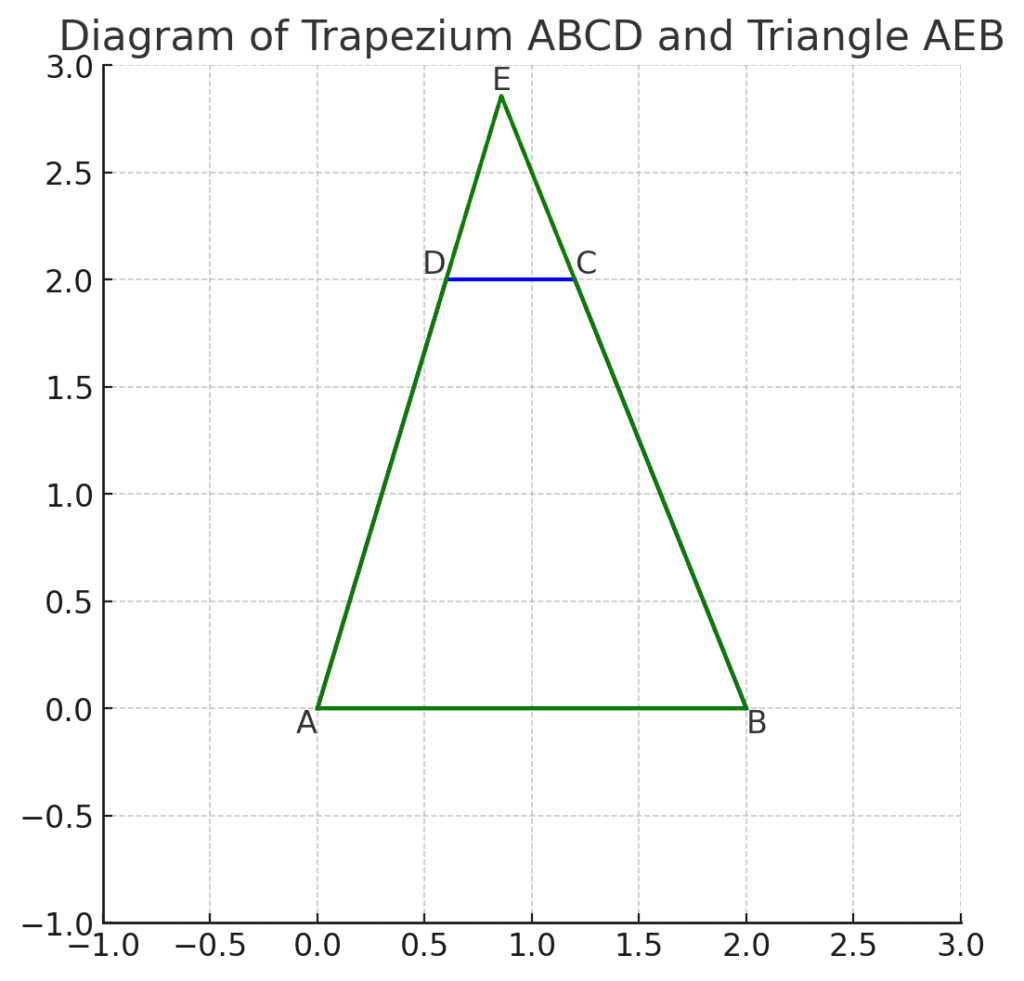
ABCD is a trapezium in which AB is parallel to CD. The sides AD and BC when extended, intersect at point E. If AB = 2 cm, CD = 1 cm, and perimeter of ABCD is 6 cm, then the perimeter, in cm, of ΔAEB is
1) 9
2) 7
3) 8
4) 10
Solution
Finding the Perimeter of \( \triangle AEB \)
Given:
- ABCD is a trapezium with \( AB \parallel CD \)
- AB = 2 cm, CD = 1 cm
- Perimeter of trapezium ABCD = 6 cm
- AD and BC extended intersect at point E
Step 1: Use similarity
Since \( AB \parallel CD \), triangles \( \triangle AEB \sim \triangle DCE \). Thus,
\[ \frac{AB}{CD} = \frac{AE}{ED} = \frac{BE}{EC} = \frac{2}{1} \]
Step 2: Assign variables
Let \( AD = x \), \( BC = y \)
So total perimeter of ABCD:
\[
AB + BC + CD + DA = 2 + y + 1 + x = 6 \Rightarrow x + y = 3 \tag{1}
\]
Since the ratio is 2:1, we get:
\[
AE = 2x, \quad BE = 2y
\]
Step 3: Perimeter of \( \triangle AEB \)
\[ \text{Perimeter} = AE + BE + AB = 2x + 2y + 2 = 2(x + y + 1) \] From equation (1), \( x + y = 3 \): \[ \text{Perimeter} = 2(3 + 1) = \boxed{8} \]
✅ Final Answer: \( \boxed{8 \text{ cm}} \)
Question 3
The coordinates of the three vertices of a triangle are: (1, 2), (7, 2), and (1, 10). Then the radius of the in circle of the triangle is ________
Solution
Problem:
The coordinates of the vertices of a triangle are: \( (1, 2), (7, 2), (1, 10) \). Find the radius of the incircle of the triangle.
Solution:
When plotted, the triangle clearly forms a right-angled triangle with the right angle at point \( (1, 2) \). This is because two sides are aligned along the x-axis and y-axis.
Let side \( a \) be the vertical leg: \[ a = 10 – 2 = 8 \] Let side \( b \) be the horizontal leg: \[ b = 7 – 1 = 6 \]

Using the Pythagorean Theorem: \[ \text{Hypotenuse } h = \sqrt{a^2 + b^2} = \sqrt{8^2 + 6^2} = \sqrt{64 + 36} = \sqrt{100} = 10 \]
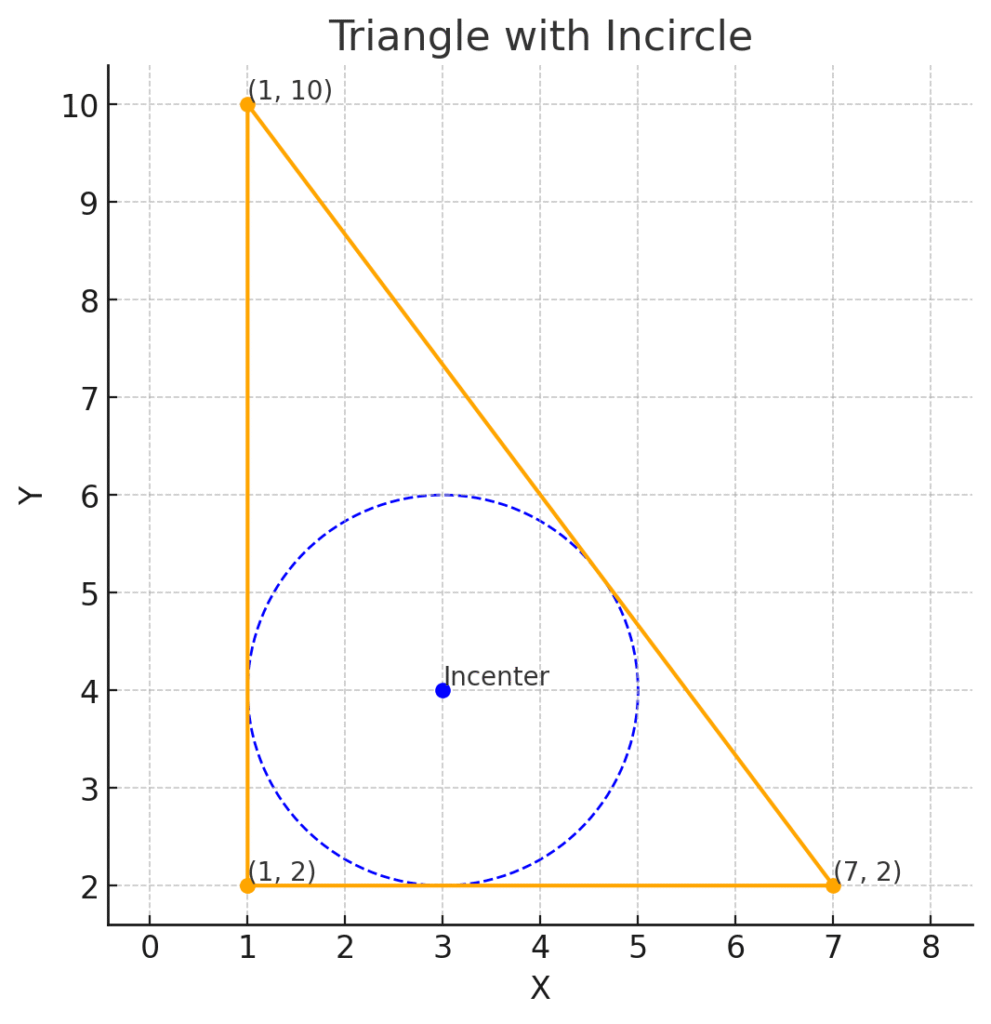
The inradius of a right triangle is given by: \[ r = \frac{a + b – h}{2} \] Substituting the values: \[ r = \frac{8 + 6 – 10}{2} = \frac{4}{2} = 2 \]
Final Answer:
The radius of the incircle is: \( \boxed{2} \)
Question 4
A vessel contained a certain amount of a solution of acid and water. When 2 litres of water was added to it, the new solution had 50% acid concentration. When 15 litres of acid was further added to this new solution, the final solution had 80% acid concentration. The ratio of water and acid in the original solution was
1) 5 : 4 2) 5 : 3 3) 3 : 5 4) 4 : 5
Let the original quantities of acid and water be \( A \) and \( W \) litres respectively.
Step 1: After adding 2 litres of water, the concentration of acid becomes 50%.
\( \frac{A}{A + W + 2} = \frac{1}{2} \)
\( \Rightarrow 2A = A + W + 2 \Rightarrow A = W + 2 \quad \text{(Equation 1)} \)
Step 2: Then, 15 litres of acid is added and acid becomes 80% of the solution:
\( \frac{A + 15}{A + W + 17} = \frac{4}{5} \)
\( \Rightarrow 5(A + 15) = 4(A + W + 17) \)
\( \Rightarrow 5A + 75 = 4A + 4W + 68 \)
\( \Rightarrow A = 4W – 7 \quad \text{(Equation 2)} \)
Step 3: Solving equations:
From (1): \( A = W + 2 \)
Plug into (2):
\( W + 2 = 4W – 7 \Rightarrow 3W = 9 \Rightarrow W = 3 \)
\( \Rightarrow A = 5 \)
So, the original ratio of Water : Acid = \( 3 : 5 \)