Interactive Quiz
The midpoints of sides AB, BC, and AC in ∆ABC are M, N, and P, respectively. The medians drawn from A, B, and C intersect the line segments MP, MN, and NP at X, Y, and Z, respectively. If the area of ∆ABC is 1440 sq cm, then the area, in sq cm, of ∆XYZ is:
Solution:
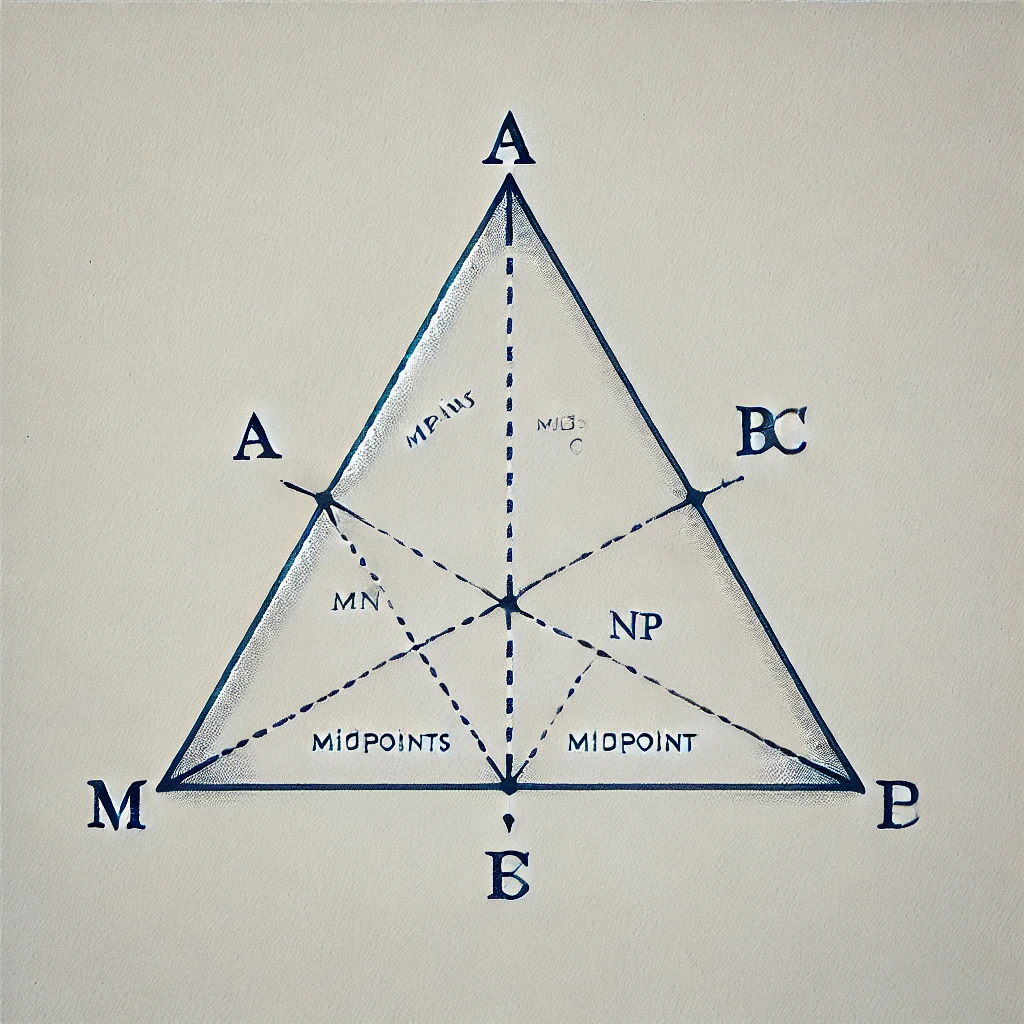
Step 1: In a triangle, the midpoints of its sides divide it into smaller regions. The medians further divide these regions into sub-triangles of equal areas.
Step 2: The medians of a triangle intersect at the centroid, which divides each median into a 2:1 ratio.
Step 3: The centroid divides the triangle into six smaller triangles of equal area. Thus, each smaller triangle has an area equal to:
\[ \text{Area of one small triangle} = \frac{\text{Total area of ∆ABC}}{6} = \frac{1440}{6} = 240 \, \text{sq cm}. \]Step 4: The sub-triangle ∆XYZ is formed by joining the centroids of the mid-segments of the main triangle. Since ∆XYZ comprises two of these smaller triangles, its area is:
\[ \text{Area of ∆XYZ} = 2 \times 240 = 160 \, \text{sq cm}. \]Final Answer: The area of ∆XYZ is \( \mathbf{160} \, \text{sq cm} \).