CAT CET SNAP NMAT CMAT XAT

CAT Previous Year Questions | Trigonometry

  1. CAT 2019 QA Slot 1 | Geometry – Trigonometry CAT Question
    The number of the real roots of the equation 2cos(x(x + 1)) = 2x + 2–x is

(a) 0

(b) 2

(c) infinite

(d) 1

EXPLANATION

Given: 2 cos (x(x + 1)) = 2x + 2–x

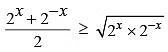
Now, by AM – GM inequality, we get

∴ 2 cos (x(x + 1)) ≥ 2

We know, –1 ≤ cosθ ≤ 1

∴ 2 cos(x(x + 1)) = 2

Hence, the expression is valid only if 2x + 2–x = 2, which is true for only one value of x i.e. 0. Therefore, the expression has only one real solution.

  1. CAT 2004 QA | Geometry – Trigonometry CAT Question
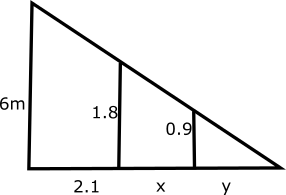
    A father and his son are waiting at a bus stop in the evening. There is a lamp post behind them. The lamp post, the father and his son stand on th same straight line. The father observes that the shadows of his head and his son’s head are incident at the same point on the ground. If the heights o the lamp post, the father and his son are 6 metres, 1.8 metres and 0.9 metres respectively, and the father is standing 2.1 metres away from the pos then how far (in metres) is the son standing from his father?

(a) 0.9

(b) 0.75

(c) 0.6

(d) 0.45

EXPLANATION

The three triangles are similar.

Let the distance of the tip of the shadow from the child be y. Let the child be standing at distance x from the father.

So, 6/(2.1+x+y) = 1.8/(x+y) = 0.9/y

=> 2y = x+y => x = y

=> 6/(2.1 + 2x) = 0.9/x

=> 6x = 0.9*(2.1+2x)

=> 6x = 1.89 + 1.8x

=> 4.2x = 1.89

=> x = 1.89/4.2 = 0.45

  1. CAT 2003 QA – Leaked | Geometry – Trigonometry CAT Question
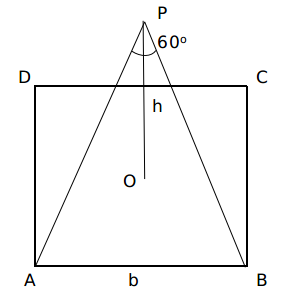
    A vertical tower OP stands at the centre O of a square ABCD. Let h and b denote the lengths OP and AB respectively. Suppose ∠APB = 60°, then the relationship between h and b can be expressed as

(a) 2b2 = h2

(b) 2h2 = b2

(c) 3b2 = 2h2

(d) 3h2 = 2b2

EXPLANATION

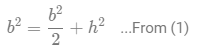
Consider the triangle APB.  ∠ ∠P = 60 and AP = BP => APB is an equilateral triangle. Hence AP = b    …(1)

AC2 =AB2 +BC2

AC2 =b2 +b2  

AP2 =AO2 +OP2

2h 2 =b 2

Hence, option B is the correct answer

  1. CAT 2003 QA – Retake | Geometry – Trigonometry CAT Question

A car is being driven, in a straight line and at a uniform speed, towards the base of a vertical tower. The top of the tower is observed from the car and in the process, it takes 10 minutes for the angle of elevation to change from 45° to 60°. After how much more time will this car reach the base of th tower?
(a) 5(√3 + 1)
(b) 6(√3 + 1)
(c) 7(√3 − 1)
(d) 8(√3 − 2)

EXPLANATION

The correct answer is option a.

a. 5( √3+ 1 )

Given that the angle changes from 45° to 60° in 10 minutes.

This situation can be represented as right angled triangles \triangleABC (in the starting when angle is 45°)and \triangleABD (after 10 minutes when the angle is 60°).

AB is the tower (A be its top and B be its base).

Now, we need to find the time to be taken to cover the distance D to B.

First of all, let us consider \triangleABC.

Using tangent property:

tan\theta =(Perpendicular)/(Base)\n\Rightarrow tan 45=(AB)/(BC)\n\Rightarrow 1=(h)/(BC)\n\Rightarrow h = BC

Using tangent property in \triangleABD:

\Rightarrow tan 60=(AB)/(BD)\n\Rightarrow \sqrt3=(h)/(BD)\n\Rightarrow BD = (h)/( \sqrt3)\ units

Now distance traveled in 10 minutes, CD  = BC – BD

\Rightarrow h - (h)/(\sqrt3)\n\Rightarrow ((\sqrt3-1)h)/(\sqrt3)
Speed =(Distance )/(Time)
\Rightarrow ((\sqrt3-1)h)/(10\sqrt3)

Now, we can say that more distance to be traveled to reach the base of tower is BD i.e. ‘\bold{(h)/(\sqrt3)}

So, more time required = Distance left divided by Speed

\Rightarrow ((h)/(\sqrt3))/(((\sqrt3-1)h)/(10\sqrt3))\n\Rightarrow (h* 10\sqrt3)/(\sqrt3(\sqrt3-1)h)\n\Rightarrow (10 (\sqrt3+1))/((\sqrt3-1)(\sqrt3+1))   (\text{Rationalizing the denominator})\n\Rightarrow (10 (\sqrt3+1))/(3-1)\n\Rightarrow (10 (\sqrt3+1))/(2)\n\Rightarrow 5(\sqrt3+1)}

So, The correct answer is option a.

a. 5( √3+ 1 )

  1. CAT 2001 QA | Geometry – Trigonometry CAT Question
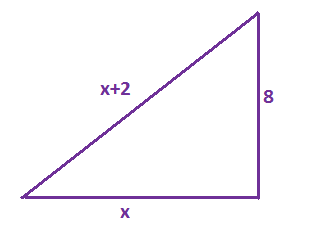
    A ladder leans against a vertical wall. The top of the ladder is 8 m above the ground. When the bottom of the ladder is moved 2 m farther away fro the wall, the top of the ladder rests against the foot of the wall. What is the length of the ladder?

(a) 10 m

(b) 15 m

(c) 20 m

(d) 17 m

EXPLANATION

The correct option is D 17m
Option (d)

Length of the ladder = x+2

Thus, 82+x2 = (x+2)2

Solving for x, x=15

Length of ladder = 17 m.

  1. CAT 1999 QA | Geometry – Trigonometry CAT Question
    Directions: Each question is followed by two statements I and II. Mark:
    • 1. if the question can be answered by any one of the statements alone, but cannot be answered by using the other statement alone.
    • 2. if the question can be answered by using either statement alone.
    • 3. if the question can be answered by using both the statements together, but cannot be answered by using either statement alone.
    • 4. if the question cannot be answered even by using both the statements together.
      A line graph on a graph sheet shows the revenue for each year from 1990 through 1998 by points and joins the successive points by straight-lin segments. The point for revenue of 1990 is labelled A, that for 1991 as B, and that for 1992 as C. What is the ratio of growth in revenue between 1991 92 and 1990-91?
      I. The angle between AB and X-axis when measured with a protractor is 40°, and the angle between CB and X-axis is 80°.
      II. The scale of Y-axis is 1 cm = Rs. 100

(a) 1

(b) 2

(c) 3

(d) 4

EXPLANATION

Growth = Change in value on Y-axis / Change in value on X-axis = Tangent of the angle made by the line with the X-axis

In statement 1, since we know both the angles, we can calculate the growth for both the periods and hence the ratio of growths.

Using statement 2 alone, we cannot determine the answer.

Option a) is the correct answer.

Register to Attend Free Workshop by Rav Sir